Legge is right to refuse Balfour's "the divine man" for the True Man. His reason is good: the same rendering would have to apply to the Perfect, Spirit-like and Sagely Man, with whom the True Man is interchanged in these paragraphs. He is right too that the dictionary's mountain recluse who "ascends to heaven" belongs to a later phase of Taoism, and should not be read back into this text.
The Tâo Teh King — Sacred Books of China Part I, SBE Vol. 39 (trans. James Legge, 1891)
Open to all
page 237
No image is selected for this page; its own page image is shown.
page 237
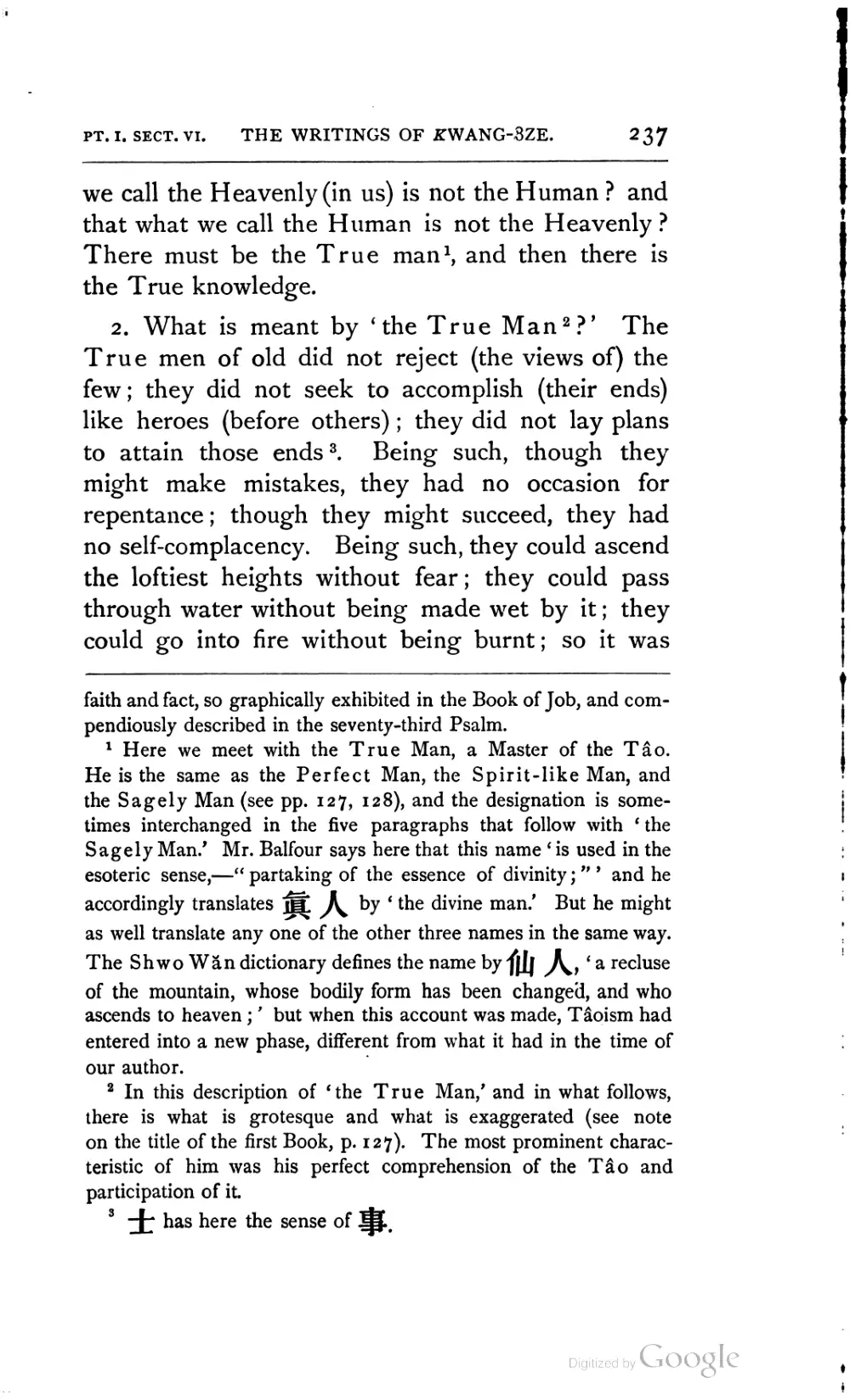
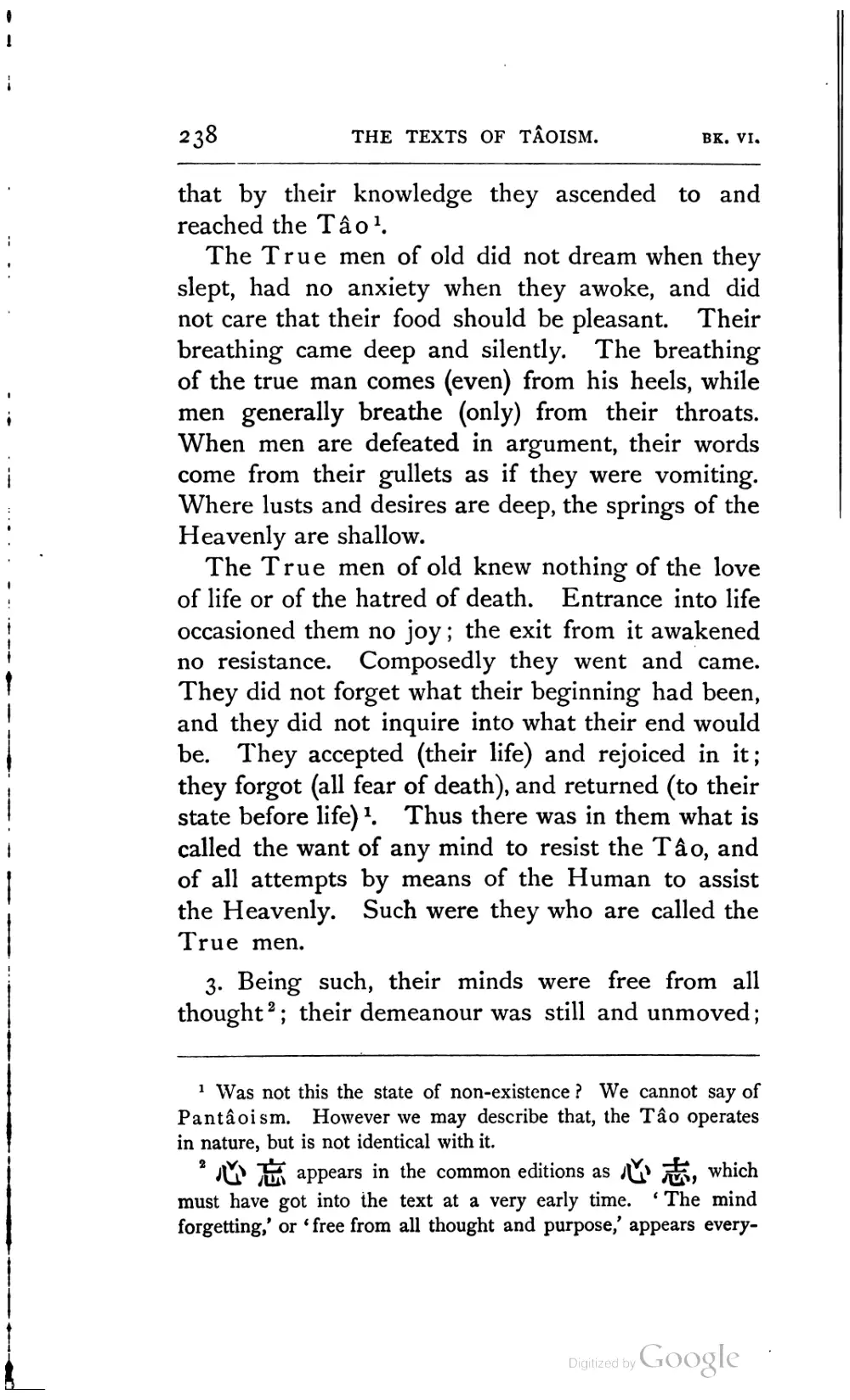
2. What is meant by ‘the True Man²’? The True men of old did not reject (the views of) the few; they did not seek to accomplish (their ends) like heroes (before others); they did not lay plans to attain those ends³. Being such, though they might make mistakes, they had no occasion for repentance; though they might succeed, they had no self-complacency. Being such, they could climb the loftiest heights without fear; they could pass through water without being made wet by it; they could go into fire without being burnt; so it was that by their knowledge they ascended to and reached the Tâo¹.
1 Here we meet the True Man, a Master of the Tâo. He is the same as the Perfect Man, the Spirit-like Man, and the Sagely Man (see pp. 127, 128), and in the five paragraphs that follow the designation is sometimes interchanged with ‘the Sagely Man.’ Mr. Balfour says here that this name ‘is used in the esoteric sense,—“partaking of the essence of divinity;”’ and he accordingly translates 眞人 by ‘the divine man.’ But he might as well translate any one of the other three names in the same way. The Shwo Wăn dictionary defines the name by 仙人, ‘a recluse of the mountain, whose bodily form has been changed, and who ascends to heaven;’ but when this account was made, Taoism had entered a new phase, different from what it had been in the time of our author.
2 In this description of ‘the True Man,’ and in what follows, there is what is grotesque and what is exaggerated (see the note on the title of the first Book, p. 127). His most prominent characteristic was his perfect comprehension of the Tao and participation in it.
3 士 [Press: an officer; a scholar] here has the sense of 事 [Press: affairs; service, business].