Legge objects that “a man does not come to himself in his dream, and in that state try to interpret it.” The text claims less than he supposes: the dreamers “did not know it was a dream,” and interpreting a dream inside a dream is a common experience. The passage's point is that waking judgment may be exactly this, and the speaker includes himself among the dreamers.
The Tâo Teh King — Sacred Books of China Part I, SBE Vol. 39 (trans. James Legge, 1891)
Open to all
page 194
No image is selected for this page; its own page image is shown.
page 194
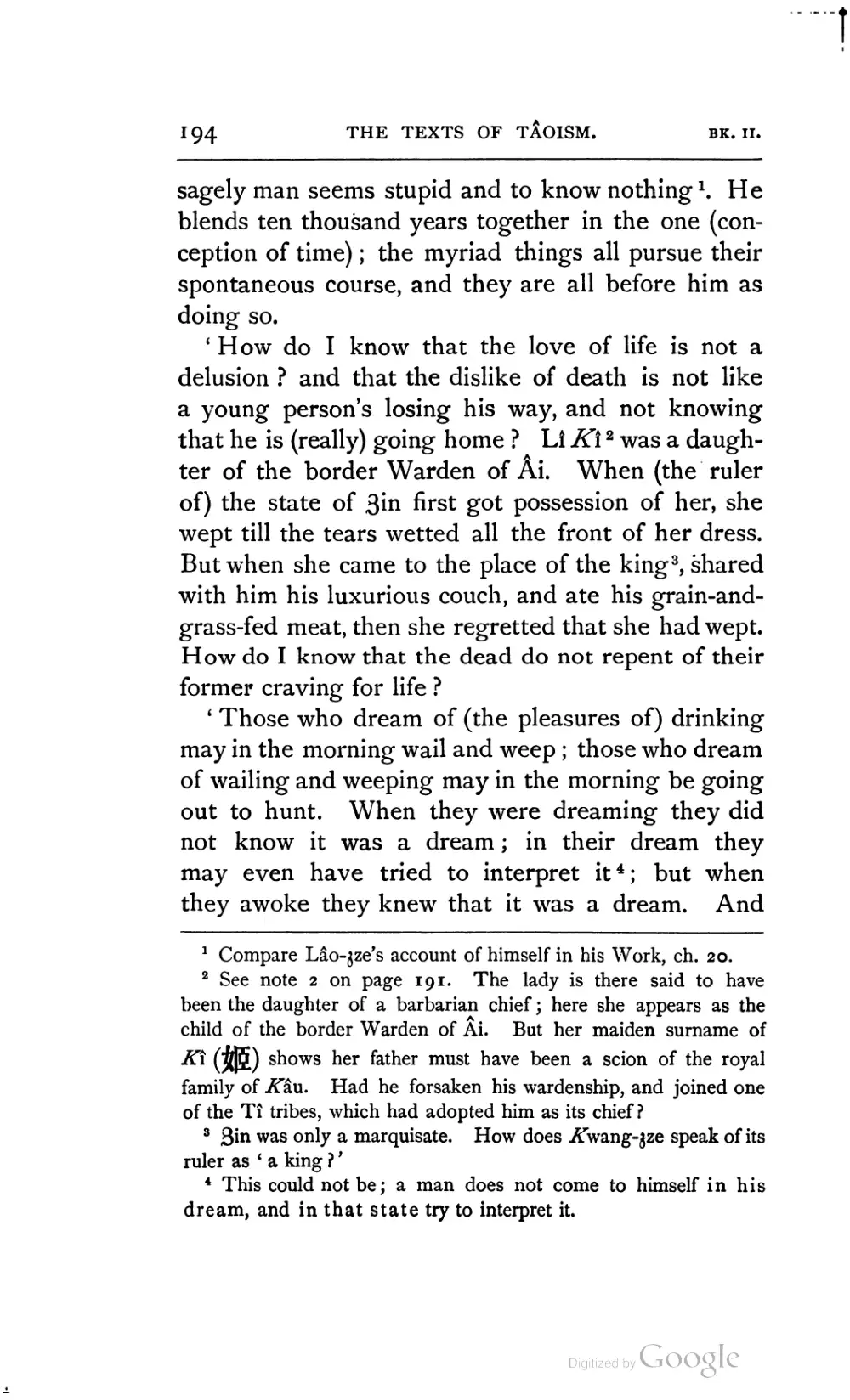
‘How do I know that the love of life is not a delusion? and that the dislike of death is not like a young person’s losing his way, and not knowing that he is (really) going home? Li Kî2 was a daughter of the border Warden of Ai. When (the ruler of) the state of Ȝin first got possession of her, she wept till the tears wetted all the front of her dress. But when she came to the king’s place, shared his luxurious couch with him, and ate his grain-and-grass-fed meat, then she regretted that she had wept. How do I know that the dead do not repent of their former craving for life?
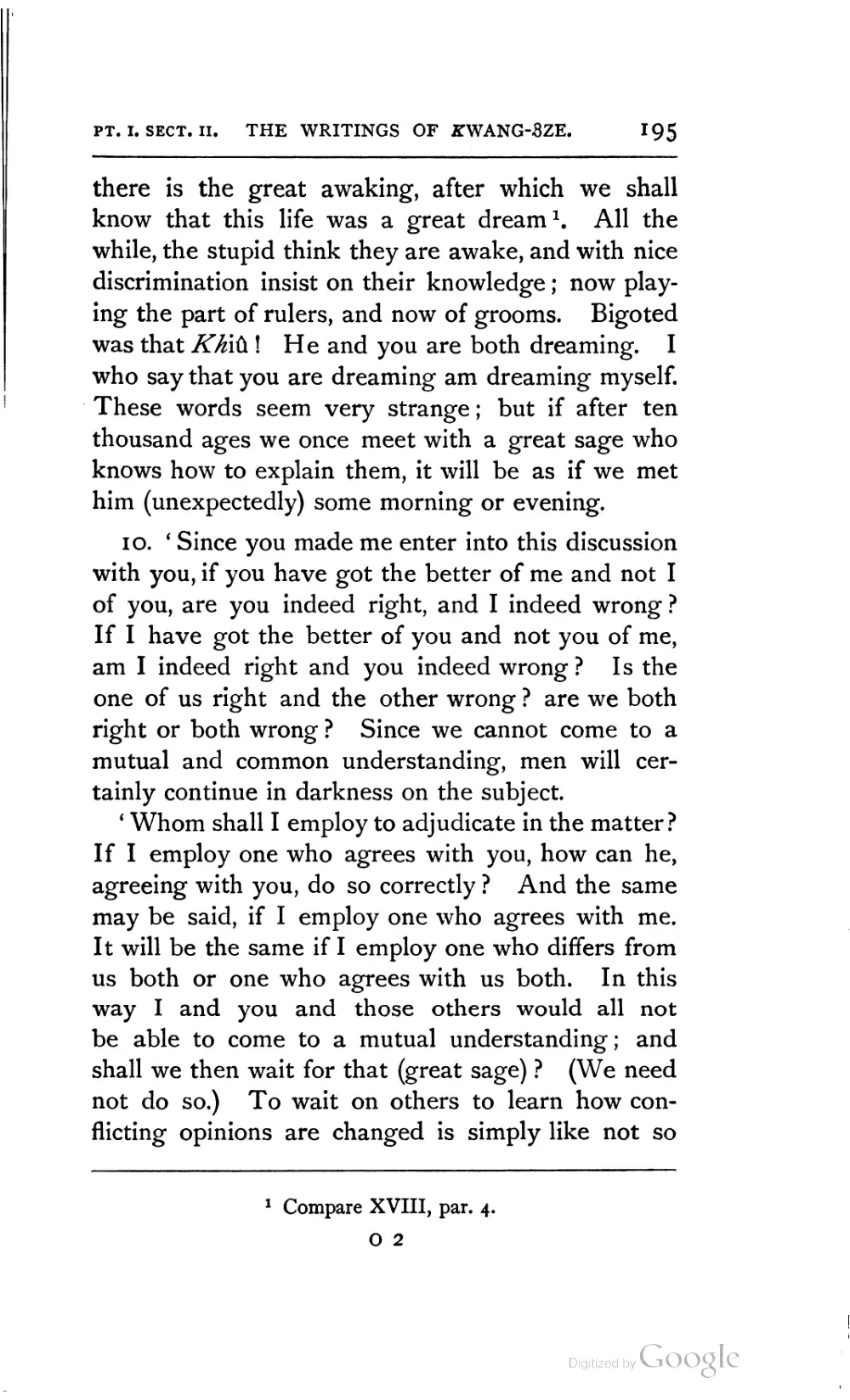
‘Those who dream of (the pleasures of) drinking may in the morning wail and weep; those who dream of wailing and weeping may in the morning be going out to hunt. When they were dreaming they did not know it was a dream; in their dream they may even have tried to interpret it4; but when they awoke they knew that it was a dream. And there is the great awaking, after which we shall know that this life was a great dream1.
All the while, the stupid think they are awake, and with nice discrimination insist on their knowledge; now playing the part of rulers, and now of grooms. Bigoted was that Khiû! He and you are both dreaming. I who say that you are dreaming am dreaming myself. These words seem very strange; but if after ten thousand ages we once meet with a great sage who knows how to explain them, it will be as if we met him (unexpectedly) some morning or evening.
* Compare Lâo-ȝze’s account of himself in his Work, ch. 20.
* See note 2 on page 191. The lady is there said to have been the daughter of a barbarian chief; here she appears as the child of the border Warden of Ai. But her maiden surname of Kî (姬 [Press: Ji (the surname of the royal house of Zhou)]) shows that her father must have been a scion of the royal family of Kâu. Had he forsaken his wardenship, and joined one of the Ti tribes, which had adopted him as its chief?
* Ȝin was only a marquisate. Why does Kwang-ȝze speak of its ruler as ‘a king’?
* This could not be; a man does not come to himself in his dream, and in that state try to interpret it.
Legge notes that Țin “was only a marquisate” and asks why Kwang-ȝze calls its ruler “a king.” The catch is fair for the period of the story. But the tale is told by a fictive speaker, and in Kwang-ȝze's own century the rulers of the larger states had begun to call themselves kings, so the title may reflect the writer's usage rather than a historical error.