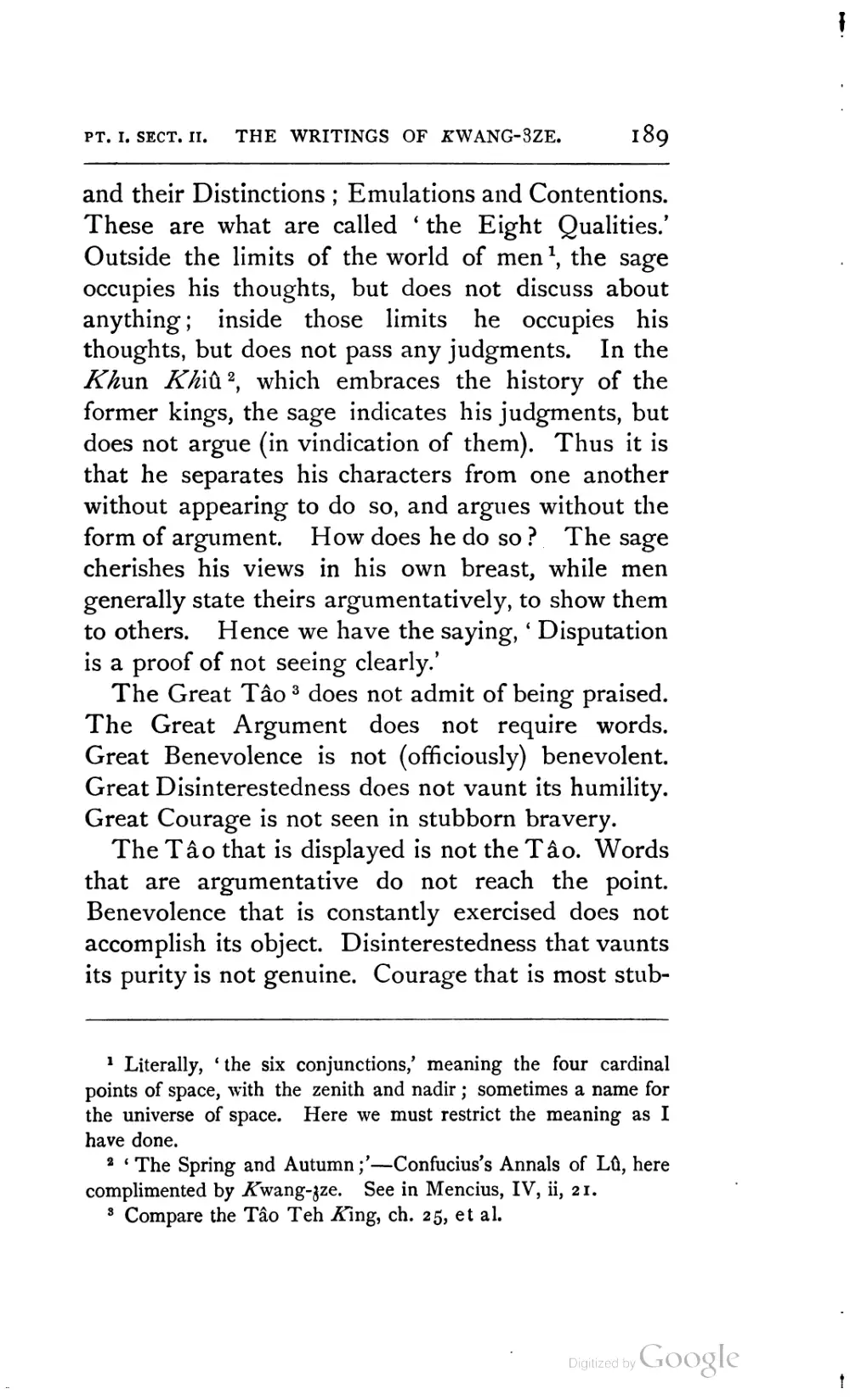
Legge reads the line on the Spring and Autumn as Kwang-ȝze complimenting Confucius's Annals. The compliment is double-edged: the sage there “indicates his judgments, but does not argue,” which is exactly the virtue the passage commends just before the saying “Disputation is a proof of not seeing clearly.” Confucius is praised, but as a Taoist would wish him to be.
The Tâo Teh King — Sacred Books of China Part I, SBE Vol. 39 (trans. James Legge, 1891)
Open to all
page 189
No image is selected for this page; its own page image is shown.
page 189
The Great Tao3 does not admit of being praised. The Great Argument does not require words. Great Benevolence is not (officiously) benevolent. Great Disinterestedness does not vaunt its humility. Great Courage is not seen in stubborn bravery.
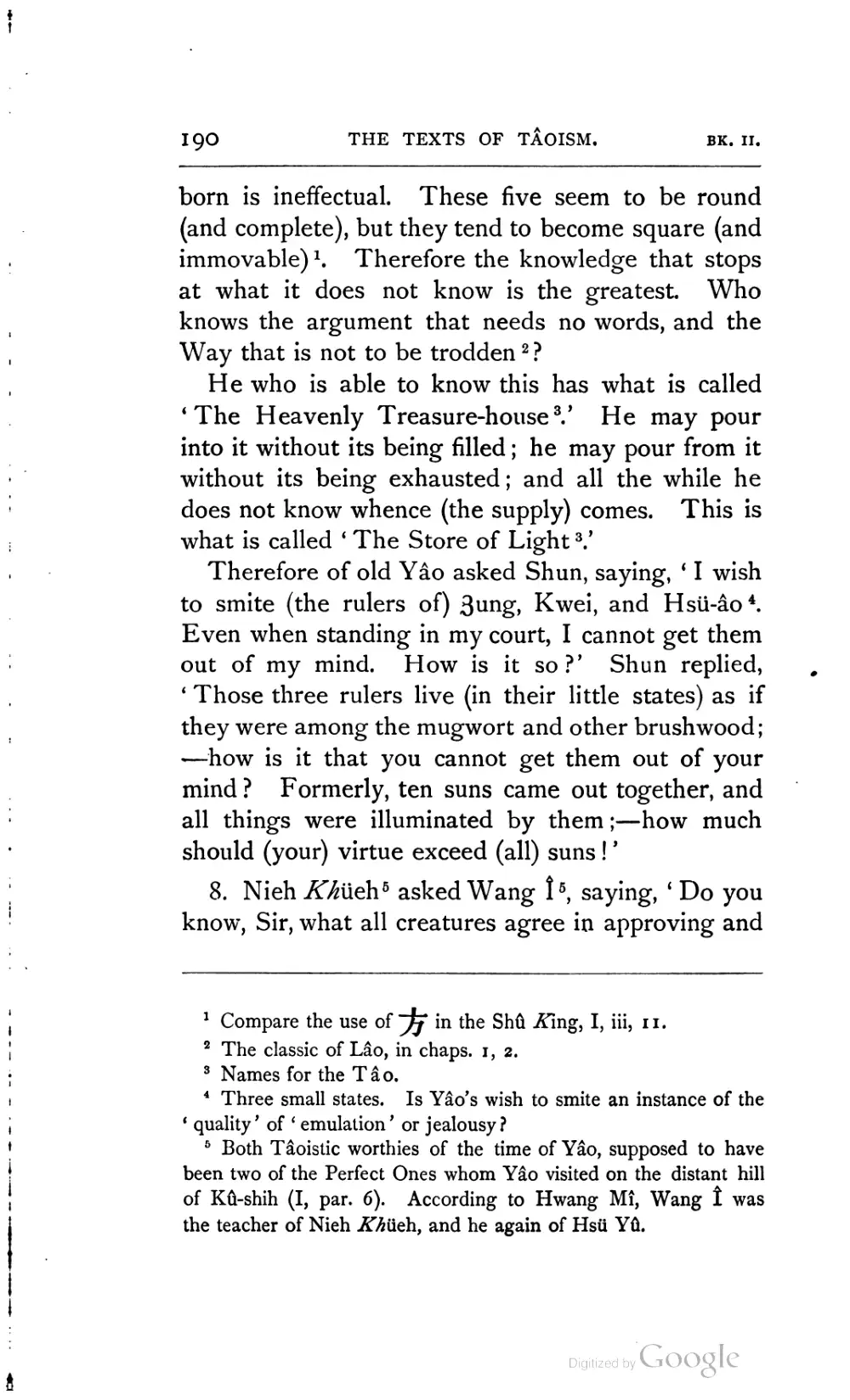
The Tao that is displayed is not the Tao. Words that are argumentative do not reach the point. Benevolence that is constantly exercised does not accomplish its object. Disinterestedness that vaunts its purity is not genuine. Courage that is most stubborn is ineffectual. These five seem to be round (and complete), but they tend to become square (and immovable)1. Therefore the knowledge that stops at what it does not know is the greatest. Who knows the argument that needs no words, and the Way that is not to be trodden2?
1 Literally, ‘the six conjunctions,’ meaning the four cardinal points of space, with the zenith and nadir; sometimes a name for the universe of space. Here we must restrict the meaning as I have done.
2 ‘The Spring and Autumn’;—Confucius’s Annals of Lû, here complimented by Kwang-ȝze. See Mencius, IV, ii, 21.
8 Compare the Tao Teh King, ch. 25, and elsewhere.