Legge confesses it is “difficult to understand” why the musicians enter the argument. The page answers him: the three men loved their arts “because they were different from those of others” and wished to make them known, so each is a case of the partial preference that, the paragraph says, injures the Tao. Their excellence is the excellence of a part, and that is the link Legge misses.
The Tâo Teh King — Sacred Books of China Part I, SBE Vol. 39 (trans. James Legge, 1891)
Open to all
page 186
No image is selected for this page; its own page image is shown.
page 186
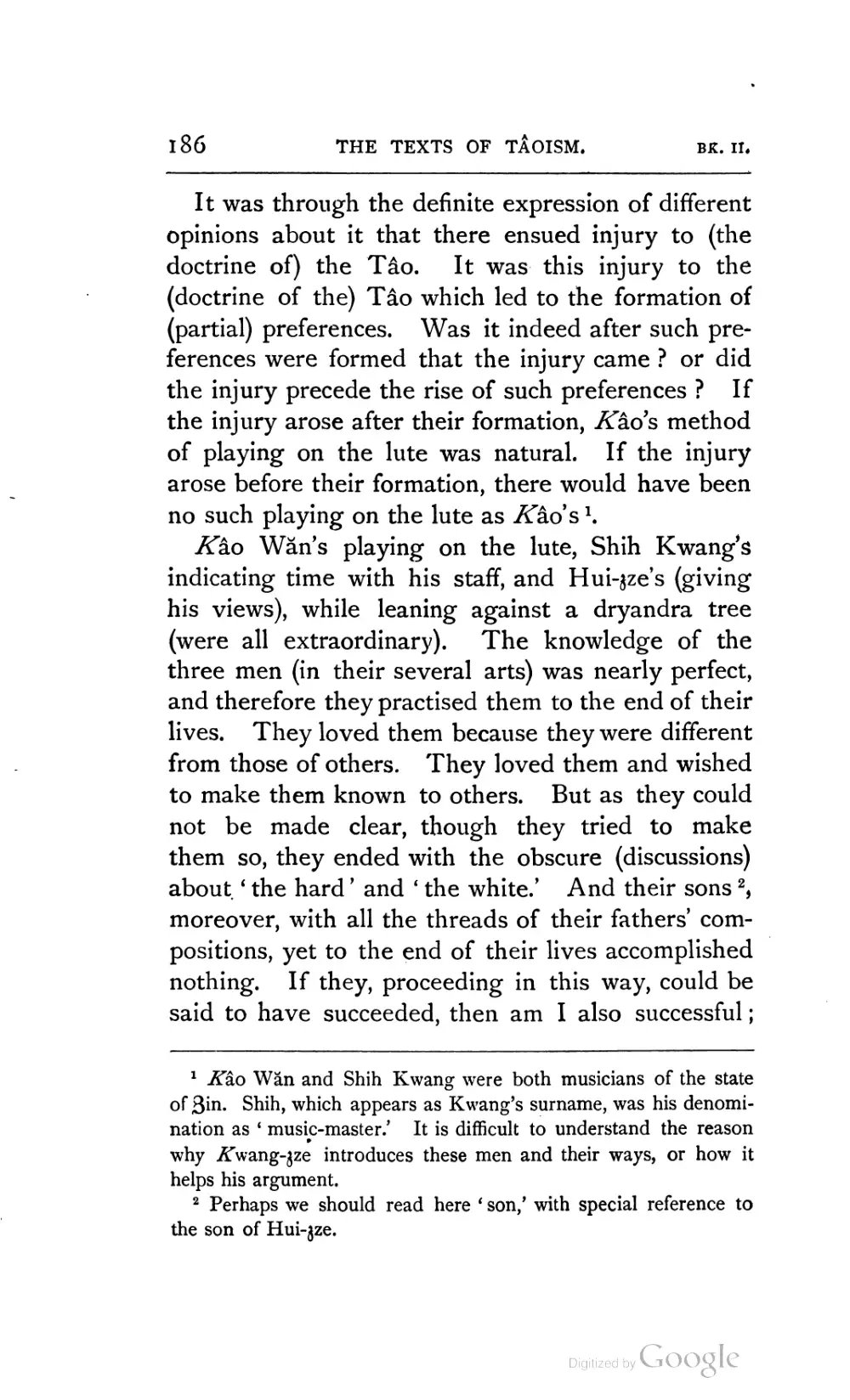
It was through the definite expression of different opinions about it that injury came to (the doctrine of) the Tao. It was this injury to the (doctrine of the) Tao which led to the formation of (partial) preferences. Was it indeed after such preferences were formed that the injury came? Or did the injury come before such preferences arose? If the injury arose after their formation, Kâo’s method of playing on the lute was natural. If the injury arose before their formation, there would have been no such playing on the lute as Kâo’s1.
Kao Wan’s playing on the lute, Shih Kwang’s marking time with his staff, and Hui-ȝze’s (giving his views) while leaning against a dryandra tree (were all extraordinary). The knowledge of the three men (in their several arts) was nearly perfect, and therefore they practised them to the end of their lives. They loved them because they were different from those of others. They loved them and wished to make them known to others.
But as they could not be made clear, though they tried to make them so, they ended with the obscure (discussions) about ‘the hard’ and ‘the white.’ And their sons2, moreover, with all the threads of their fathers’ compositions, yet to the end of their lives accomplished nothing. If they, proceeding in this way, could be said to have succeeded, then I am also successful; if they cannot be pronounced successful, neither I nor anyone else can succeed.
* Kao Wan and Shih Kwang were both musicians of the state of Ȝin. Shih, which appears as Kwang’s surname, was his title as ‘music-master.’ It is difficult to understand why Kwang-ȝze introduces these men and their ways, or how it helps his argument,
* Perhaps we should read ‘son’ here, with special reference to the son of Hui-ȝze.