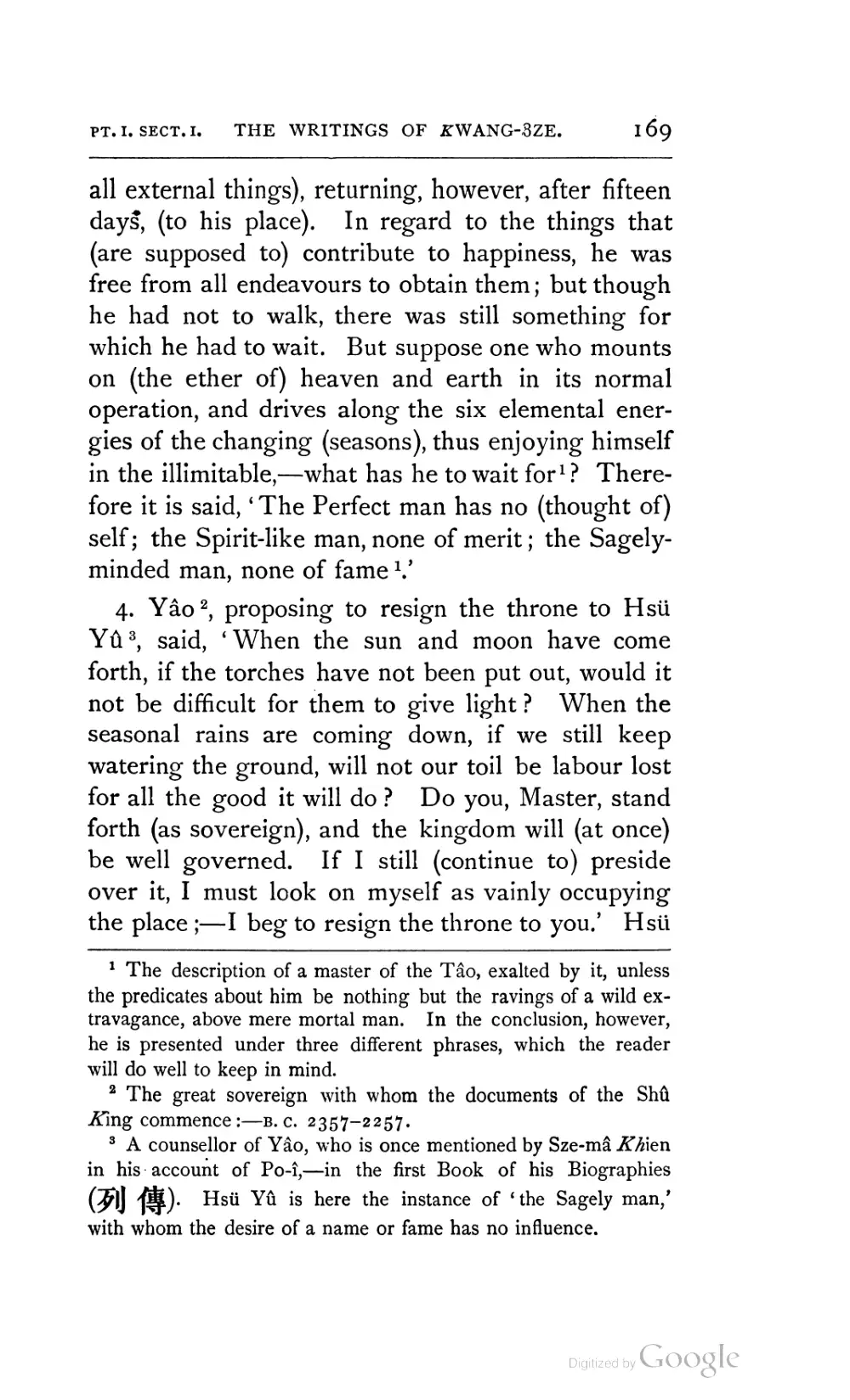
The maxim that closes the paragraph, the Perfect man with no thought of self, the Spirit-like man none of merit, the Sagely-minded man none of fame, is then illustrated in reverse order: Hsü Yû as the sagely man indifferent to name (p. 169), the man of the hill as the spirit-like (pp. 170-171), Yâo's oblivion as the perfect man (p. 172). Legge's notes track the sequence and show the chapter is built on the maxim, not loosely strung.
The Tâo Teh King — Sacred Books of China Part I, SBE Vol. 39 (trans. James Legge, 1891)
Open to all
page 168
No image is selected for this page; its own page image is shown.
page 168
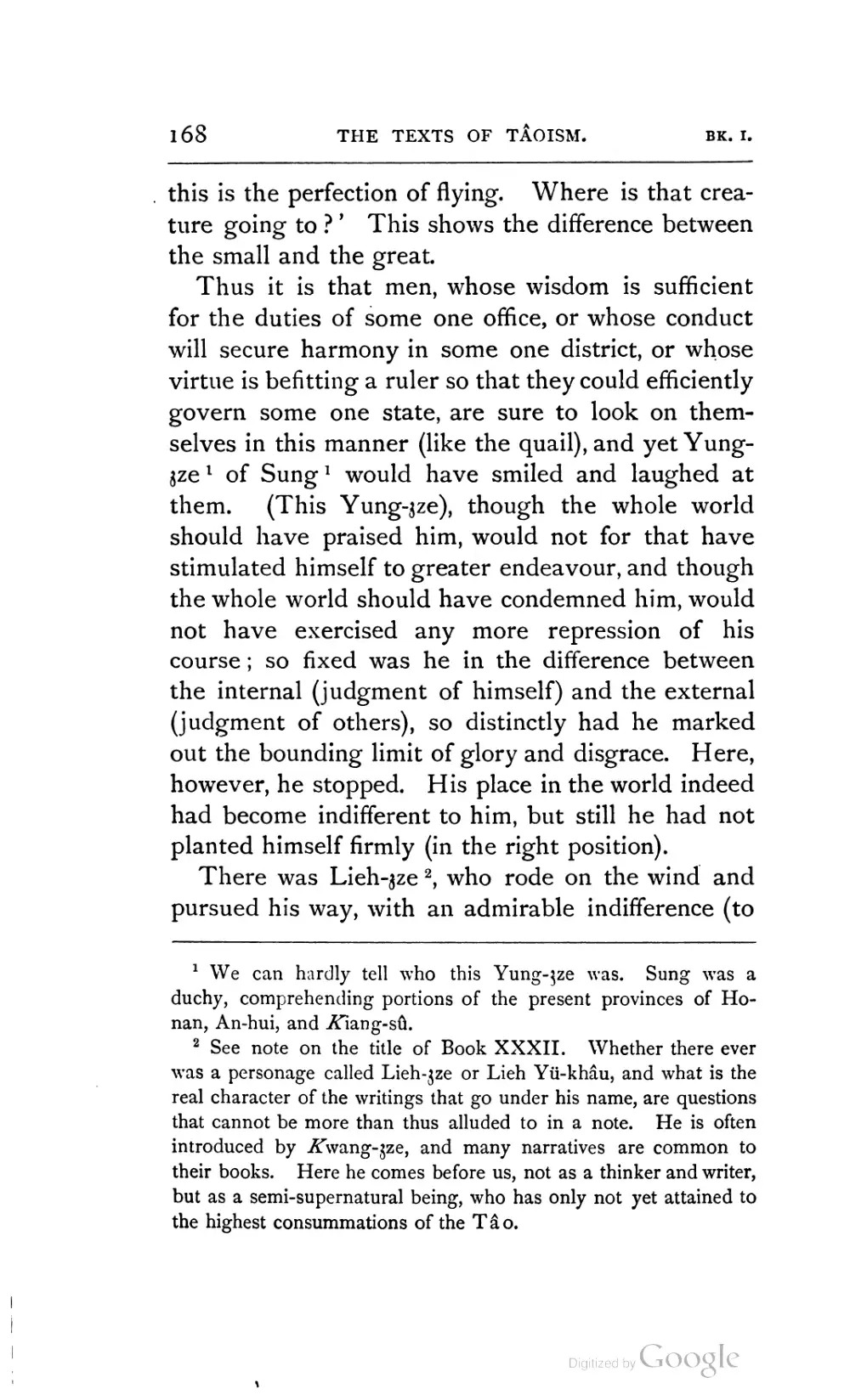
Thus it is that men whose wisdom is sufficient for the duties of some one office, or whose conduct will secure harmony in some one district, or whose virtue befits a ruler so that they could govern some one state efficiently, are sure to look on themselves in this way (like the quail); and yet Yung-ȝze of Sung1 would have smiled and laughed at them.
(This Yung-ȝze), though the whole world had praised him, would not for that have spurred himself to greater effort, and though the whole world had condemned him, would not have held himself back any more from his course; so fixed was he in the difference between the internal (judgment of himself) and the external (judgment of others), so clearly had he marked out the boundary between glory and disgrace. Here, however, he stopped. His place in the world had indeed become indifferent to him, but still he had not planted himself firmly (in the right position).
There was Lieh-ȝze2, who rode on the wind and went on his way, with an admirable indifference (to all external things), returning, however, after fifteen days, (to his place). As for the things that (are supposed to) contribute to happiness, he was free from all efforts to obtain them; but though he did not have to walk, there was still something for which he had to wait. But suppose one who mounts on (the ether of) heaven and earth in its normal operation, and drives along the six elemental energies of the changing (seasons), so enjoying himself in the boundless,—what has he to wait for1? Therefore it is said, ‘The Perfect man has no (thought of) self; the Spirit-like man, none of merit; the Sagely-minded man, none of fame.’
1 We can hardly tell who this Yung-ȝze was. Sung was a duchy that included portions of the present provinces of Ho-nan, An-hui, and Kiang-sû.
2 See the note on the title of Book XXXII. Whether there ever was a person called Lieh-ȝze or Lieh Yü-khau, and what the real character is of the writings that go under his name, are questions that cannot be more than alluded to like this in a note. Kwang-ȝze often introduces him, and many narratives are common to their books. Here he appears before us not as a thinker and writer, but as a semi-supernatural being who has only not yet attained the highest consummations of the Tâo.