Sze-ma Khien writes the surname with a different character and judged such figures to have no reality behind them; Legge grants the point but says “the value of the Book would hardly be thereby affected.” That separation of historicity from worth runs through these notices, as in his reading of Book XXX as wholly metaphorical (p. 158). It is the right standard for texts that openly use invented speakers.
The Tâo Teh King — Sacred Books of China Part I, SBE Vol. 39 (trans. James Legge, 1891)
Open to all
page 153
No image is selected for this page; its own page image is shown.
page 153
Book XXIII. KĂNG-SANG Kuzvd.
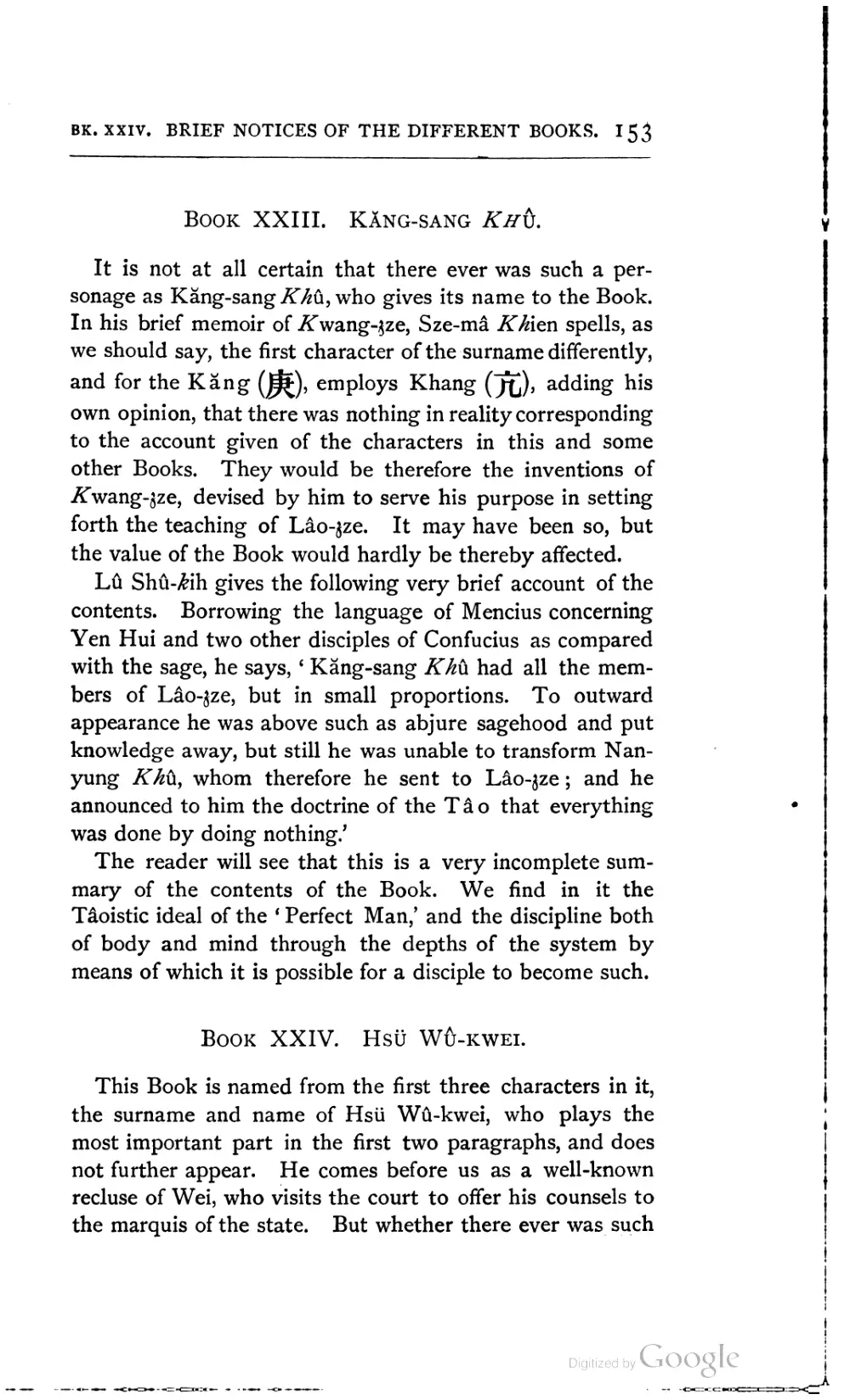
It is not at all certain that there ever was such a person as Kang-sang K 40, who gives his name to the Book. In his brief memoir of Kwang-ȝze, Sze-ma Khien spells, as we should say, the first character of the surname differently: for the Kăng (庚 [Press: Kăng, first character of a surname]) he uses Khang (亢 [Press: Khang, another writing of that surname character]), adding his own opinion that there was nothing in reality corresponding to the account given of the characters in this and some other Books. They would therefore be inventions of Kwang-ȝze, devised by him to serve his purpose in setting out the teaching of Lâo-ȝze. It may have been so, but the value of the Book would hardly be affected by it.
Lû Shû-kih gives the following very brief account of the contents. Borrowing the language of Mencius about Yen Hui and two other disciples of Confucius as compared with the sage, he says, ‘Kang-sang Khû had all the members of Lâo-ȝze, but in small proportions. To outward appearance he was above those who renounce sagehood and put knowledge away, but still he was unable to transform Nan-yung Khû, whom he therefore sent to Lâo-ȝze; and he announced to him the doctrine of the Tao, that everything is done by doing nothing.’
The reader will see that this is a very incomplete summary of the contents of the Book. We find in it the Taoist ideal of the ‘Perfect Man,’ and the discipline of both body and mind, through the depths of the system, by which it is possible for a disciple to become one.
Book XXIV. Hsti WO-KWEI.
This Book is named from the first three characters in it, the surname and name of Hsü Wû-kwei, who plays the most important part in the first two paragraphs and does not appear again. He comes before us as a well-known recluse of Wei, who visits the court to offer his counsel to the marquis of the state. But whether there ever was such a man, or whether he was only a creation of Kwang-ȝze, we cannot, so far as I know, tell.