Legge renders the predicate as making the name “the same as Ti or God,” where Balfour hedges with “One with God” and Giles with “Of God.” His is the strongest of the three, because it equates Ti outright with God, as he does when he translates the Shû King. He admits none of the native critics could explain the phrase, so the English here records Legge's own theology as much as the text's meaning.
The Tâo Teh King — Sacred Books of China Part I, SBE Vol. 39 (trans. James Legge, 1891)
Open to all
page 146
No image is selected for this page; its own page image is shown.
page 146
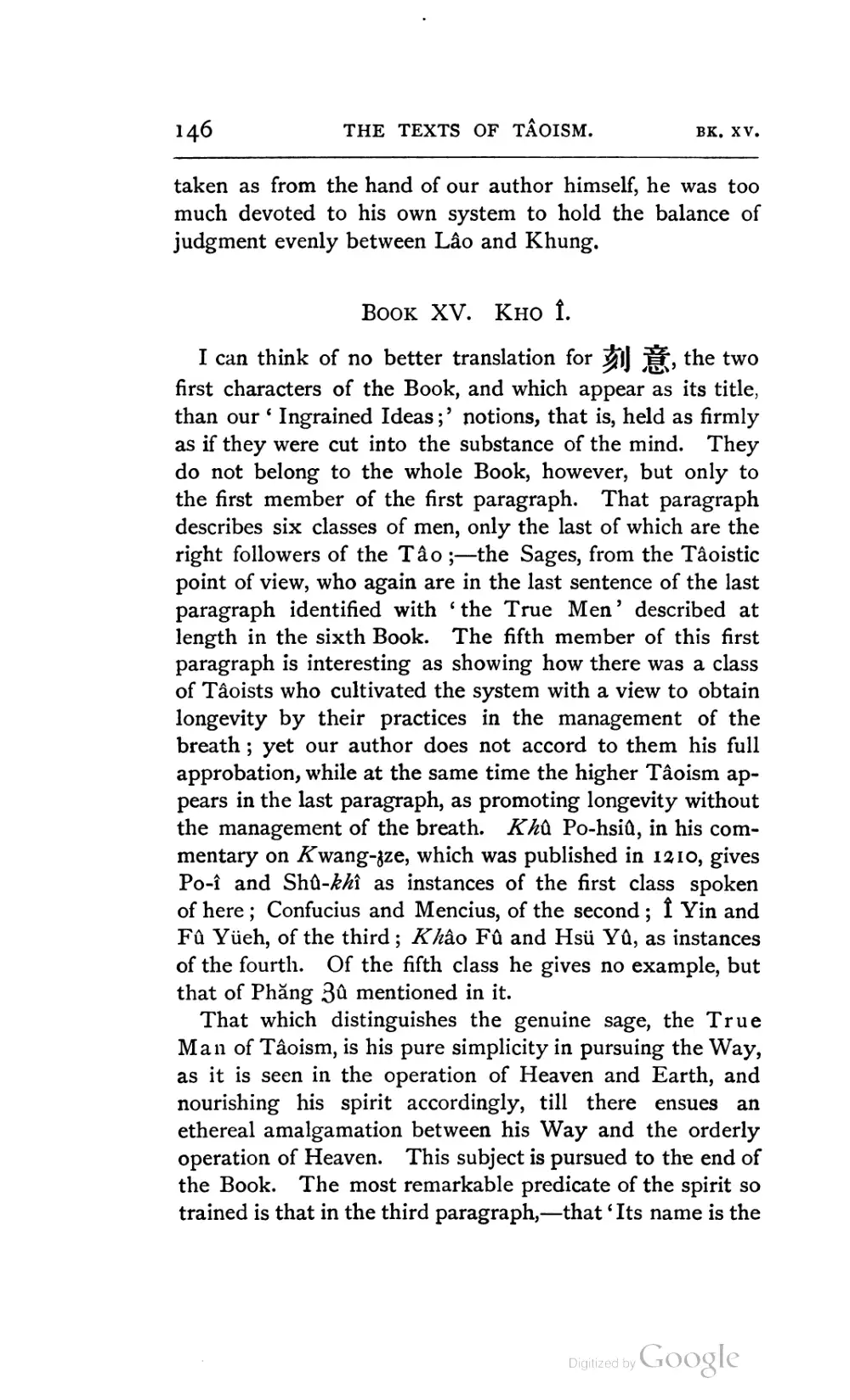
Book XV. Kuo f.
I can think of no better translation for 刻意 [Press: carving the mind; fixed purpose], the first two characters of the Book, which appear as its title, than our ‘Ingrained Ideas’: notions, that is, held as firmly as if they were cut into the substance of the mind. They do not belong to the whole Book, however, but only to the first member of the first paragraph. That paragraph describes six classes of men, only the last of whom are the right followers of the Tao: the Sages, from the Taoistic point of view, who again, in the last sentence of the last paragraph, are identified with ‘the True Men’ described at length in the sixth Book.
The fifth member of this first paragraph is interesting as showing that there was a class of Taoists who cultivated the system with a view to obtaining longevity by their practices in managing the breath; yet our author does not give them his full approval, while at the same time the higher Taoism appears in the last paragraph as promoting longevity without the management of the breath.
Ad Po-hsid, in his commentary on Kwang-ȝze, which was published in 1210, gives Po-i and Shi-i as instances of the first class spoken of here; Confucius and Mencius, of the second; Vin and Fu Yiich, of the third; Khâo Ft and Hsii YQ, of the fourth. Of the fifth class he gives no example but that of Phang 34, who is mentioned in it.
What distinguishes the genuine sage, the True Man of Taoism, is his pure simplicity in pursuing the Way, as it is seen in the operation of Heaven and Earth, and his nourishing of his spirit accordingly, until there ensues an ethereal amalgamation between his Way and the orderly operation of Heaven. This subject is pursued to the end of the Book. The most remarkable predicate of the spirit so trained is that in the third paragraph: that ‘Its name is the same as Ti, or God;’ on which none of the critics has been able to throw any satisfactory light. Balfour’s version is: ‘Its name is called “One with God;”’ Giles’s, ‘Its name is then “Of God,”’ the ‘then’ being due to his view that the subject is ‘man’s spiritual existence before he is born into the world of mortals.’ My own view of the meaning appears in my version.
The fifth class of the paragraph seeks longevity through “the management of the breath,” and Legge reads the author as withholding full approval. The ranking matters: on his account the Book places breath-gymnasts below the sage, who reaches long life without such practice. Early Taoism is shown judging a technique of its own as a lesser path, which is a distinction worth keeping in view when the later tradition is read back into Kwang-ȝze.