Legge answers the butterfly dream as a claim about dreaming: in a dream “the conviction of our identity is never lost”. But the story as he has just told it does not say Kwang Kau lost himself while asleep. Its point falls after waking, when he cannot tell from within which state is the dream, and it even grants that there must be a difference between man and butterfly. The rebuttal is true of dreams and misses the doubt the story is about.
The Tâo Teh King — Sacred Books of China Part I, SBE Vol. 39 (trans. James Legge, 1891)
Open to all
page 130
No image is selected for this page; its own page image is shown.
page 130
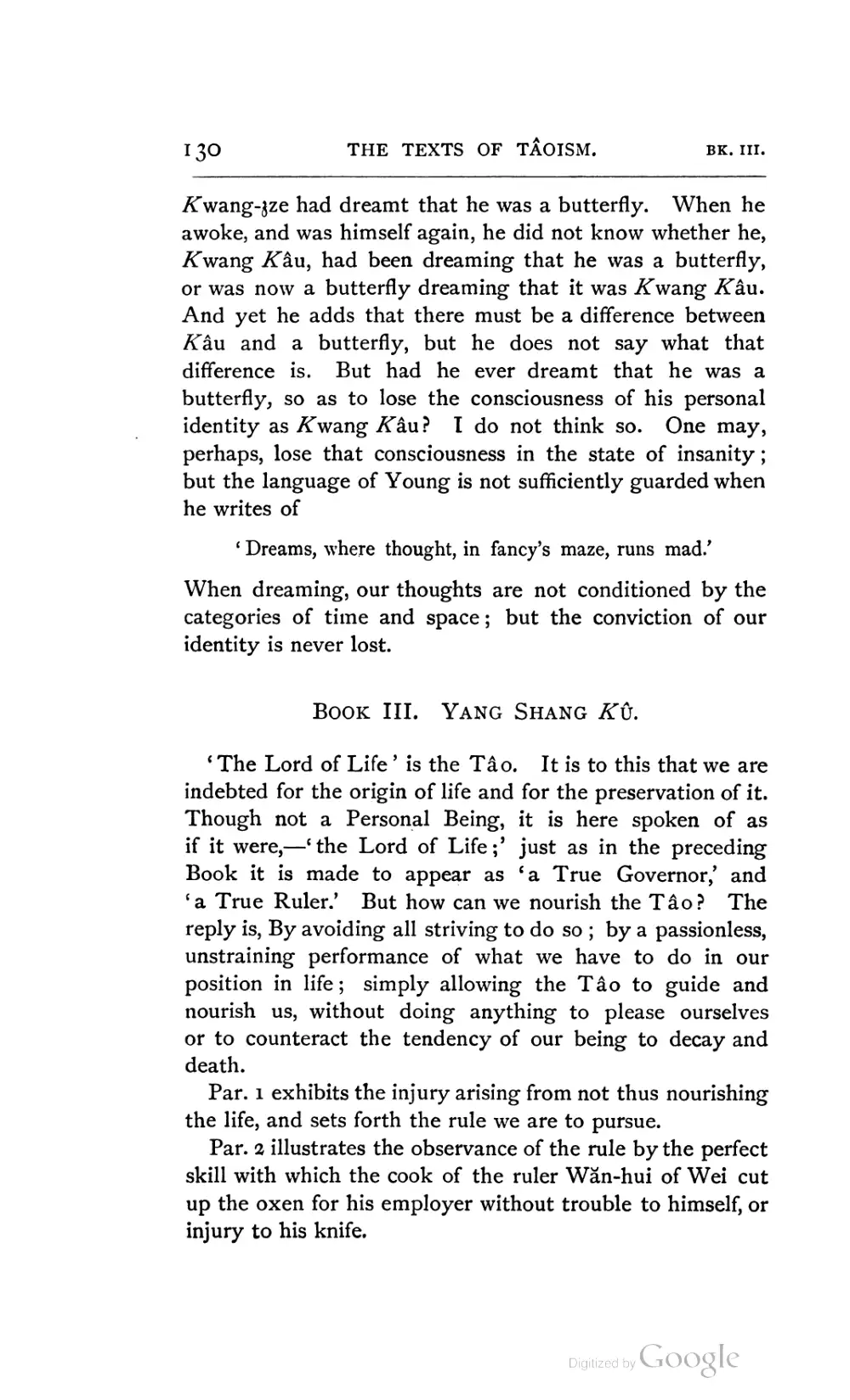
‘Dreams, where thought, in fancy’s maze, runs mad.’ When we dream, our thoughts are not conditioned by the categories of time and space; but the conviction of our identity is never lost.
Book III. YANG SHANG XU.
‘The Lord of Life’ is the Tao. It is to this that we owe the origin of life and its preservation. Though it is not a Personal Being, it is spoken of here as if it were,—‘the Lord of Life;’ just as in the preceding Book it is made to appear as ‘a True Governor’ and ‘a True Ruler.’ But how can we nourish the Tao? The answer is: by avoiding all striving to do so; by a passionless, unstraining performance of what we have to do in our position in life; simply letting the Tao guide and nourish us, without doing anything to please ourselves or to counteract the tendency of our being towards decay and death.
Par. 1 shows the injury that comes from not nourishing the life in this way, and sets out the rule we are to follow.
Par. 2 illustrates the keeping of the rule by the perfect skill with which the cook of the ruler Wan-hui of Wei cut up the oxen for his employer without trouble to himself or injury to his knife.