Legge calls the maxim closing paragraph 1, to recompense injury with kindness, “the chief glory” of the teaching, yet finds its value “somewhat diminished” by how it is reached. The method he means is the procedure “by contraries”: the maxim stands in a list beside tasting without flavour and counting the small as great, one more inversion. The objection is fair to the page, which gives it no motive of love, though a reader may think a principle drawn from the nature of things no weaker for that.
The Tâo Teh King — Sacred Books of China Part I, SBE Vol. 39 (trans. James Legge, 1891)
Open to all
page 107
No image is selected for this page; its own page image is shown.
page 107
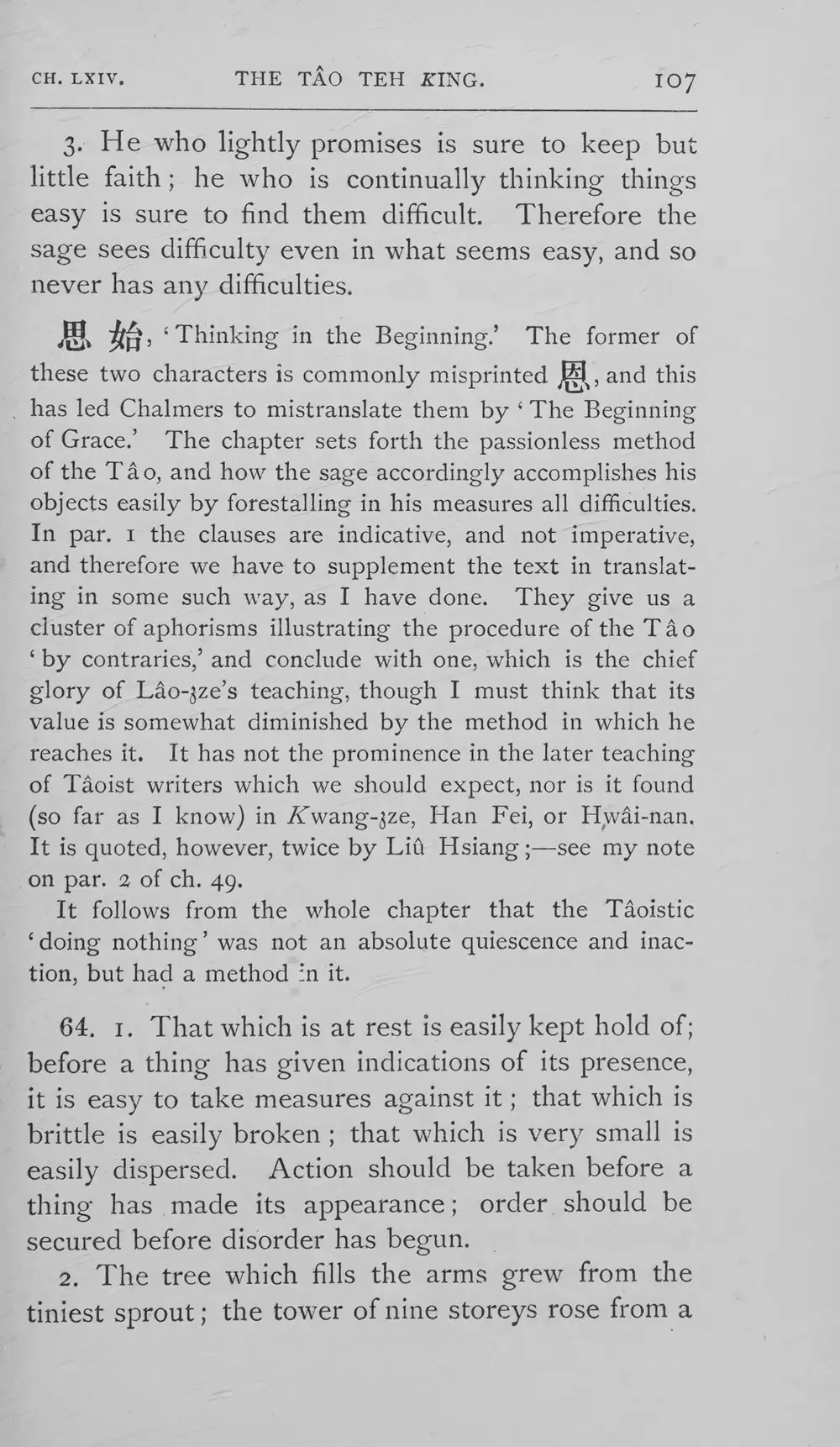
3. He who promises lightly is sure to keep little faith; he who is always thinking things easy is sure to find them difficult. Therefore the sage sees difficulty even in what seems easy, and so never has any difficulties.
思始, ‘Thinking in the Beginning.’ The first of these two characters is commonly misprinted 恩 [Press: kindness; favour], and this has led Chalmers to mistranslate them as ‘The Beginning of Grace.’ The chapter sets out the passionless method of the Tâo, and how the sage, following it, accomplishes his aims easily by forestalling every difficulty in his measures. In par. 1 the clauses are indicative, not imperative, and so in translating we have to supplement the text in some such way as I have done. They give us a cluster of aphorisms illustrating how the Tao proceeds ‘by contraries,’ and they end with one which is the chief glory of Lâo-ȝze’s teaching, though I cannot help thinking its value is somewhat lessened by the way in which he reaches it.
It does not have the prominence in the later teaching of Taoist writers that we would expect, nor is it found (so far as I know) in Kwang-ȝze, Han Fei, or Hwâi-nan. It is quoted, however, twice by Liû Hsiang;—see my note on par. 2 of ch. 49.
It follows from the whole chapter that the Tâoistic ‘doing nothing’ was not absolute quiescence and inaction, but had a method in it.
64. 1. What is at rest is easily kept hold of; before a thing has given signs of its presence, it is easy to take measures against it; what is brittle is easily broken; what is very small is easily scattered. Action should be taken before a thing has made its appearance; order should be secured before disorder has begun.
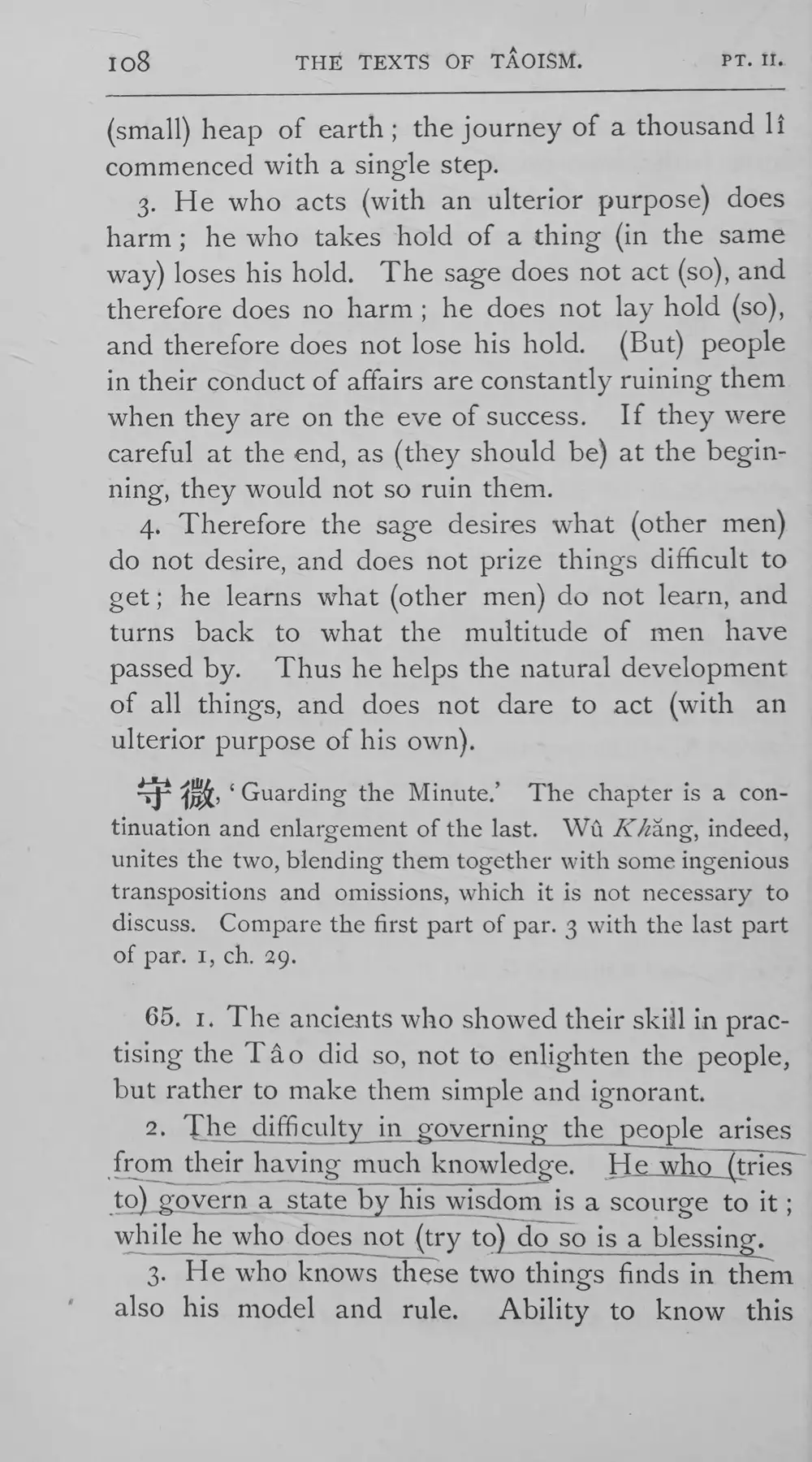
2. The tree that fills the arms grew from the tiniest sprout; the tower of nine storeys rose from a (small) heap of earth; the journey of a thousand li began with a single step.