Legge rejects the Jesuits’ sense that nothing is to be feared after death as ‘a meaning which the characters will not bear’, then concludes there was ‘the germ’ of later life-preserving arts in Lâo-ȝze’s mind. Both moves go beyond the clause, which says only that he will be free from peril to the end of his life. The caution he applies to the Jesuits applies to his own germ as well.
The Tâo Teh King — Sacred Books of China Part I, SBE Vol. 39 (trans. James Legge, 1891)
Open to all
page 96
No image is selected for this page; its own page image is shown.
page 96
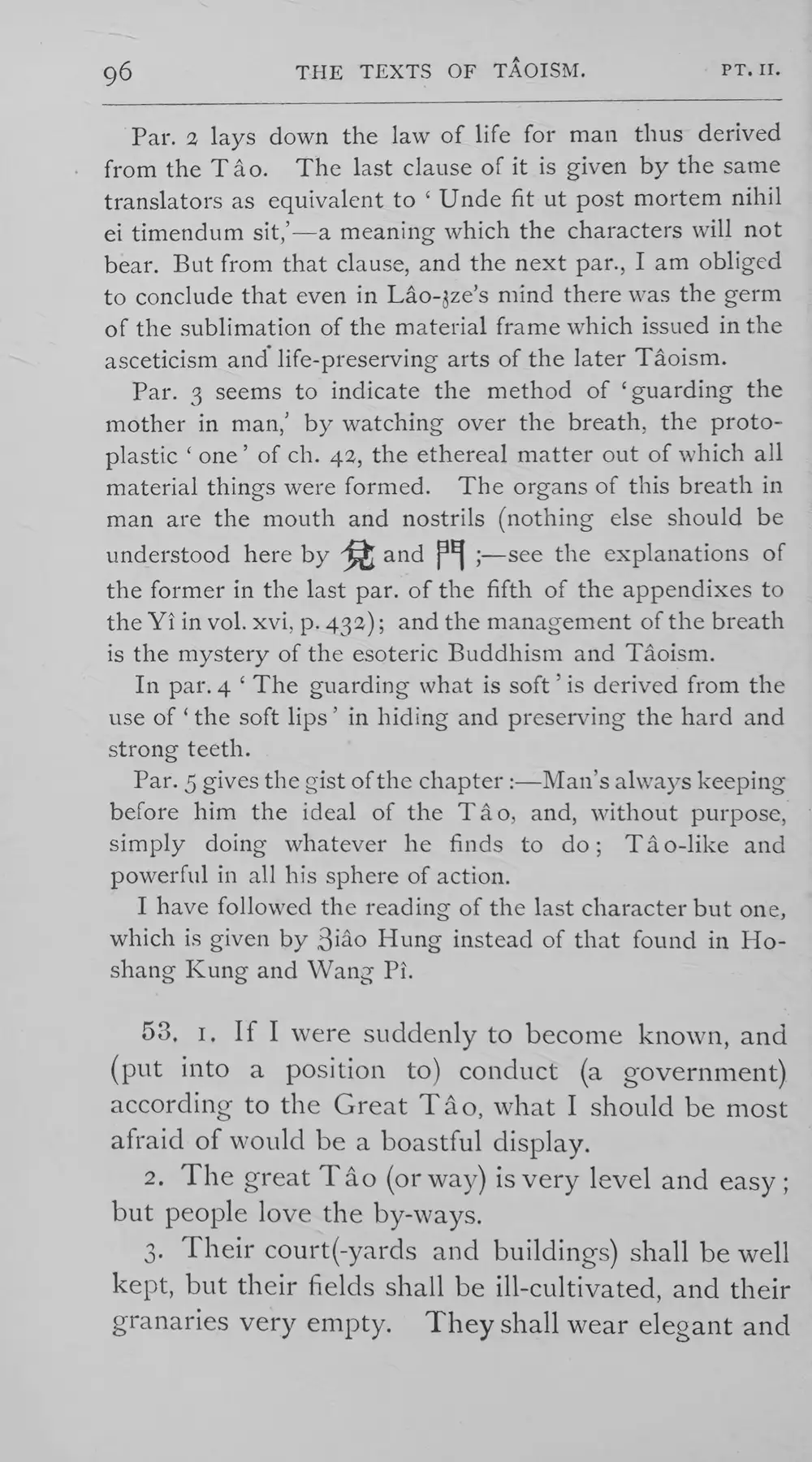
Par. 2 lays down the law of life for man thus derived from the Tâo. The last clause of it is given by the same translators as equivalent to ‘Whence it comes about that after death he has nothing to fear,’—a meaning which the characters will not bear. But from that clause, and the next paragraph, I am obliged to conclude that even in Lâo-ȝze’s mind there was the germ of the sublimation of the material frame which issued in the asceticism and life-preserving arts of the later Tâoism.
Par. 3 seems to indicate the method of ‘guarding the mother’ in man, by watching over the breath, the protoplastic ‘one’ of ch. 42, the ethereal matter out of which all material things were formed. The organs of this breath in man are the mouth and nostrils (nothing else should be understood here by 兌 and 門;—see the explanations of the former in the last paragraph of the fifth of the appendixes to the Yi in vol. xvi, p. 432); and the management of the breath is the mystery of esoteric Buddhism and Tâoism.
In par. 4, ‘the guarding of what is soft’ is derived from the use of ‘the soft lips’ in hiding and preserving the hard and strong teeth.
Par. 5 gives the gist of the chapter:—Man’s always keeping before him the ideal of the Tâo, and, without purpose, simply doing whatever he finds to do; Tâo-like and powerful in all his sphere of action.
I have followed the reading of the last character but one which is given by Ȝiâo Hung, instead of that found in Ho-shang Kung and Wang Pî.
53. 1. If I were suddenly to become known, and (put into a position to) conduct (a government) according to the Great Tâo, what I should be most afraid of would be a boastful display.
2. The great Tâo (or way) is very level and easy; but people love the by-ways.
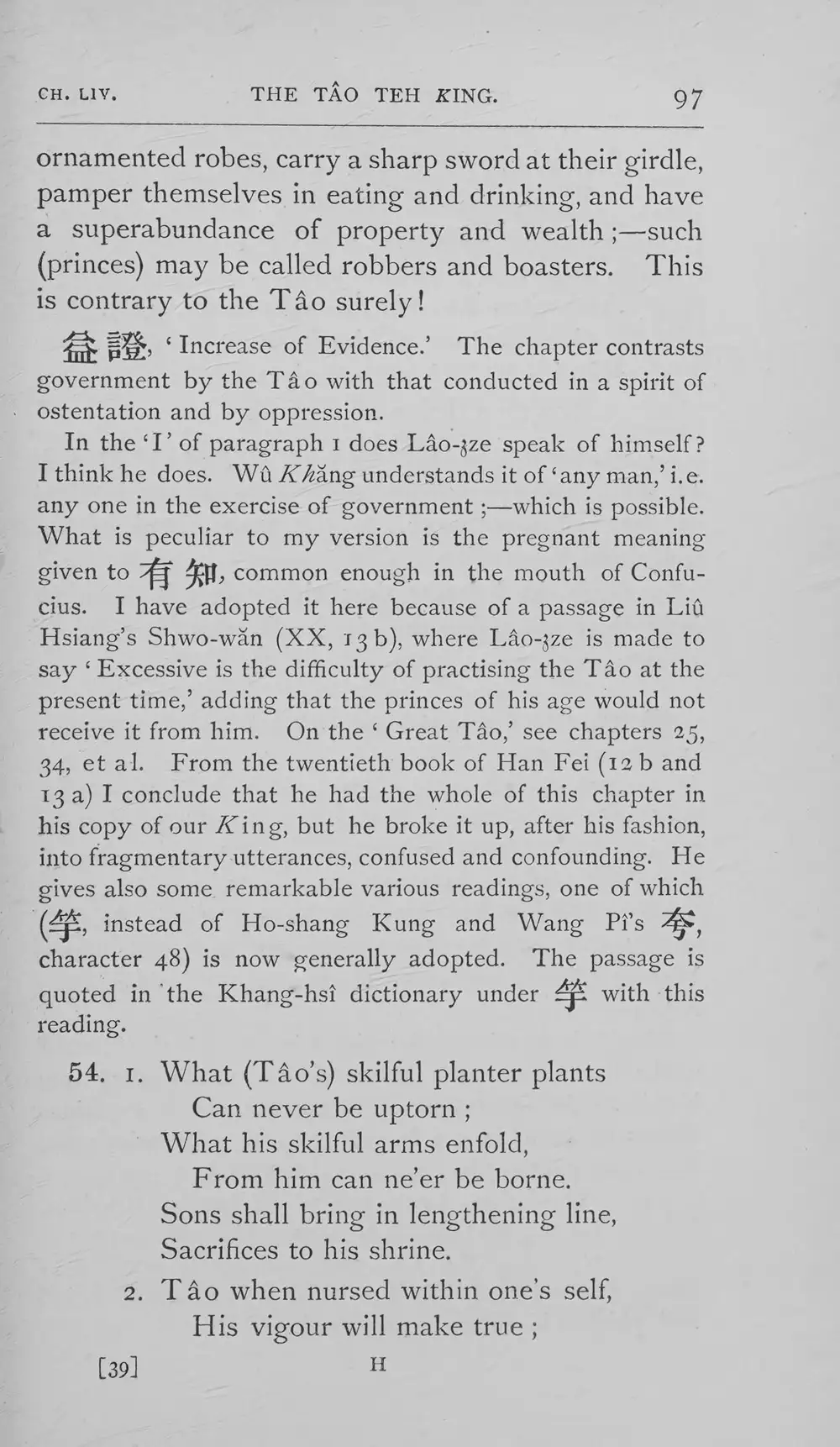
3. Their court(-yards and buildings) shall be well kept, but their fields shall be ill-cultivated, and their granaries very empty. They shall wear elegant and ornamented robes, carry a sharp sword at their girdle, pamper themselves in eating and drinking, and have a superabundance of property and wealth;—such (princes) may be called robbers and boasters. This is surely contrary to the Tâo!
Legge rests his reading of 兌 as the mouth on the fifth appendix to the Yî King, which he translates in SBE vol. 16, p. 432, where that trigram stands for the mouth. The warrant comes from within the classical shelf, not from a later Taoist commentator, which makes this physiological reading better grounded than his reading of ‘the gates of heaven’ on p. 54.
cites The Yî King — Sacred Books of China Part II, SBE Vol. 16 (trans. James Legge, 1882)