Legge's text has the phoenix resting only on "the bignonia," and his note identifies that tree as the Dryandra cordifolia. Earlier in this volume the hearer of Hwang-Ti's music leans against "an old rotten" tree Legge calls a dryandra, the same tree in the Chinese. One plant thus carries two English names a few pages apart, and only the footnote here lets a reader see that they are one.
The Tâo Teh King — Sacred Books of China Part I, SBE Vol. 39 (trans. James Legge, 1891)
Open to all
page 391
No image is selected for this page; its own page image is shown.
page 391
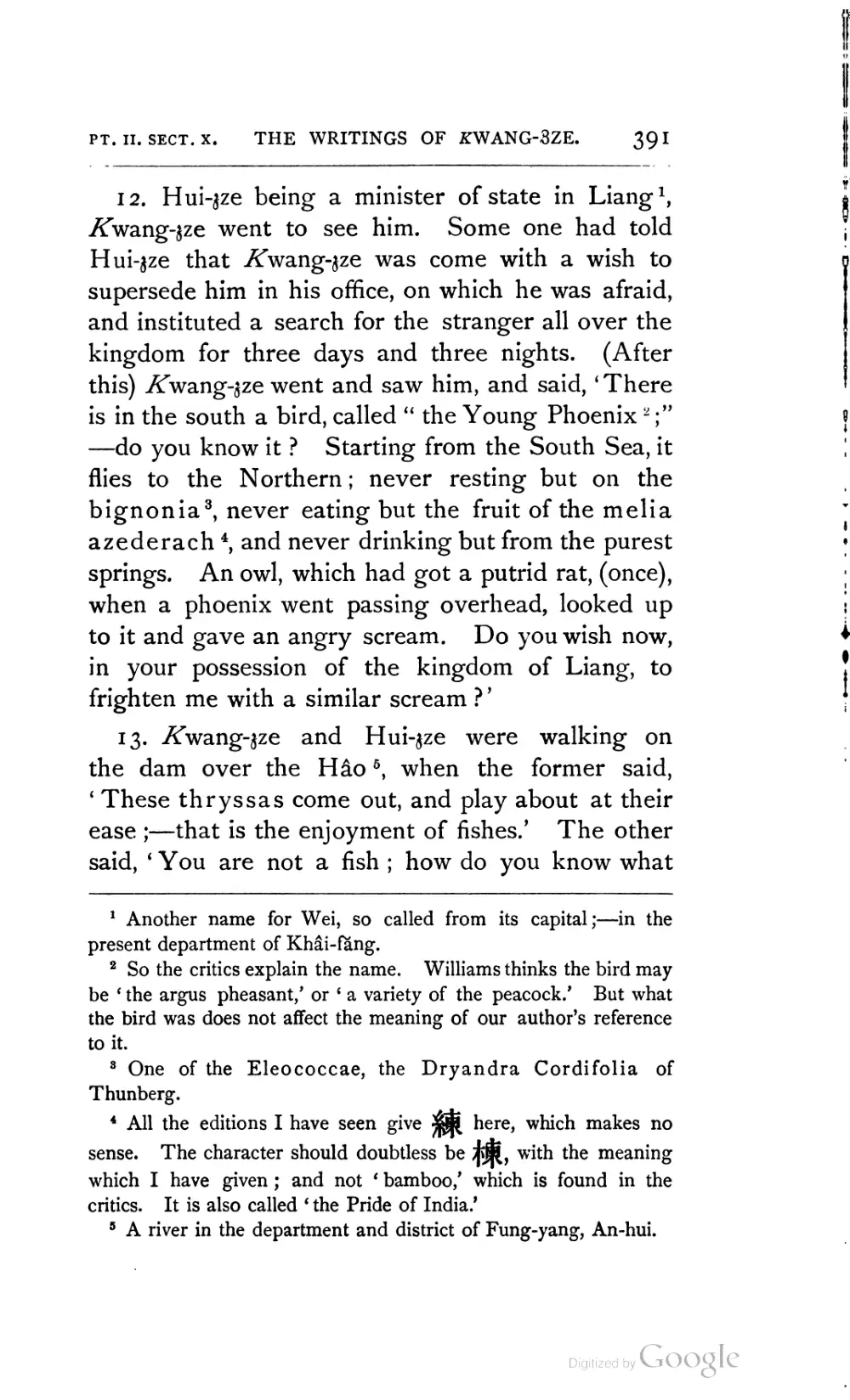
391 12. When Hui-yze was a minister of state in Liang, Kwang-ȝze went to see him. Someone had told Hui-yze that Kwang-ȝze had come wishing to take his place in office, at which he was afraid, and had a search made for the stranger all over the kingdom for three days and three nights. (After this) Kwang-ȝze went and saw him, and said, ‘There is in the south a bird called “the Young Phoenix *”;—do you know it? Starting from the South Sea, it flies to the Northern; it never rests but on the bignonia, never eats but the fruit of the melia azederach 4, and never drinks but from the purest springs. An owl that had got hold of a putrid rat (once) looked up as a phoenix passed overhead and gave an angry scream. Do you now wish, in your possession of the kingdom of Liang, to frighten me with a similar scream?’
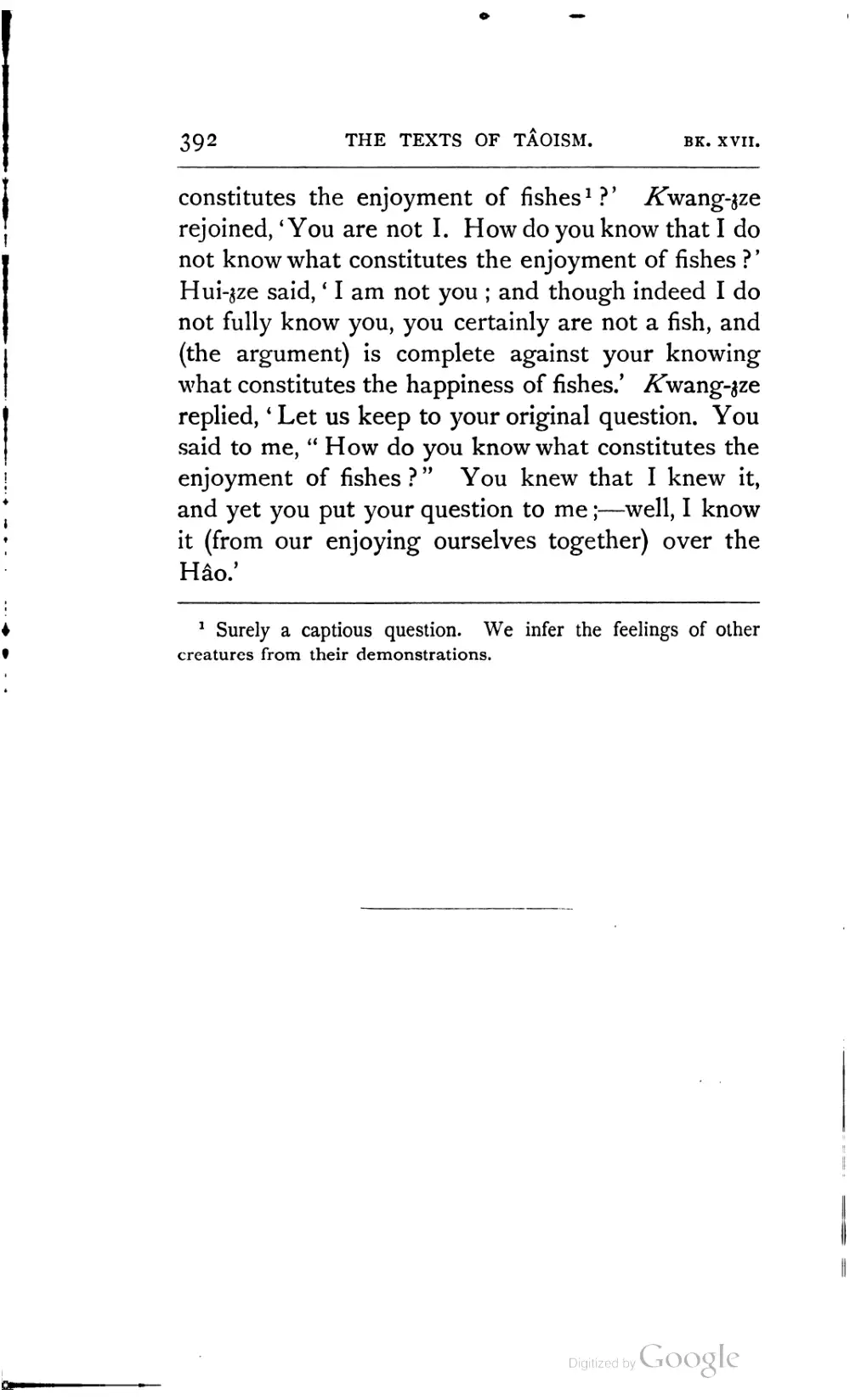
13. Kwang-ȝze and Hui-ȝze were walking on the dam over the Hâo⁵, when the former said, ‘These thryssas come out and play about at their ease;—that is the enjoyment of fishes.’ The other said, ‘You are not a fish; how do you know what constitutes the enjoyment of fishes¹?’ Kwang-ȝze rejoined, ‘You are not I. How do you know that I do not know what constitutes the enjoyment of fishes?’ Hui-ȝze said, ‘I am not you; and though I do not indeed fully know you, you certainly are not a fish, and (the argument) is complete against your knowing what constitutes the happiness of fishes.’ Kwang-ȝze replied, ‘Let us go back to your original question. You said to me, “How do you know what constitutes the enjoyment of fishes?” You knew that I knew it, and yet you put your question to me;—well, I know it (from our enjoying ourselves together) over the Hâo.’
1 Another name for Wei, so called from its capital;—in what is now the department of Khâi-făng.
2 So the critics explain the name. Williams thinks the bird may be ‘the argus pheasant’, or ‘a variety of the peacock’. But what the bird was does not affect the meaning of our author’s reference to it.
8 One of the Eleococcae, the Dryandra cordifolia of Thunberg.
4 All the editions I have seen give 練 [Press: to practise; to refine (silk)] here, which makes no sense. The character should doubtless be 棟 [Press: ridge-pole, main beam], with the meaning I have given, and not ‘bamboo’, which is found in the critics. It is also called ‘the Pride of India.’
5 A river in the department and district of Fung-yang, in An-hui.
Legge emends 練 to 楝, the melia, because the printed character "makes no sense," and rejects the critics' "bamboo." Their gloss has the weight of the phoenix lore, in which the bird eats only bamboo seed, so the printed text may make better sense than he allows. The emendation is his conjecture against a reading the commentators could construe.