Legge says the author "adopts the common beliefs or superstitions of his time" and puts his reasoning in the mouths of mythological figures. The second half is right; the first undersells the craft. The earl of the Ho laughs with delight at his swollen river and then sighs before the sea: the spirit is a character who changes his mind, and the lesson about scale is staged as his conversion rather than told.
The Tâo Teh King — Sacred Books of China Part I, SBE Vol. 39 (trans. James Legge, 1891)
Open to all
page 374
No image is selected for this page; its own page image is shown.
page 374
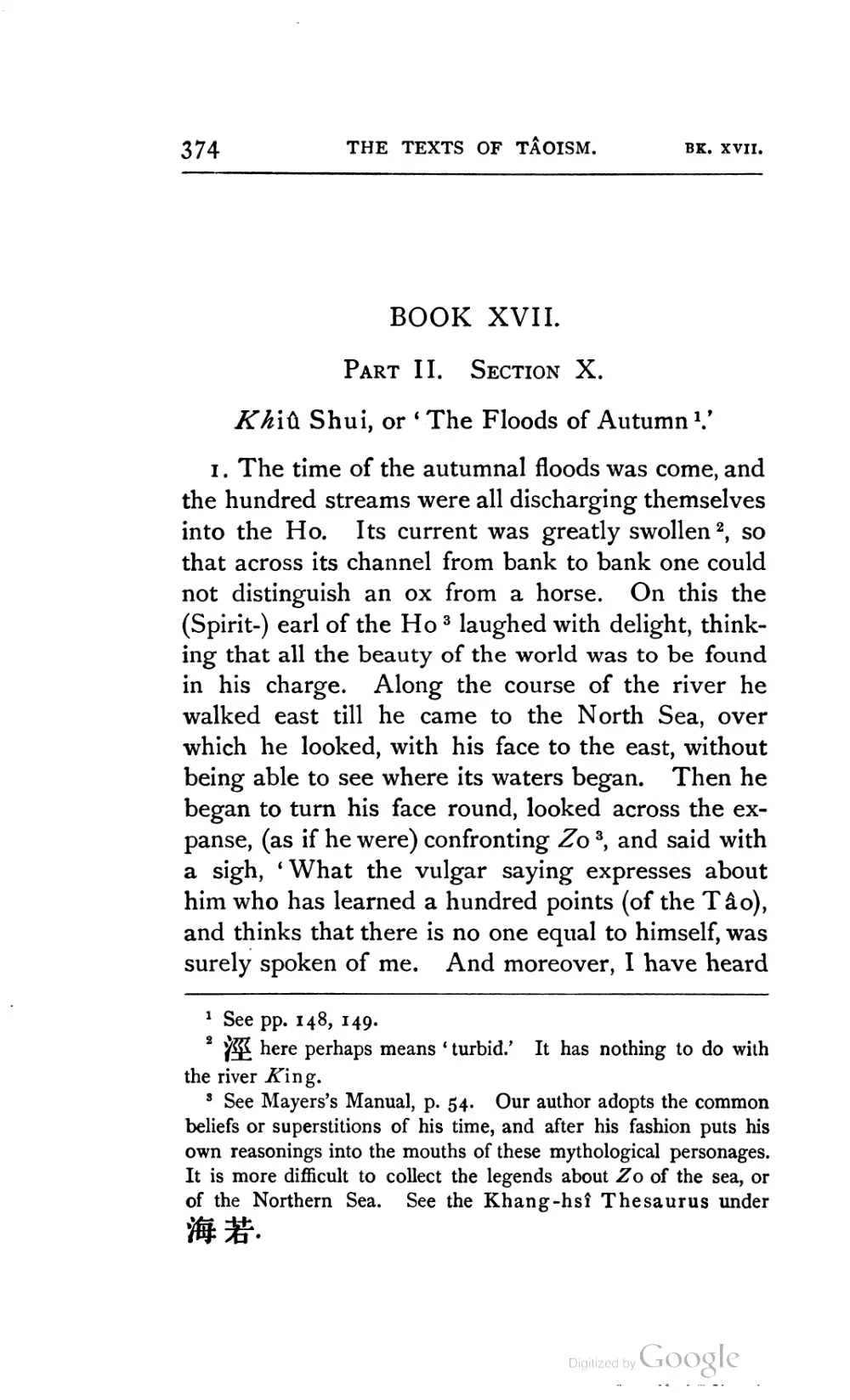
p. 374BOOK XVII.
Part II. Section X.
Khiû Shui, or ‘The Floods of Autumn1’
1. The time of the autumn floods had come, and the hundred streams were all pouring into the Ho. Its current was greatly swollen2, so that across its channel from bank to bank one could not tell an ox from a horse. At this the (Spirit-)earl of the Ho3 laughed with delight, thinking that all the beauty of the world was to be found in his charge. Following the course of the river, he walked east until he came to the North Sea, over which he looked, with his face to the east, without being able to see where its waters began. Then he began to turn his face round, looked across the expanse, (as if he were) confronting Zo, and said with a sigh, ‘What the common saying expresses about him who has learned a hundred points (of the Tâo), and thinks that there is no one equal to himself, was surely spoken of me. And moreover, I have heard
1 See pp. 148, 149.
2 涇 here perhaps means ‘turbid.’ It has nothing to do with the river King.
3 See Mayers’s Manual, p. 54. Our author adopts the common beliefs or superstitions of his time, and after his own fashion puts his own reasonings into the mouths of these mythological personages. It is more difficult to collect the legends about Zo of the sea, or of the Northern Sea. See the Khang-hsi Thesaurus under
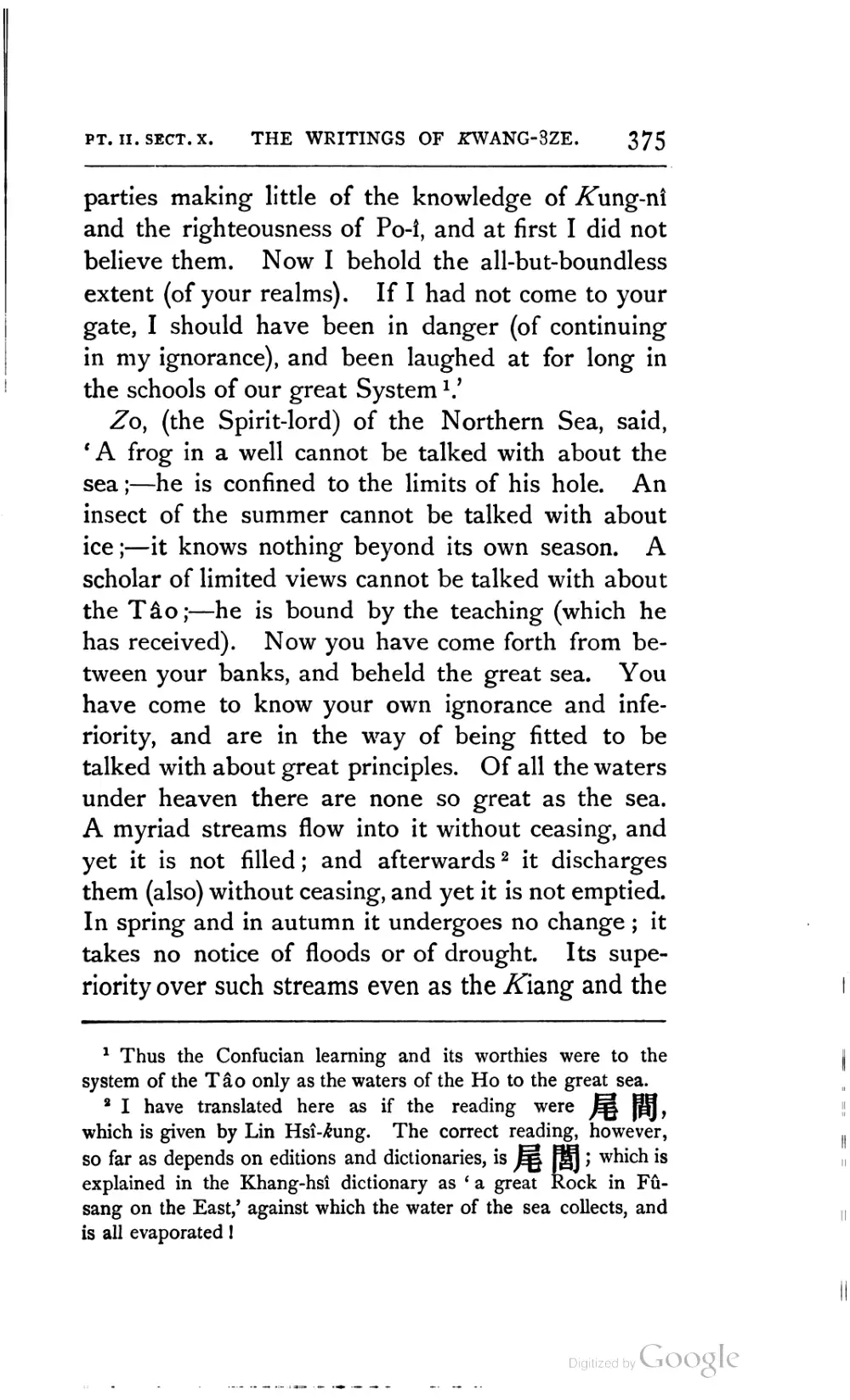
海若 [Press: Hai Ruo, the Spirit of the Sea]. ȜZE. 375 parties making little of the knowledge of Kung-ni and the righteousness of Po-i, and at first I did not believe them. Now I see the all-but-boundless extent (of your realms). If I had not come to your gate, I would have been in danger (of continuing in my ignorance), and would long have been laughed at in the schools of our great System.’