Legge takes 滑 in the sense of "regulate" on the Khang-hsî dictionary's authority, against its usual sense "to confuse," because he cannot construe the sentence otherwise. The two readings condemn the same people for different faults: with "confuse," common thinking muddles desire; with "regulate," the very attempt to govern desire by common thinking is the error. His choice fits the Book's theme, and he states it openly.
The Tâo Teh King — Sacred Books of China Part I, SBE Vol. 39 (trans. James Legge, 1891)
Open to all
page 368
No image is selected for this page; its own page image is shown.
page 368
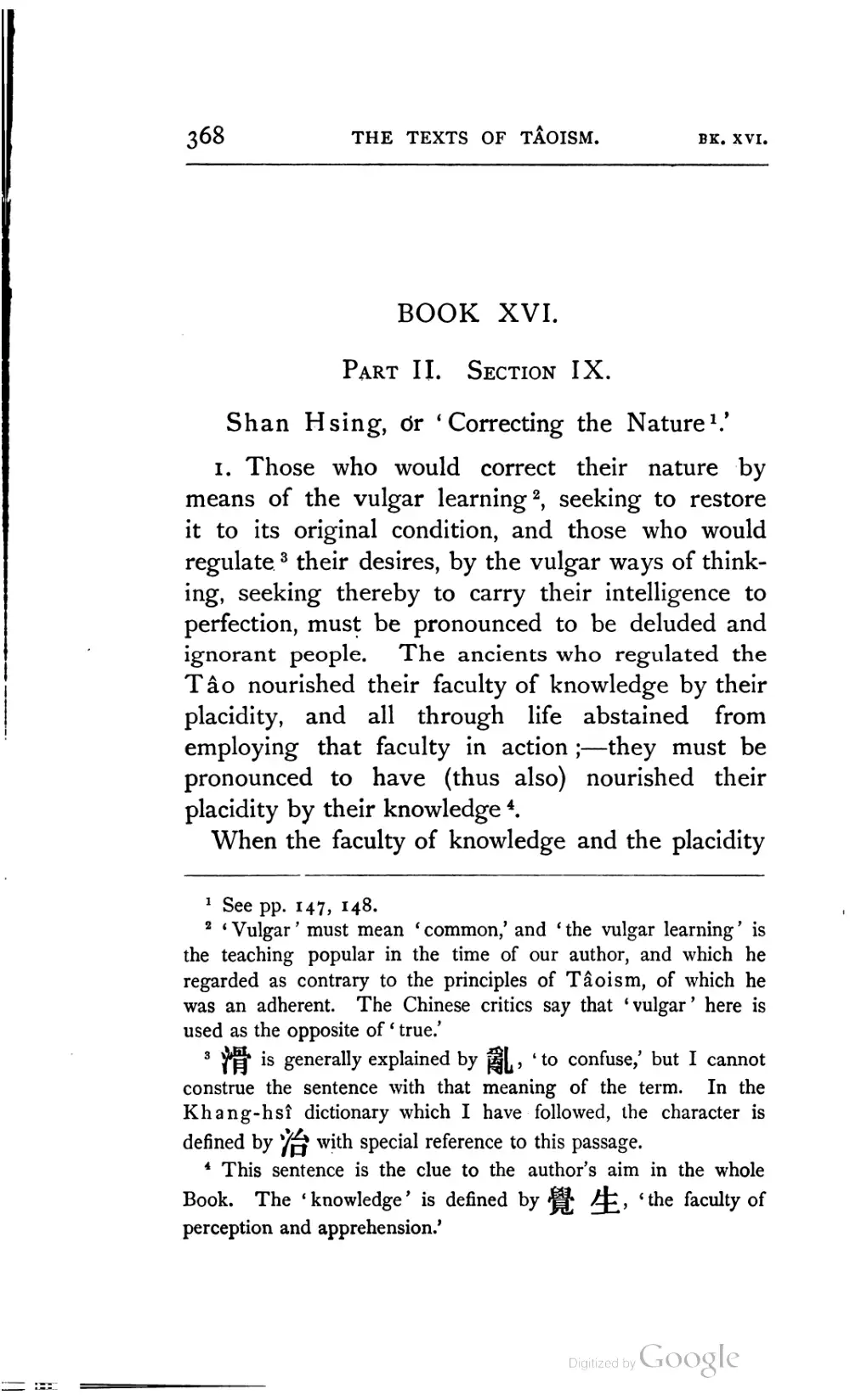
p. 368BOOK XVI.
Part II. Section IX.
Shan Hsing, or ‘Correcting the Nature1.’
1. Those who would correct their nature by means of the vulgar learning, seeking to restore it to its original condition, and those who would regulate3 their desires by the vulgar ways of thinking, seeking thereby to bring their intelligence to perfection, must be pronounced deluded and ignorant people. The ancients who regulated the Tâo nourished their faculty of knowledge by their placidity, and all through life refrained from employing that faculty in action;—they must be pronounced to have (thus also) nourished their placidity by their knowledge4.
When the faculty of knowledge and the placidity (thus) blend together and nourish each other, then harmony and orderly method come forth from the nature. The attributes (of the Tâo) constitute the harmony; the Tâo (itself) secures the orderly method. When the attributes appear in a universal practice of forbearance, we have Benevolence; when the path is everywhere marked by orderly method, we have Righteousness; when righteousness is clearly manifested and (all) things are regarded with affection, we have Leal-heartedness; when the (heart’s) core is thus (pure) and real, and carried back to its (proper) qualities, we have Music; when this sincerity appears in the whole range of the capacity, and its expressions accord with what is elegant, we have Ceremony. If Ceremonies and Music are carried out in an imperfect and one-sided way, the world is thrown into confusion. When men would rectify others while their own virtue is clouded, it is not sufficient to extend itself to them. If an attempt is made to extend it so, they too will lose their (proper) nature.
1 See pp. 147, 148.
2 ‘Vulgar’ must mean ‘common,’ and ‘the vulgar learning’ is the teaching popular in our author’s time, which he regarded as contrary to the principles of Taoism, of which he was an adherent. The Chinese critics say that ‘vulgar’ here is used as the opposite of ‘true.’
3 滑 is generally explained by 亂, ‘to confuse,’ but I cannot construe the sentence with that meaning of the term. In the Khang-hsi dictionary, which I have followed, the character is defined by 治 [Press: to regulate, to put in order], with special reference to this passage.
4 This sentence is the clue to the author’s aim in the whole Book. The ‘knowledge’ is defined by 覺生, ‘the faculty of perception and apprehension.’
Here the Confucian virtues are not denied but derived: benevolence, righteousness, leal-heartedness, music and ceremony each appear as a stage of the Tâo's harmony and order showing outwardly. The order is the argument, since ceremony comes last and depends on all before it. That is why ceremonies and music "carried out in an imperfect and one-sided manner" throw the world into confusion: they are the last link, worked without the chain.