Legge says these Hwangs and Tis are "different probably" from those "of par. 3," but the earlier mention, with its 576,000 years, is in par. 4, the music-master's speech; par. 3 is Hwang-Ti's music. The substance of the note holds: Ȝze-kung names Yâo, Shun, Yü, Thang, Wan and Wû, and Lao Tan's verdict on p. 360 speaks of "the Three Kings and Five Tis," so Kings are meant.
The Tâo Teh King — Sacred Books of China Part I, SBE Vol. 39 (trans. James Legge, 1891)
Open to all
page 358
No image is selected for this page; its own page image is shown.
page 358
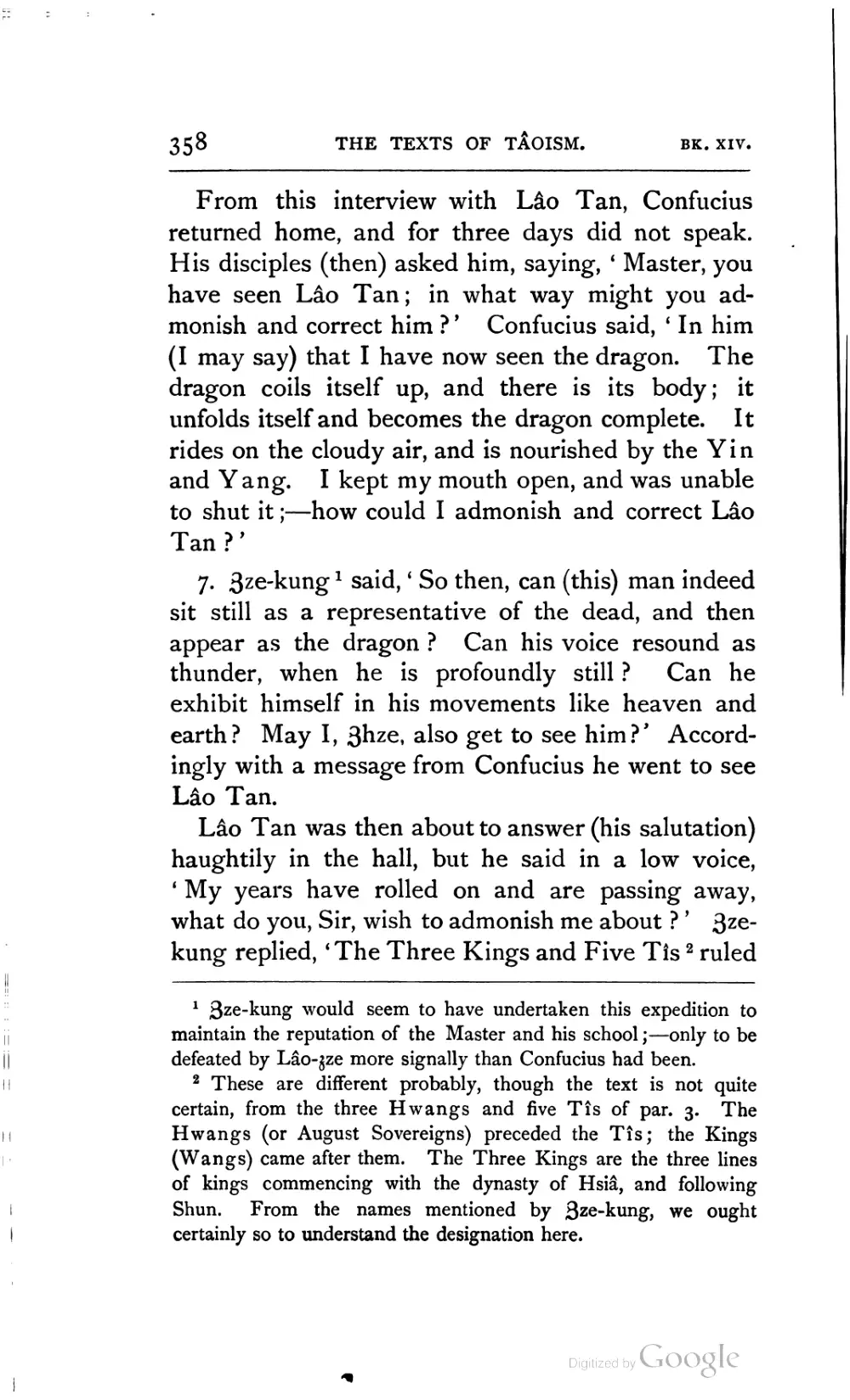
On returning home from this interview with Lâo Tan, Confucius did not speak for three days. His disciples (then) asked him, ‘Master, you have seen Lâo Tan; in what way might you admonish and correct him?’ Confucius said, ‘In him (I may say) I have now seen the dragon. The dragon coils itself up, and there is its body; it unfolds itself and becomes the complete dragon. It rides on the cloudy air, and is nourished by the Yin and Yang. I kept my mouth open and could not shut it;—how could I admonish and correct Lâo Tan?’
7. Ȝze-kung1 said, ‘So then, can (this) man indeed sit still like a representative of the dead, and then appear as the dragon? Can his voice resound like thunder while he is profoundly still? Can he show himself in his movements like heaven and earth? May I, Ȝhze, also get to see him?’ So, with a message from Confucius, he went to see Lâo Tan.
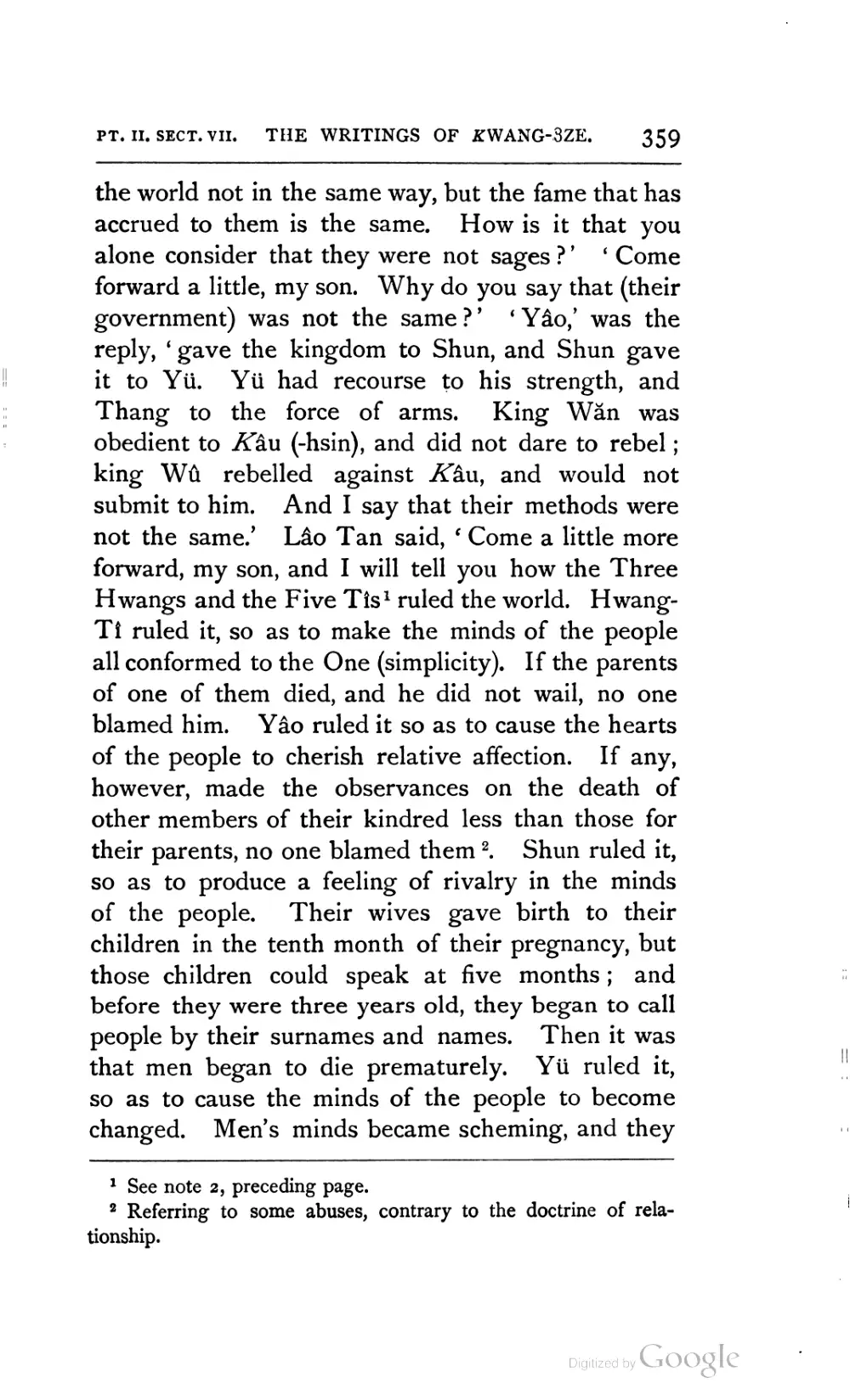
Lâo Tan was then about to answer (his salutation) haughtily in the hall, but he said in a low voice, ‘My years have rolled on and are passing away; what do you, Sir, wish to admonish me about?’ Ȝze-kung replied, ‘The Three Kings and Five Tîs2 ruled the world not in the same way, but the fame that has come to them is the same. How is it that you alone consider that they were not sages?’ ‘Come forward a little, my son. Why do you say that (their government) was not the same?’ ‘Yâo,’ was the reply, ‘gave the kingdom to Shun, and Shun gave it to Yü. Yü resorted to his strength, and Thang to force of arms. King Wăn was obedient to Kâu(-hsin), and did not dare to rebel; king Wû rebelled against Kâu, and would not submit to him. And I say that their methods were not the same.’ Lâo Tan said, ‘Come a little further forward, my son, and I will tell you how the Three Hwangs and the Five Tîs1 ruled the world. Hwang-Tî ruled it so as to make the minds of the people all conform to the One (simplicity). If one of them did not wail when his parents died, no one blamed him. Yâo ruled it so as to make the hearts of the people cherish affection for their kin. If any, however, made the observances on the death of other members of their kindred less than those for their parents, no one blamed them2. Shun ruled it so as to produce a feeling of rivalry in the minds of the people. Their wives gave birth to their children in the tenth month of pregnancy, but those children could speak at five months; and before they were three years old, they began to call people by their surnames and names. Then it was that men began to die prematurely. Yü ruled it so as to cause the minds of the people to change. Men’s minds became scheming, and they
1 Ȝze-kung seems to have undertaken this expedition to uphold the reputation of the Master and his school;—only to be defeated by Lâo-ȝze more signally than Confucius had been.
2 These are probably different, though the text is not quite certain, from the three Hwangs and five Tîs of par. 3. The Hwangs (or August Sovereigns) preceded the Tîs; the Kings (Wangs) came after them. The Three Kings are the three lines of kings beginning with the dynasty of Hsiâ, and following Shun. From the names mentioned by Ȝze-kung, we should certainly understand the designation here in this way.
Confucius's image answers Ȝze-kung before he asks: the dragon "coils itself up, and there is its body; it unfolds itself and becomes the dragon complete." Stillness and display are one creature, which is exactly what Ȝze-kung then doubts of a man who can sit "as a representative of the dead" and appear as the dragon. Legge reads the visit as a contest for the school's reputation; the text frames it as a disciple testing his master's report.