Legge cannot find the Lord of Piao in any source he searched, and proposes that the name's character should be built of three 犬 rather than three 火 if the reading Piao is right. The emendation follows from the pronunciation alone, so it is conjecture. The admission that the authority is unknown is the more useful point: Kwang-ȝze quotes him as if he needed no introduction.
The Tâo Teh King — Sacred Books of China Part I, SBE Vol. 39 (trans. James Legge, 1891)
Open to all
page 351
No image is selected for this page; its own page image is shown.
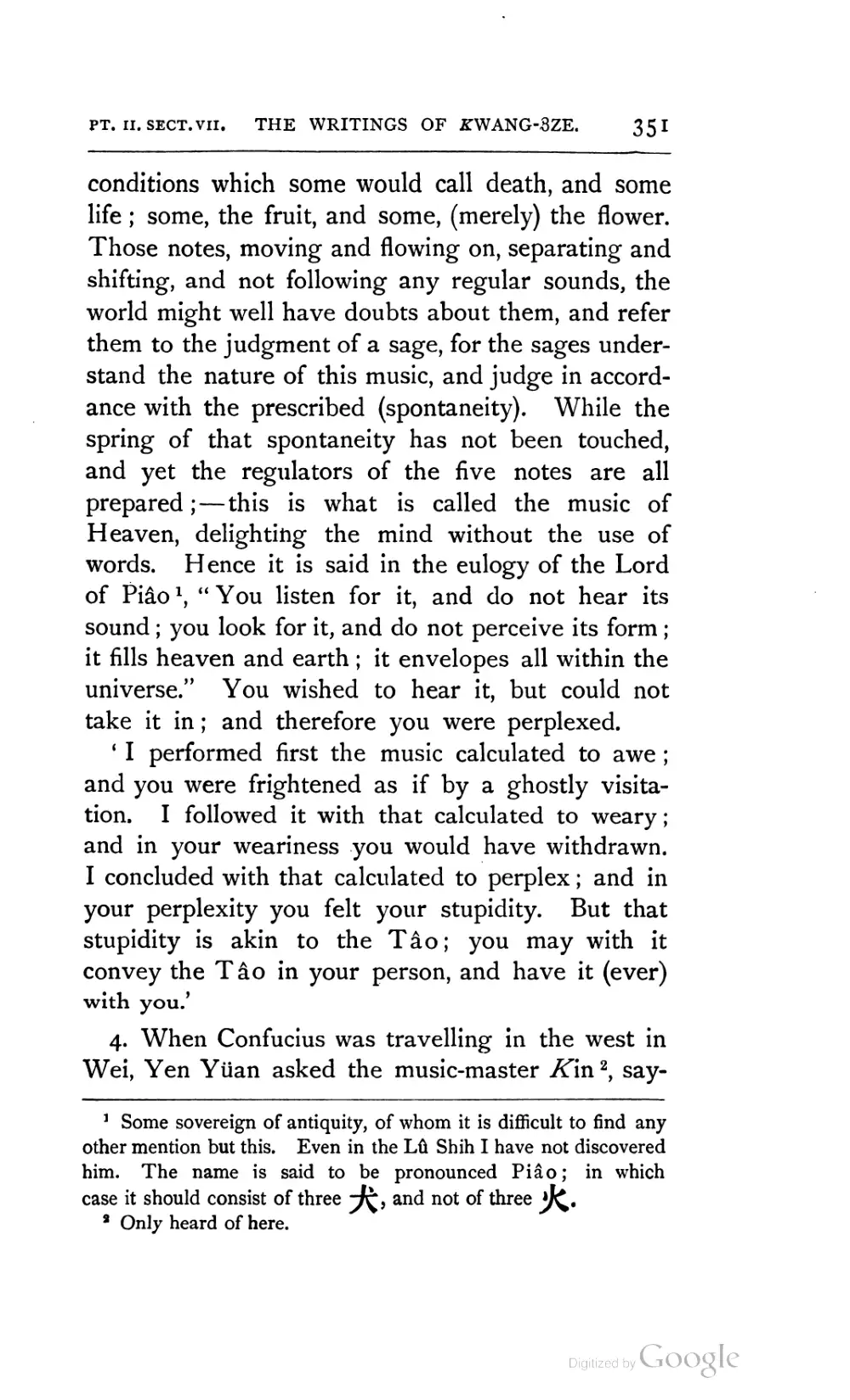
page 351
‘I performed first the music calculated to awe, and you were frightened as if by a ghostly visitation. I followed it with that calculated to weary, and in your weariness you would have withdrawn. I concluded with that calculated to perplex, and in your perplexity you felt your stupidity. But that stupidity is akin to the Tao; with it you may carry the Tâo in your person and have it (ever) with you.’
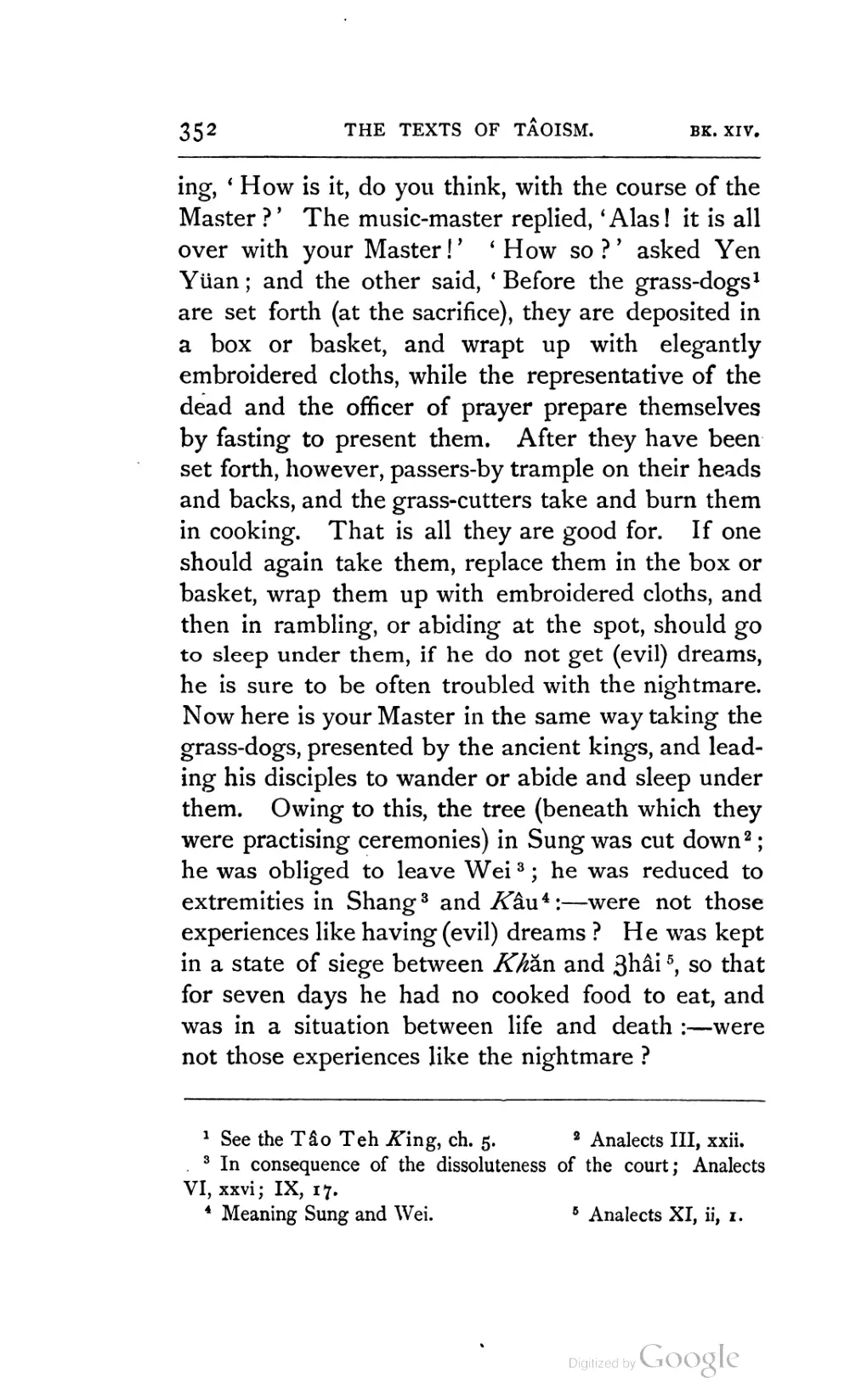
4. When Confucius was travelling west in Wei, Yen Yüan asked the music-master, ‘How do you think it goes with the course of the Master?’ The music-master replied, ‘Alas! it is all over with your Master!’ ‘How so?’ asked Yen Yüan; and the other said, ‘Before the grass-dogs1 are set out (at the sacrifice), they are put away in a box or basket and wrapped in finely embroidered cloths, while the representative of the dead and the officer of prayer prepare themselves by fasting to present them. Once they have been set out, however, passers-by trample on their heads and backs, and the grass-cutters take them and burn them for cooking. That is all they are good for. If someone were to take them again, put them back in the box or basket, wrap them in embroidered cloths, and then, whether wandering or staying on the spot, go to sleep beneath them, then even if he did not have (evil) dreams, he would be sure to be often troubled by nightmares.
Now here is your Master doing just the same: taking the grass-dogs presented by the ancient kings, and leading his disciples to wander or stay and sleep beneath them. Because of this, the tree (beneath which they were practising ceremonies) in Sung was cut down2; he was forced to leave Wei3; he was reduced to extremities in Shang and Kâu⁴:—were not those experiences like having (evil) dreams? He was kept under siege between Khăn and Ȝhâi5, so that for seven days he had no cooked food to eat, and was in a situation between life and death:—were not those experiences like the nightmare?
1 Some sovereign of antiquity, of whom it is hard to find any mention other than this. Even in the Lû Shih I have not found him. The name is said to be pronounced Piao; in which case it should consist of three 犬 [Press: dog], and not of three 火 [Press: fire].
2 Only heard of here.
The Ti ends by turning the hearer's failure into his qualification: perplexity made him feel his stupidity, "But that stupidity is akin to the Tao." The three effects are stages, not faults, and their order matters: fear, then weariness, then not knowing. The paragraph is an account of how understanding is undone before the Tâo can be carried "in your person."
The grass-dogs are honoured before the sacrifice and trampled after it; the ancient kings' institutions, on the music-master's argument, are the same thing used out of season. He does not say the old rites were worthless, only that their moment has passed, and the nightmare comes from sleeping under them now. The hardships of Confucius listed next are offered as proof, so his known misfortunes become evidence against his method.