Legge declines to translate the name of Hwang-Ti's music and reads the whole description as an image of the Tâo and its effect on the mind. The text bears him out: the three movements produce fear, weariness and perplexity in turn, and the last is called "akin to the Tao." Leaving the name untranslated is the right call, since an English name would fix a meaning the passage keeps open.
The Tâo Teh King — Sacred Books of China Part I, SBE Vol. 39 (trans. James Legge, 1891)
Open to all
page 348
No image is selected for this page; its own page image is shown.
page 348
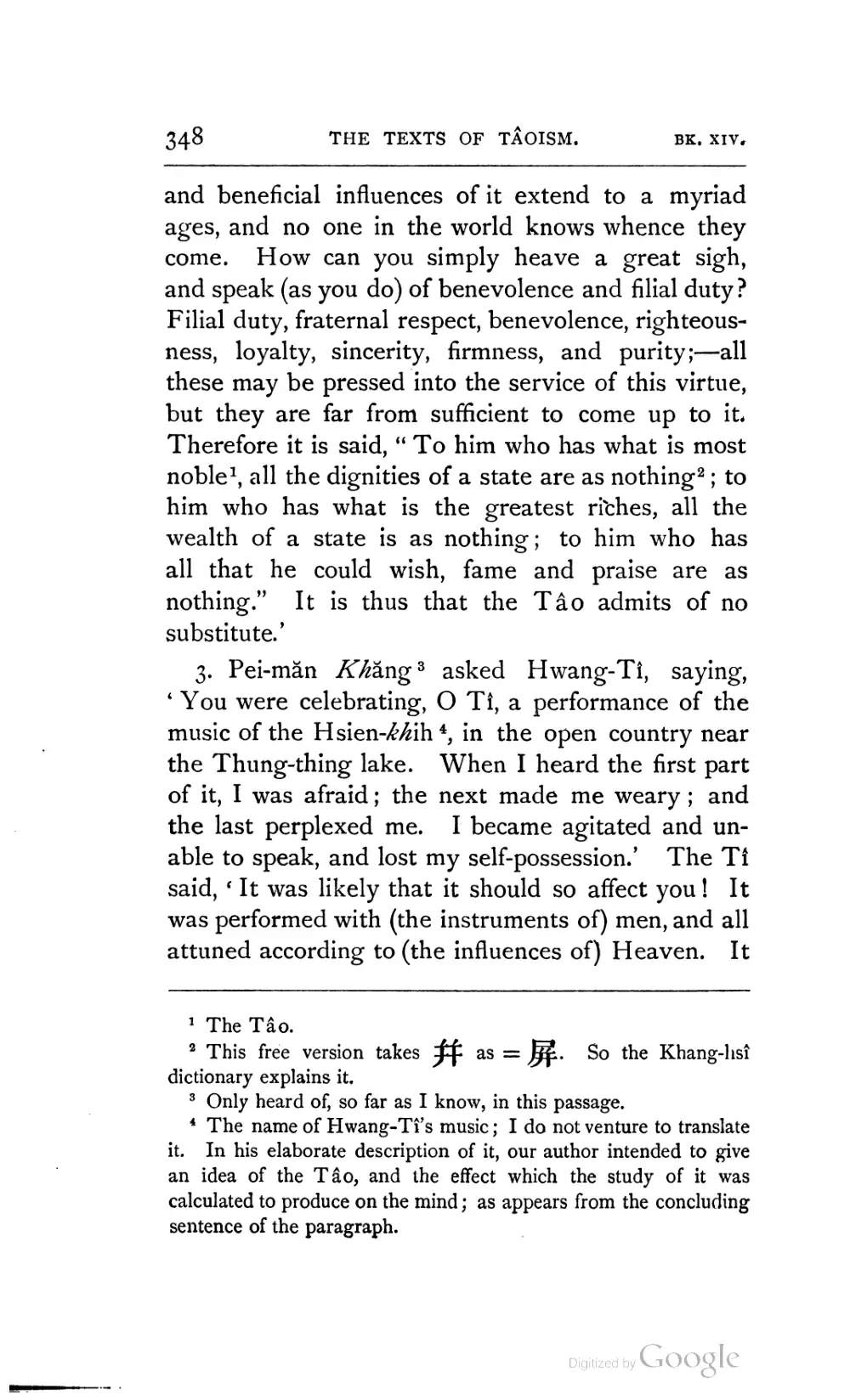
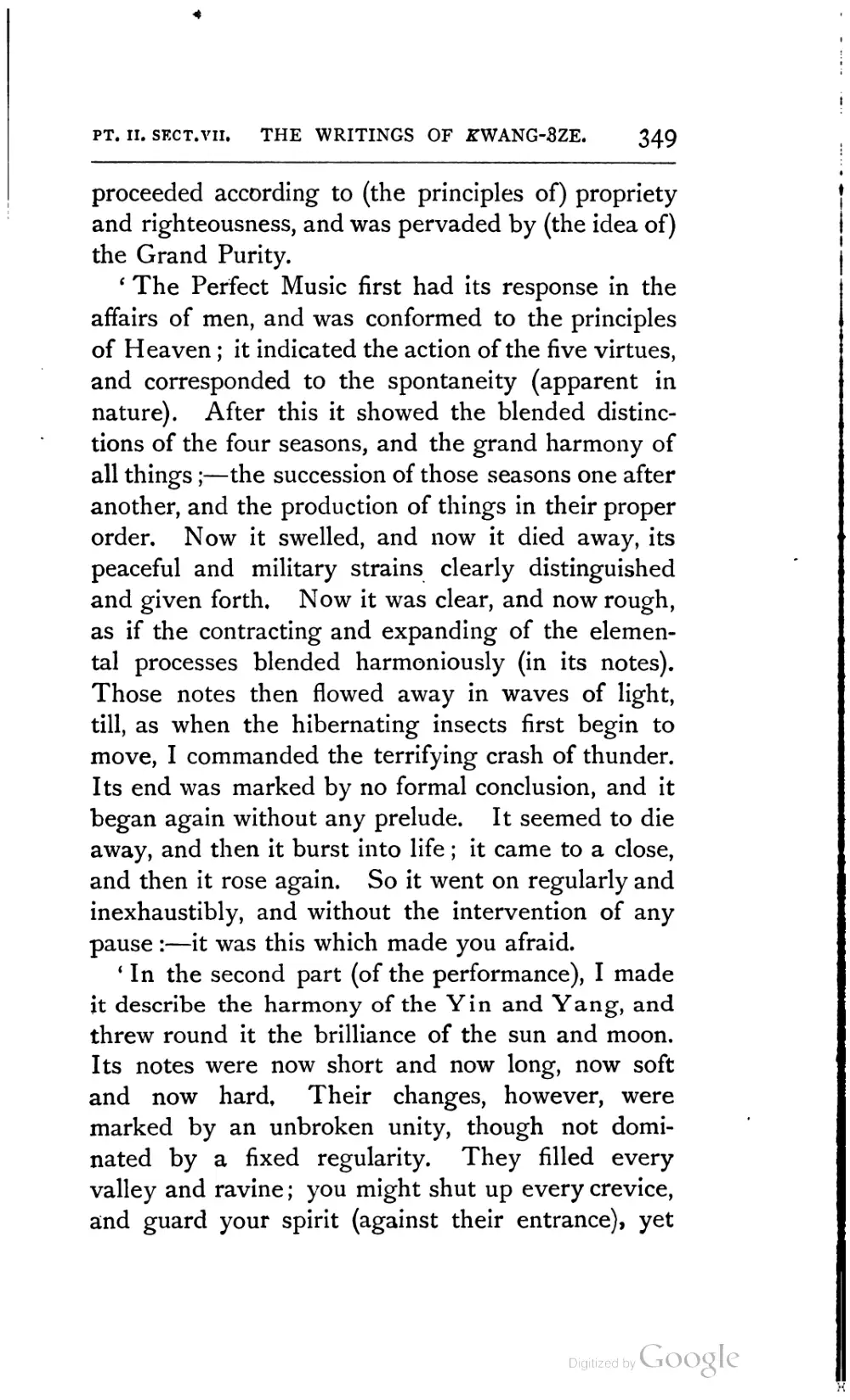
3. Pei-măn Khăng3 asked Hwang-Tî, ‘You were celebrating, O Tî, a performance of the music of the Hsien-khih4, in the open country near the Thung-thing lake. When I heard its first part I was afraid; the next made me weary; and the last perplexed me. I became agitated and unable to speak, and lost my self-possession.’ The Tî said, ‘It was likely that it would affect you so! It was performed with (the instruments of) men, and all attuned according to (the influences of) Heaven. It proceeded according to (the principles of) propriety and righteousness, and was pervaded by (the idea of) the Grand Purity.
1 The Tao.
2 This free version takes 幷 [Press: together; to combine] as equivalent to 屏 [Press: to screen, to put aside]. That is how the Khang-hsî dictionary explains it.
* Only heard of, as far as I know, in this passage.
* The name of Hwang-Ti’s music; I do not venture to translate it. In his elaborate description of it our author meant to give an idea of the Tao, and of the effect that the study of it was calculated to produce on the mind, as appears from the concluding sentence of the paragraph.
Legge marks his rendering as a "free version" resting on one equation, 幷 taken as 屏, which he finds in the Khang-hsî dictionary. That dictionary, compiled under the Khang-hsî emperor, is his court of appeal several times in these Books; its gloss is evidence of usage, not proof of what the author wrote. The line it supports should be read as Legge's construction.