The count checks against the ladder on the page before. With Heaven as the first step, ‘Objects and their Names’ comes fifth and ‘Rewards and Penalties’ ninth, so ‘after four other steps’ and ‘after eight steps’ are exact. The argument depends on that order: to begin with names or penalties is to start from the instruments and skip the root, which is why such a speaker is ‘a mere sophist, a man of one small idea.’
The Tâo Teh King — Sacred Books of China Part I, SBE Vol. 39 (trans. James Legge, 1891)
Open to all
page 337
No image is selected for this page; its own page image is shown.
page 337
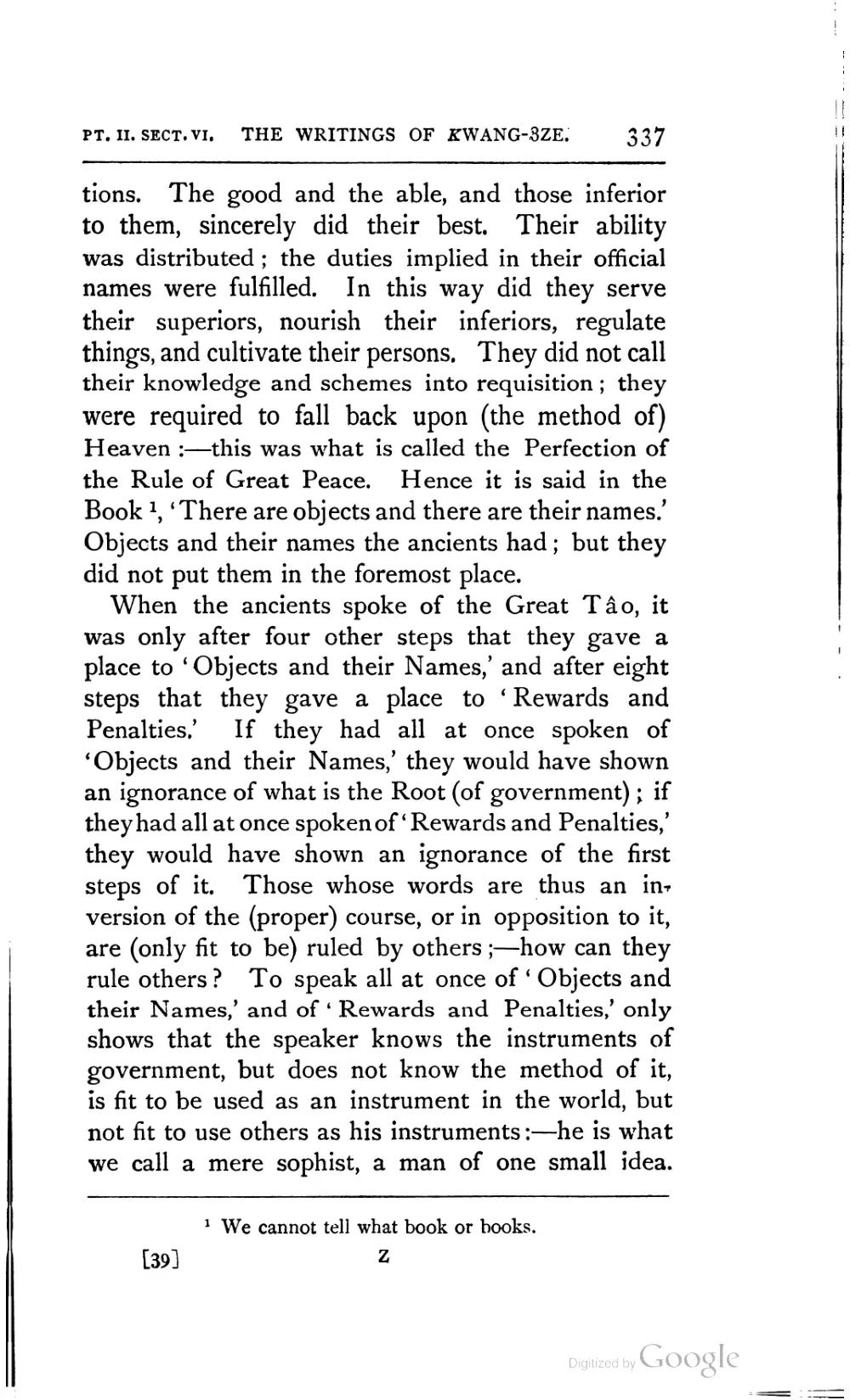
When the ancients spoke of the Great Tâo, it was only after four other steps that they gave a place to ‘Objects and their Names,’ and only after eight steps that they gave a place to ‘Rewards and Penalties.’ If they had spoken straight away of ‘Objects and their Names,’ they would have shown ignorance of the Root (of government); if they had spoken straight away of ‘Rewards and Penalties,’ they would have shown ignorance of its first steps. Those whose words thus invert the (proper) course, or oppose it, are (only fit to be) ruled by others;—how can they rule others?
To speak straight away of ‘Objects and their Names’ and of ‘Rewards and Penalties’ only shows that the speaker knows the instruments of government, but does not know the method of it, is fit to be used as an instrument in the world, but not fit to use others as his instruments:—he is what we call a mere sophist, a man of one small idea.
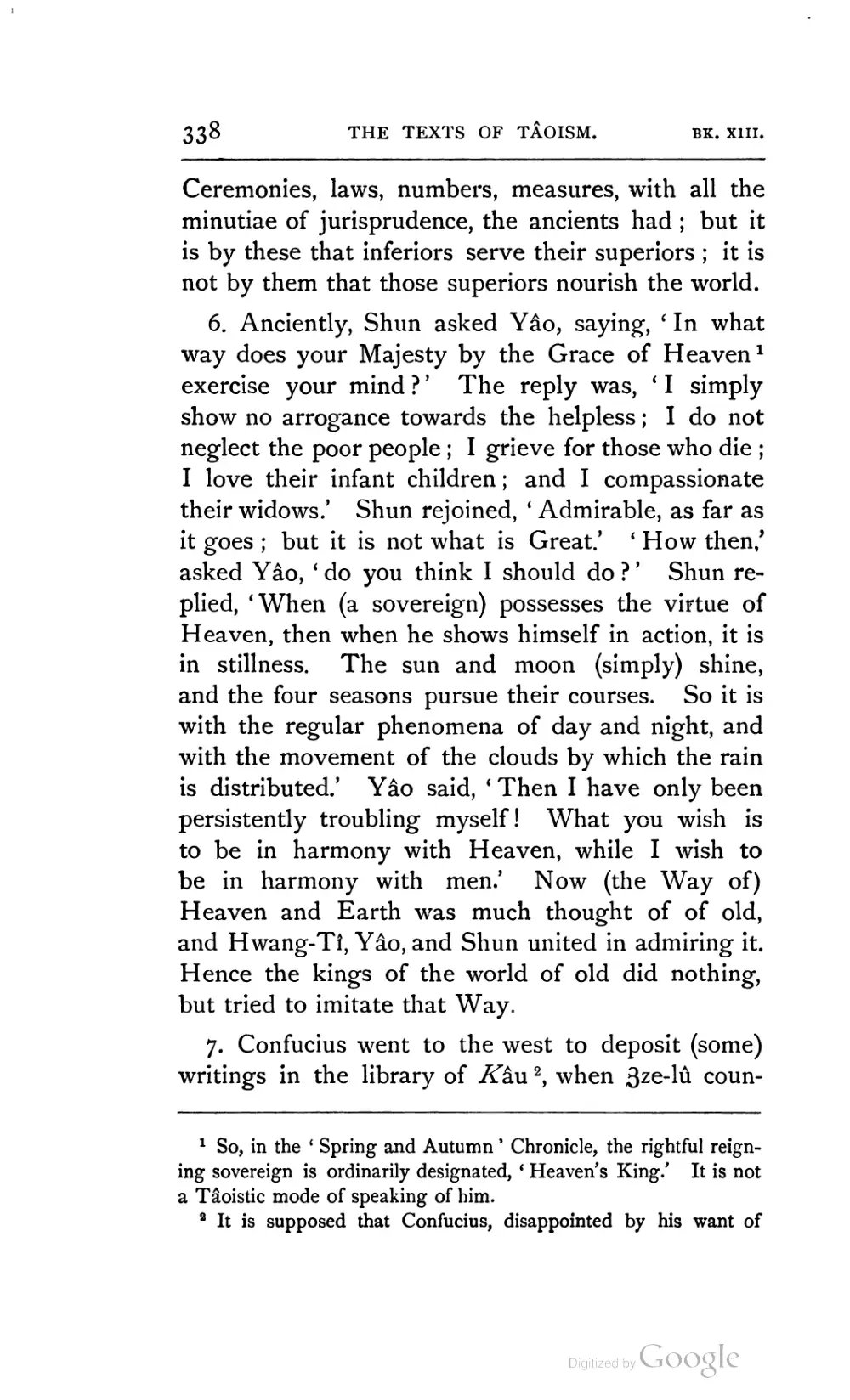
Ceremonies, laws, numbers, and measures, with all the minutiae of jurisprudence, the ancients had; but it is by these that inferiors serve their superiors; it is not by them that those superiors nourish the world,
1 We cannot tell what book or books.