Ȝze-kâo makes Yâo's reign the age when people did right ‘without his offering them rewards’, and puts the fall at Yü, who uses ‘both rewards and punishments’. That contradicts Book XI, where Hwang-Ti, then Yâo and Shun, first disturbed men's minds (p. 295). The books do not agree on when the decline began; each moves the golden age just far enough back to blame the next ruler. Legge doubts the paragraph is genuine.
The Tâo Teh King — Sacred Books of China Part I, SBE Vol. 39 (trans. James Legge, 1891)
Open to all
page 315
No image is selected for this page; its own page image is shown.
page 315
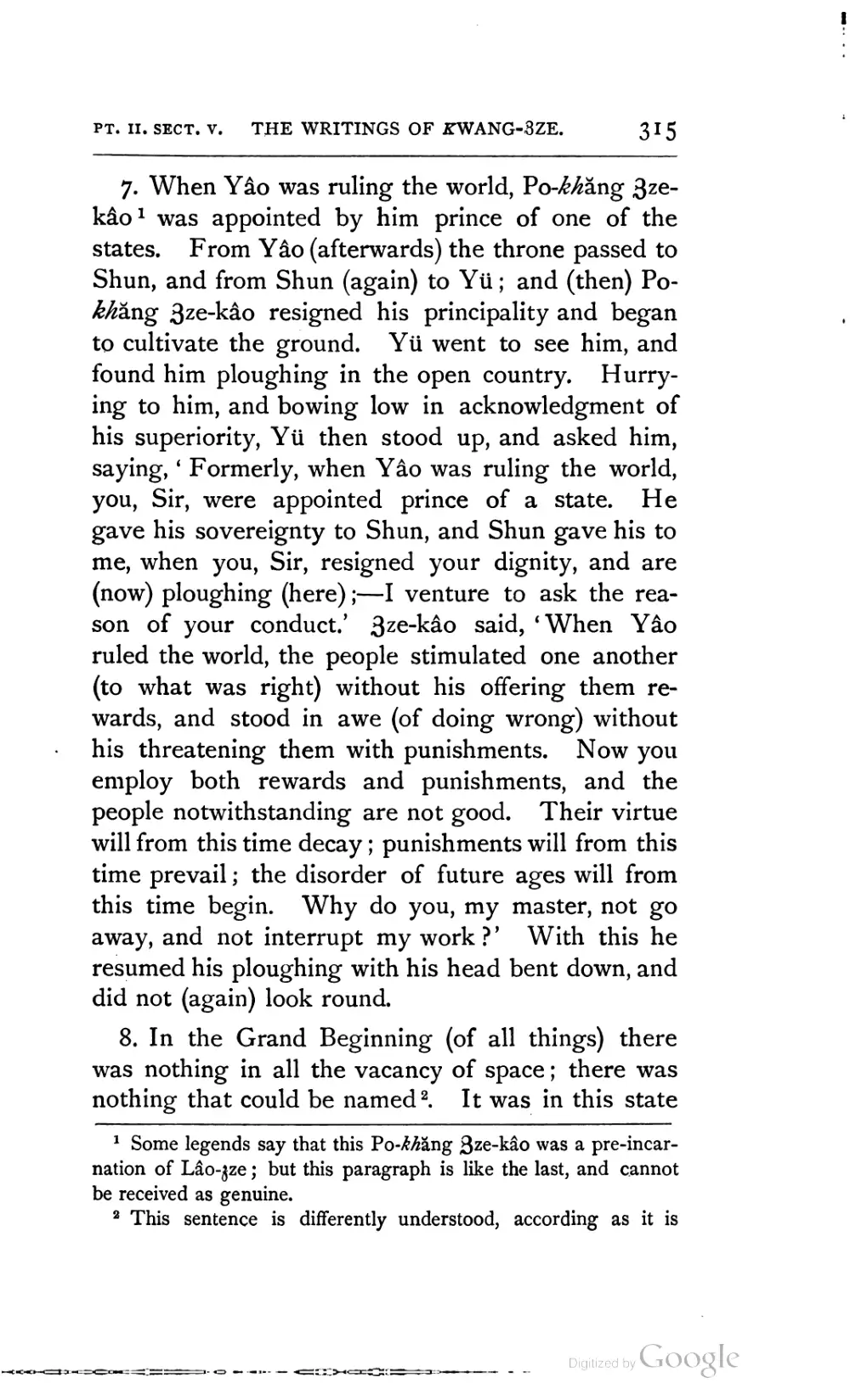
315 7. When Yâo was ruling the world, Po-khang Ȝze-kâo was appointed by him prince of one of the states. From Yâo the throne (afterwards) passed to Shun, and from Shun (again) to Yii; and (then) Po-khang Ȝze-kâo resigned his principality and began to till the ground. Yii went to see him and found him ploughing in the open country. Hurrying to him, and bowing low in acknowledgment of his superiority, Yii then stood up and asked him, ‘Formerly, when Yâo was ruling the world, you, Sir, were appointed prince of a state. He gave his sovereignty to Shun, and Shun gave his to me, and then you, Sir, resigned your dignity, and are (now) ploughing (here);—I venture to ask the reason for your conduct.’
Ȝze-kâo said, ‘When Yâo ruled the world, the people urged one another on (to what was right) without his offering them rewards, and stood in awe (of doing wrong) without his threatening them with punishments. Now you employ both rewards and punishments, and still the people are not good. From this time their virtue will decay; from this time punishments will prevail; from this time the disorder of future ages will begin. Why do you, my master, not go away, and not interrupt my work?’ With that he went back to his ploughing with his head bent down, and did not look round (again).
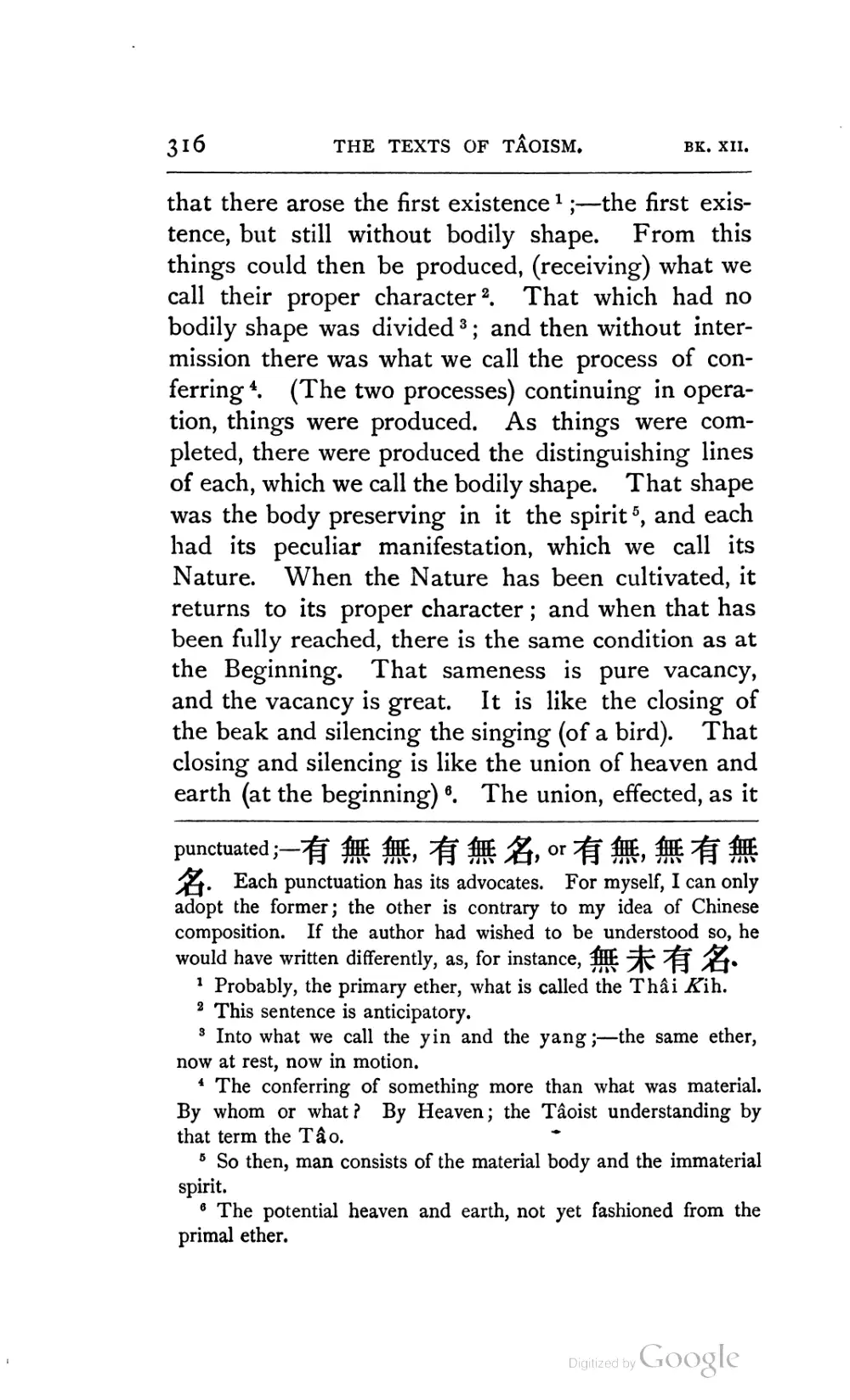
8. In the Grand Beginning (of all things) there was nothing in all the vacancy of space; there was nothing that could be named2. It was in this state that there arose the first existence1;—the first existence, but still without bodily shape. From this things could then be produced, (receiving) what we call their proper character2. That which had no bodily shape was divided3; and then without intermission there was what we call the process of conferring4. (The two processes) continuing in operation, things were produced. As things were completed, there were produced the distinguishing lines of each, which we call the bodily shape. That shape was the body preserving the spirit within it5, and each had its own manifestation, which we call its Nature.
When the Nature has been cultivated, it returns to its proper character; and when that has been fully reached, there is the same condition as at the Beginning. That sameness is pure vacancy, and the vacancy is great. It is like the closing of the beak and the silencing of the singing (of a bird). That closing and silencing is like the union of heaven and earth (at the beginning)6. The union, effected, as it
1 Some legends say that this Po-khăng Ȝze-kâo was a pre-incarnation of Lâo-ȝze; but this paragraph is like the last, and cannot be accepted as genuine.
2 This sentence is understood differently according to how it is punctuated;—有無無 [Press: there was the non-being of non-being], 有無名 [Press: there was the nameless (non-being)], or 有無 [Press: there was non-being], 無有無 [Press: there was no being, no (name)] 名 [Press: name]. Each punctuation has its advocates. For myself, I can only adopt the former; the other is contrary to my idea of Chinese composition. If the author had wished to be understood so, he would have written differently, for instance, 無未有名 [Press: nothing; not yet having a name].
This punctuation note decides a philosophical question: whether the Grand Beginning held simply nothing, or a non-being that had no name. Legge takes the first because the other ‘is contrary to my idea of Chinese composition’, and he shows how an author meaning it would have written. It is an argument from style, honestly declared, and he grants that ‘Each punctuation has its advocates’. The cosmogony a reader takes away depends on it.