Legge uses this question to argue that the character Tâo ‘retained its proper meaning of the Way or Course’ even for Kwang-ȝze. The page supports him: a Tâo that splits into ‘the Way of Heaven’ and ‘the Way of Man’, one playing ‘the Lord’ and the other ‘the Servant’, is a course of conduct, not a single substance. It is worth holding on to when pages like p. 298 push the word toward darkness and silence.
The Tâo Teh King — Sacred Books of China Part I, SBE Vol. 39 (trans. James Legge, 1891)
Open to all
page 306
No image is selected for this page; its own page image is shown.
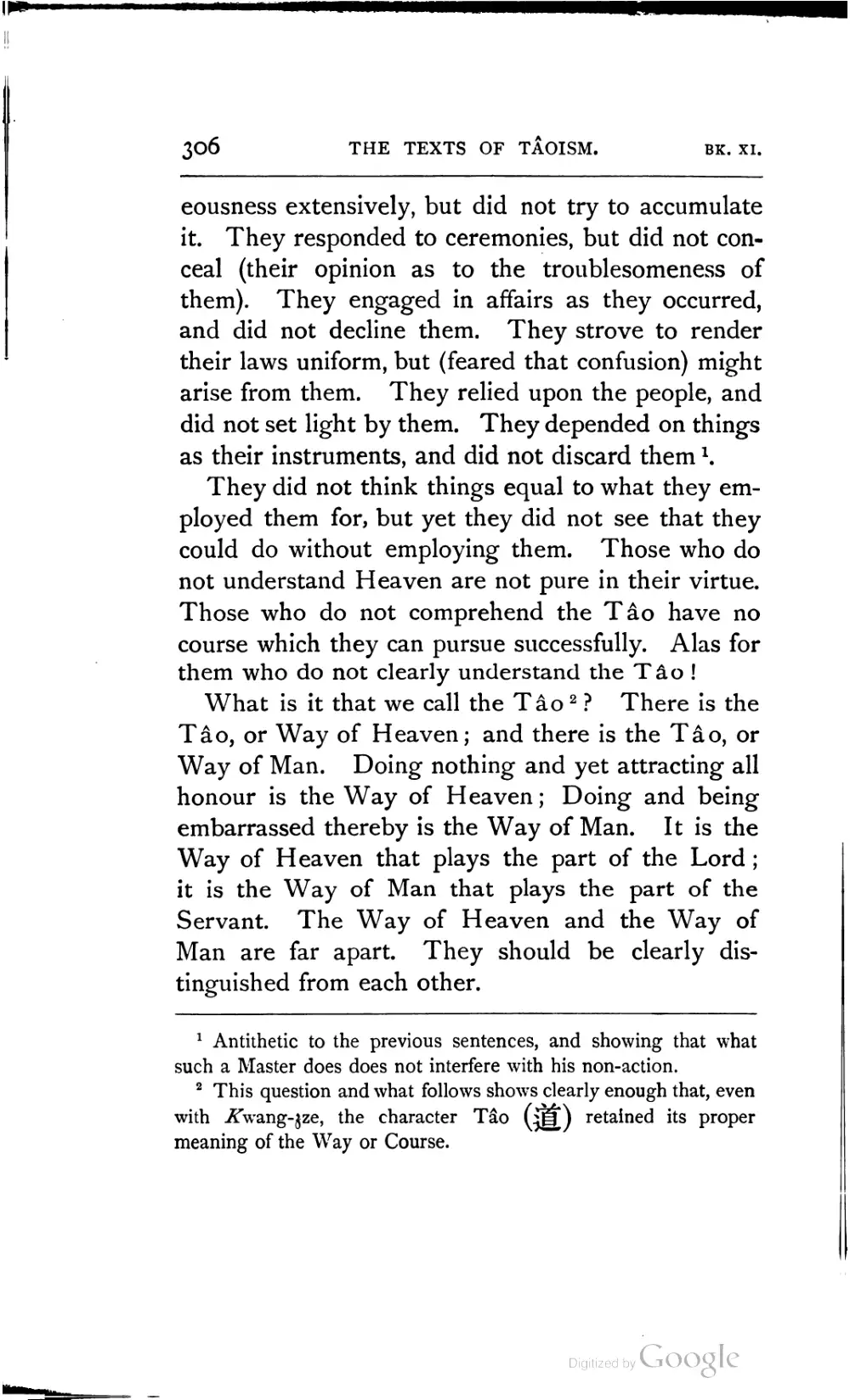
page 306
They did not think things equal to the purposes they employed them for, but yet they did not see that they could do without employing them. Those who do not understand Heaven are not pure in their virtue. Those who do not comprehend the Tao have no course which they can pursue successfully. Alas for those who do not clearly understand the Tao!
What is it that we call the Tao2? There is the Tao, or Way of Heaven; and there is the Tâo, or Way of Man. Doing nothing and yet attracting all honour is the Way of Heaven; Doing and being embarrassed by it is the Way of Man. It is the Way of Heaven that plays the part of the Lord; it is the Way of Man that plays the part of the Servant. The Way of Heaven and the Way of Man are far apart. They should be clearly distinguished from each other.
1 Antithetic to the previous sentences, and showing that what such a Master does does not interfere with his non-action.
2 This question and what follows show clearly enough that, even with Kwang-ȝze, the character Tâo (道) kept its proper meaning of the Way or Course,