The neighbouring states within sight and hearing whose people ‘would have no communication together’ come from the Tâo Teh King’s eightieth chapter, as Legge notes. There the picture is of what a small state might be; here it is set in the past tense of a golden age. The shift turns a counsel into a history, and that is what lets the author set it against a present of crowds hurrying after a reputed wise man.
The Tâo Teh King — Sacred Books of China Part I, SBE Vol. 39 (trans. James Legge, 1891)
Open to all
page 288
No image is selected for this page; its own page image is shown.
page 288
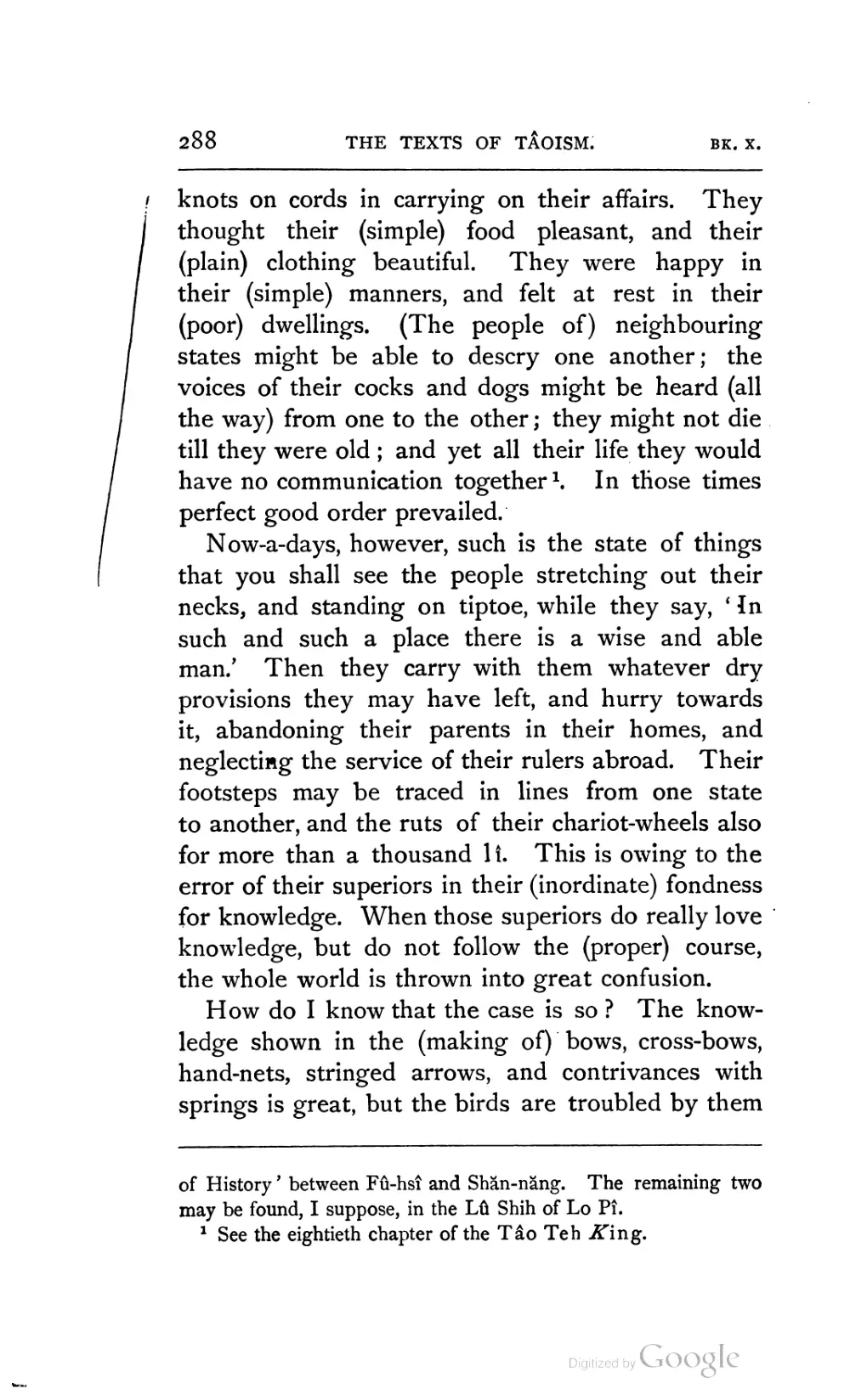
Nowadays, however, such is the state of things that you will see the people stretching out their necks and standing on tiptoe, while they say, ‘In such and such a place there is a wise and able man.’ Then they carry with them whatever dry provisions they may have left, and hurry towards it, abandoning their parents at home and neglecting the service of their rulers abroad. Their footsteps may be traced in lines from one state to another, and the ruts of their chariot wheels too, for more than a thousand li. This is owing to the error of their superiors in their (inordinate) fondness for knowledge. When those superiors really do love knowledge but do not follow the (proper) course, the whole world is thrown into great confusion.
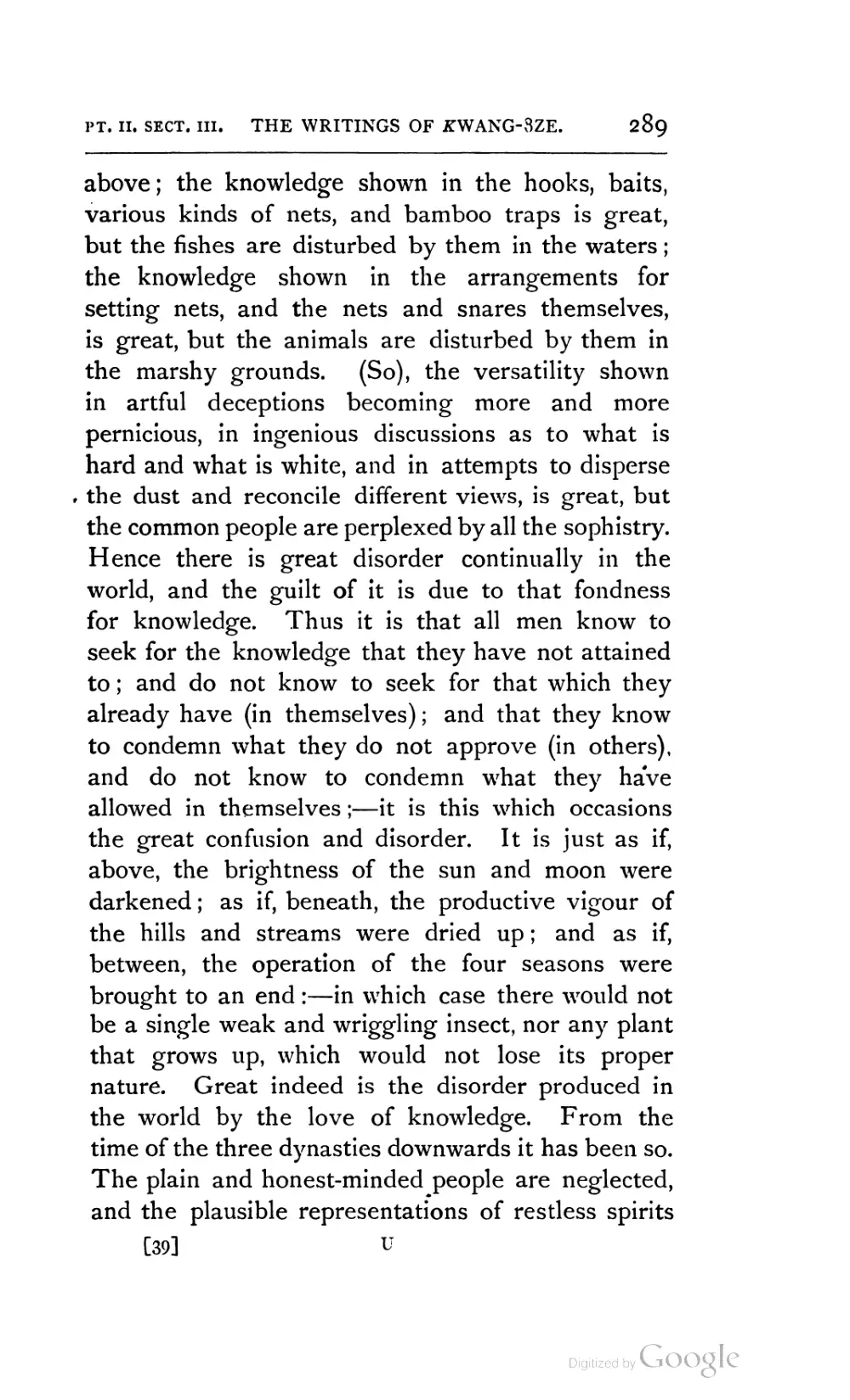
How do I know that this is so? The knowledge shown in the (making of) bows, cross-bows, hand-nets, stringed arrows and contrivances with springs is great, but the birds are troubled by them above; the knowledge shown in hooks, baits, various kinds of nets and bamboo traps is great, but the fishes are disturbed by them in the waters; the knowledge shown in the arrangements for setting nets, and in the nets and snares themselves, is great, but the animals are disturbed by them in the marshy grounds. (So) the versatility shown in artful deceptions growing ever more pernicious, in clever disputes about what is hard and what is white, and in attempts to scatter the dust and reconcile different views, is great, but the common people are bewildered by all the sophistry. Hence there is constantly great disorder in the world, and the guilt of it lies with that fondness for knowledge.
So it is that all men know to seek the knowledge they have not attained, and do not know to seek what they already have (in themselves); and that they know to condemn what they do not approve (in others), and do not know to condemn what they have allowed in themselves;—it is this that causes the great confusion and disorder. It is just as if, above, the brightness of the sun and moon were darkened; as if, below, the productive vigour of the hills and streams were dried up; and as if, between, the working of the four seasons were brought to an end:—in which case there would not be a single feeble, wriggling insect, nor any growing plant, that would not lose its proper nature. Great indeed is the disorder brought into the world by the love of knowledge. From the time of the three dynasties downwards it has been so. The plain and honest-minded people are neglected, and the plausible representations of restless spirits
1 See the eightieth chapter of the Tao Teh King.
The harm done by the love of knowledge is measured in Confucian terms: people hurry after a reputed wise man, ‘abandoning their parents in their homes, and neglecting the service of their rulers abroad.’ The author argues on his opponents’ ground, using filial duty and loyalty as evidence against the knowledge they prize.