Legge’s English makes Shun and Thâi opposites: Shun ‘had not begun to proceed by what did not belong to him as a man,’ Thâi ‘had not begun to proceed by what belonged to him as a man.’ The Chinese, as usually printed, has the same ‘not-man’ (非人) in both sentences and contrasts only ‘come out of’ with ‘enter into.’ The two kings differ in the direction of their relation to what is not man, a contrast the English replaces by dropping a negative from the second sentence.
The Tâo Teh King — Sacred Books of China Part I, SBE Vol. 39 (trans. James Legge, 1891)
Open to all
page 259
No image is selected for this page; its own page image is shown.
page 259
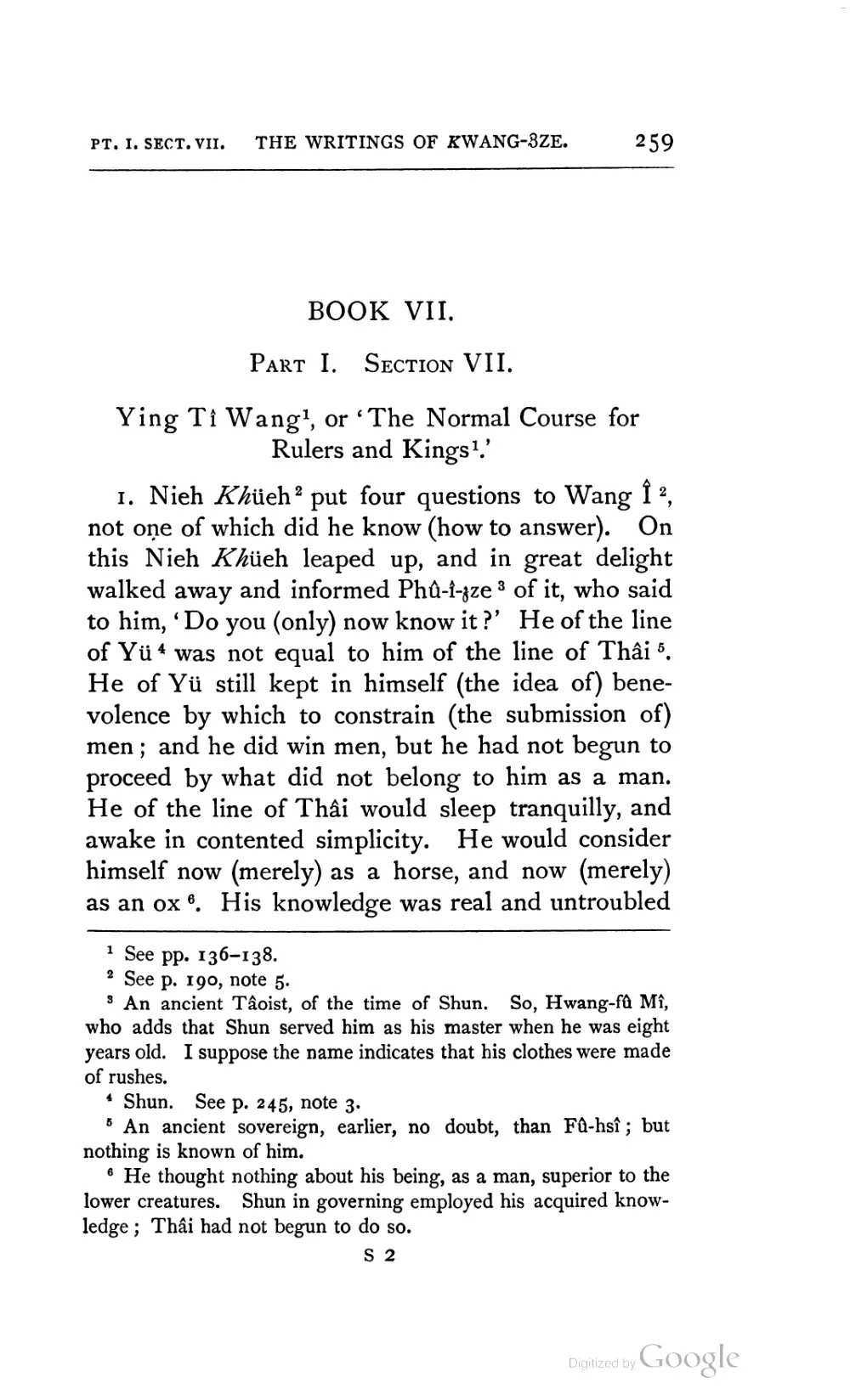
p. 259BOOK VII.
Part I. Section VII.
Ying Ti Wang, or ‘The Normal Course for Rulers and Kings1.’
1. Nieh Khüeh1 put four questions to Wang Î2, not one of which he knew (how to answer). At this Nieh Khüeh leapt up, and in great delight walked away and told Phû-î-ȝze3 of it, who said to him, ‘Do you (only) now know it? He of the line of Yü4 was not equal to him of the line of Thai5. He of Yü still kept in himself (the idea of) benevolence by which to constrain (the submission of) men; and he did win men, but he had not begun to proceed by what did not belong to him as a man. He of the line of Thai would sleep tranquilly, and awake in contented simplicity. He would consider himself now (merely) as a horse, and now (merely) as an ox6. His knowledge was real and untroubled by doubts; and his virtue was very true:—he had not begun to proceed by what belonged to him as a man.
1 See pp. 136-138.
? See p. 190, note 5.
3 An ancient Tâoist of the time of Shun. So says Hwang-fû Mi, who adds that Shun served him as his master when he was eight years old. I suppose the name indicates that his clothes were made of rushes.
4 Shun; see p. 245, note 3.
5 An ancient sovereign, no doubt earlier than Fû-hsi; but nothing is known of him.
6 He thought nothing of his being, as a man, superior to the lower creatures. Shun in governing used his acquired knowledge; Thai had not begun to do so.