Legge credits Mr. Balfour with an apt comparison to the Gospel for the saying that ‘the small man of Heaven is the superior man among men,’ and the reversal of high and low does recall sayings of Christ. The reference as printed, ‘Matthew vii. 28,’ falls where the crowds are astonished at the close of the Sermon on the Mount, not at a saying about the least and the greatest, so it should be checked. The note’s firmer point is its last: the author has Confucius rank the Taoist above himself.
The Tâo Teh King — Sacred Books of China Part I, SBE Vol. 39 (trans. James Legge, 1891)
Open to all
page 253
No image is selected for this page; its own page image is shown.
page 253
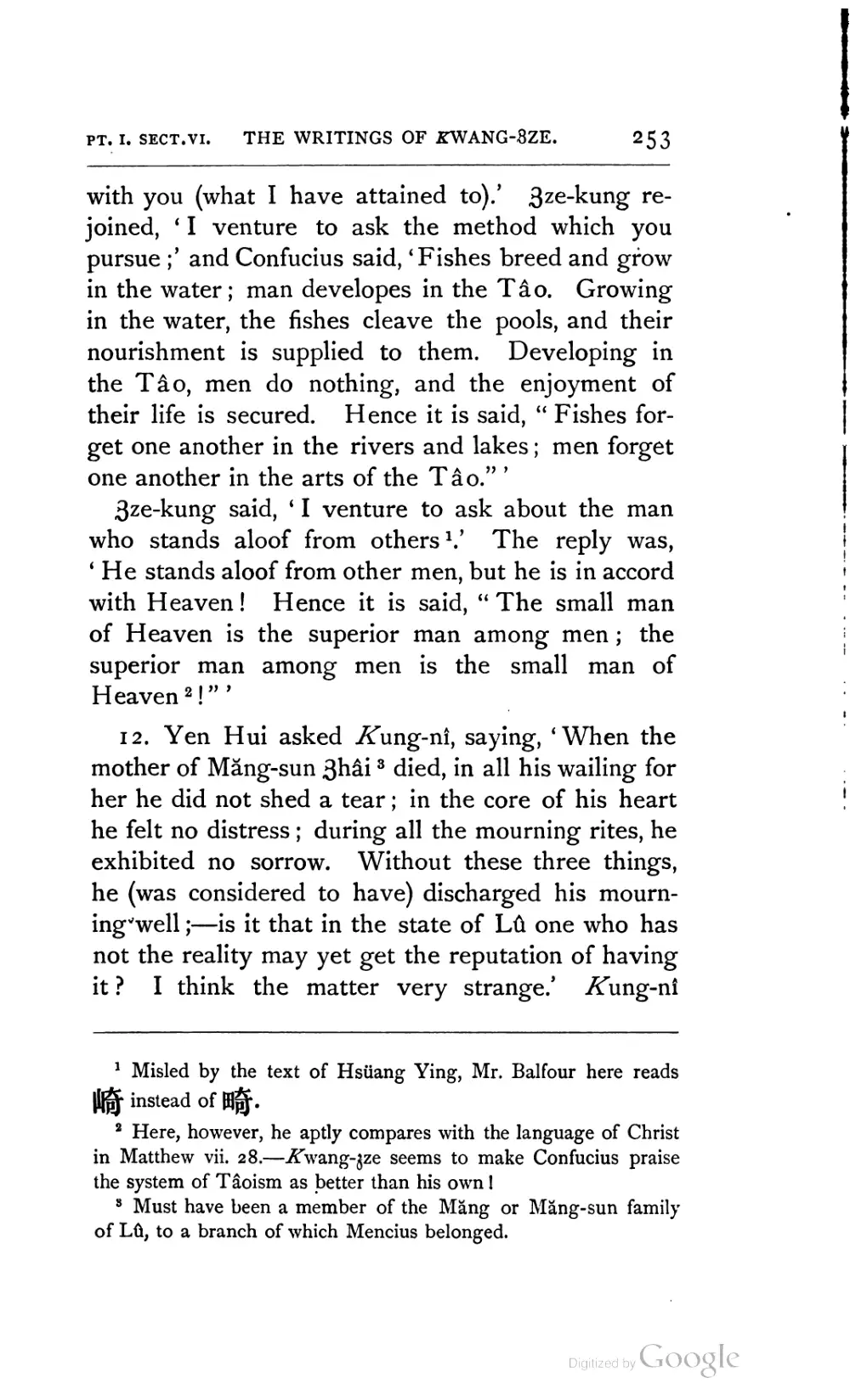
Ȝze-kung said, ‘I venture to ask about the man who stands aloof from others1.’ The reply was, ‘He stands aloof from other men, but he is in accord with Heaven! Hence it is said, “The small man of Heaven is the superior man among men; the superior man among men is the small man of Heaven2!”’
12. Yen Hui asked Kung-nî, saying, ‘When the mother of Mang-sun Ȝhâi3 died, in all his wailing for her he did not shed a tear; in the core of his heart he felt no distress; during all the mourning rites he showed no sorrow. Without these three things, he (was considered to have) discharged his mourning well;—is it that in the state of Lû one who has not the reality may yet get the reputation of having it? I think the matter very strange.’
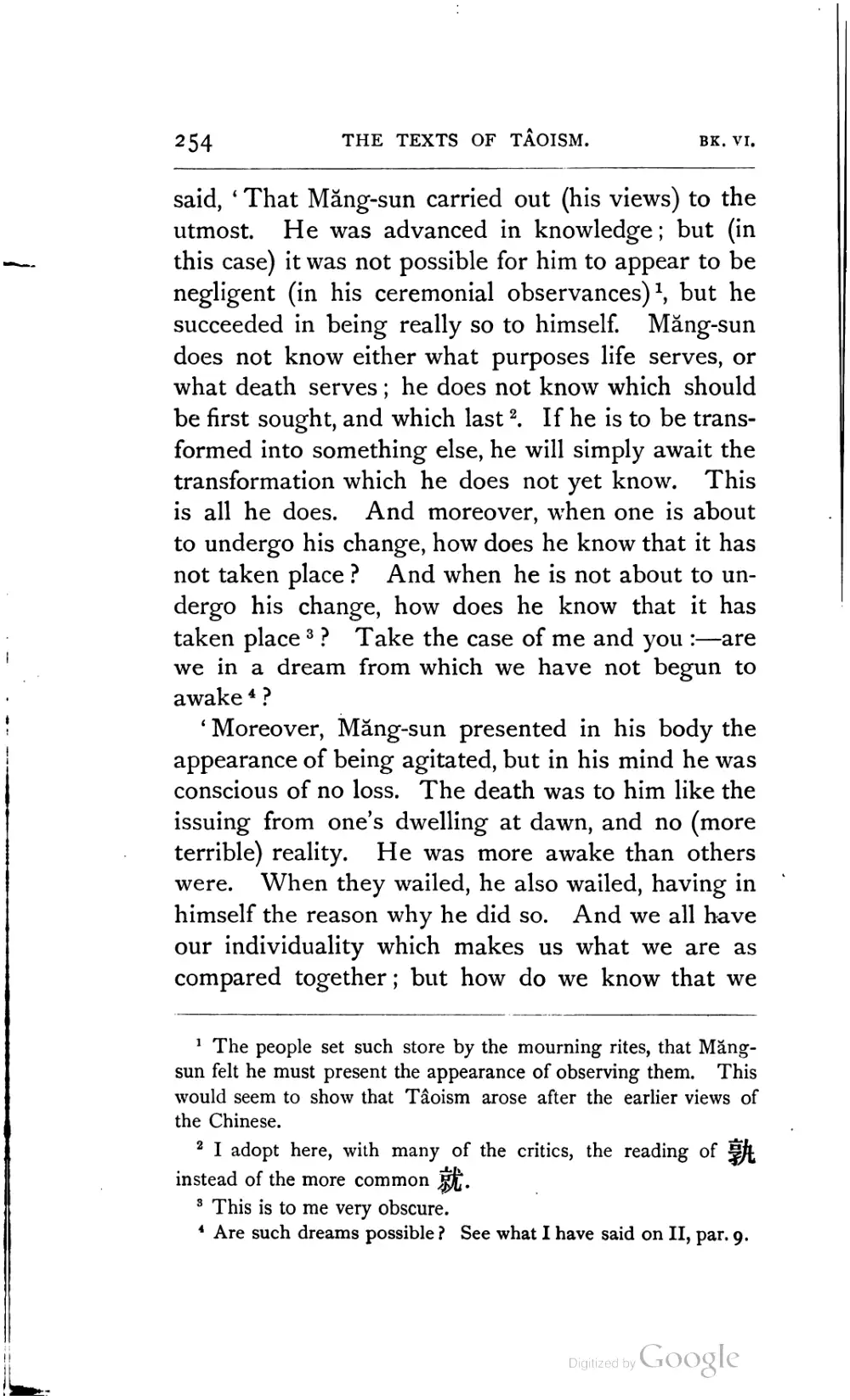
Kung-nî said, ‘That Mang-sun carried out (his views) to the utmost. He was advanced in knowledge; but (in this case) it was not possible for him to appear to be negligent (in his ceremonial observances)1, but he succeeded in being really so to himself. Mang-sun does not know either what purpose life serves, or what death serves; he does not know which should be sought first, and which last2. If he is to be transformed into something else, he will simply await the transformation which he does not yet know. This is all he does.
‘And moreover, when one is about to undergo his change, how does he know that it has not taken place? And when he is not about to undergo his change, how does he know that it has taken place3? Take the case of me and you:—are we in a dream from which we have not begun to awake4?
1 Misled by the text of Hsüan Ying, Mr. Balfour reads 崎 [Press: rugged, uneven] here instead of 畸 [Press: odd, irregular].
2 Here, however, he aptly compares with the language of Christ in Matthew vii. 28.—Kwang-ȝze seems to make Confucius praise the system of Taoism as better than his own.
8 Must have been a member of the Mang or Mang-sun family of Lû, to a branch of which Mencius belonged.