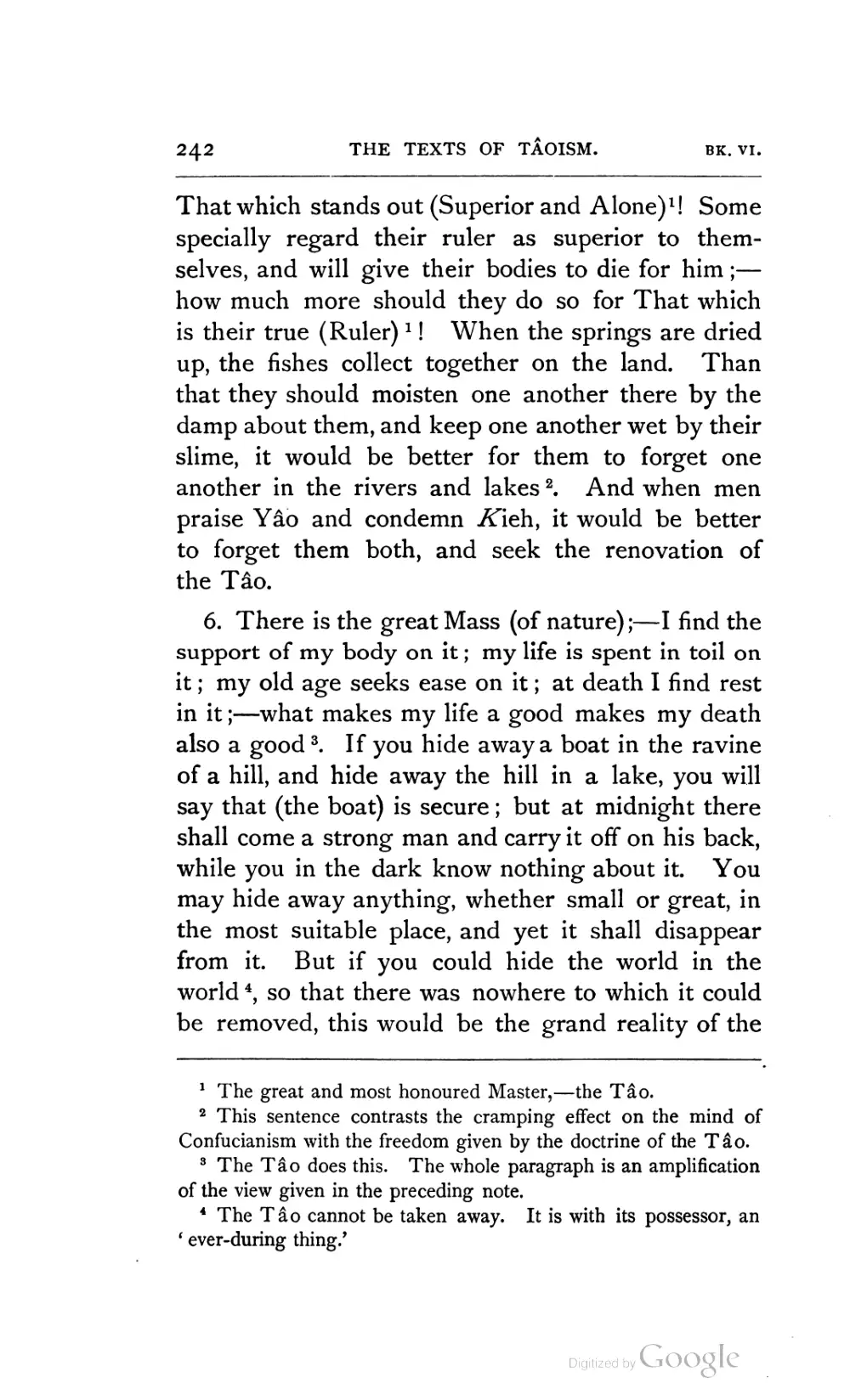
Fish stranded as the springs dry keep each other alive with their slime; better, the text says, "to forget one another in the rivers and lakes." Mutual kindness is real but belongs to a failing situation. The application follows at once: rather than praise Yâo and condemn Kieh, "forget them both." Moral comparison, like the fishes' care, is what one needs only once the Tâo has been lost.
The Tâo Teh King — Sacred Books of China Part I, SBE Vol. 39 (trans. James Legge, 1891)
Open to all
page 241
No image is selected for this page; its own page image is shown.
page 241
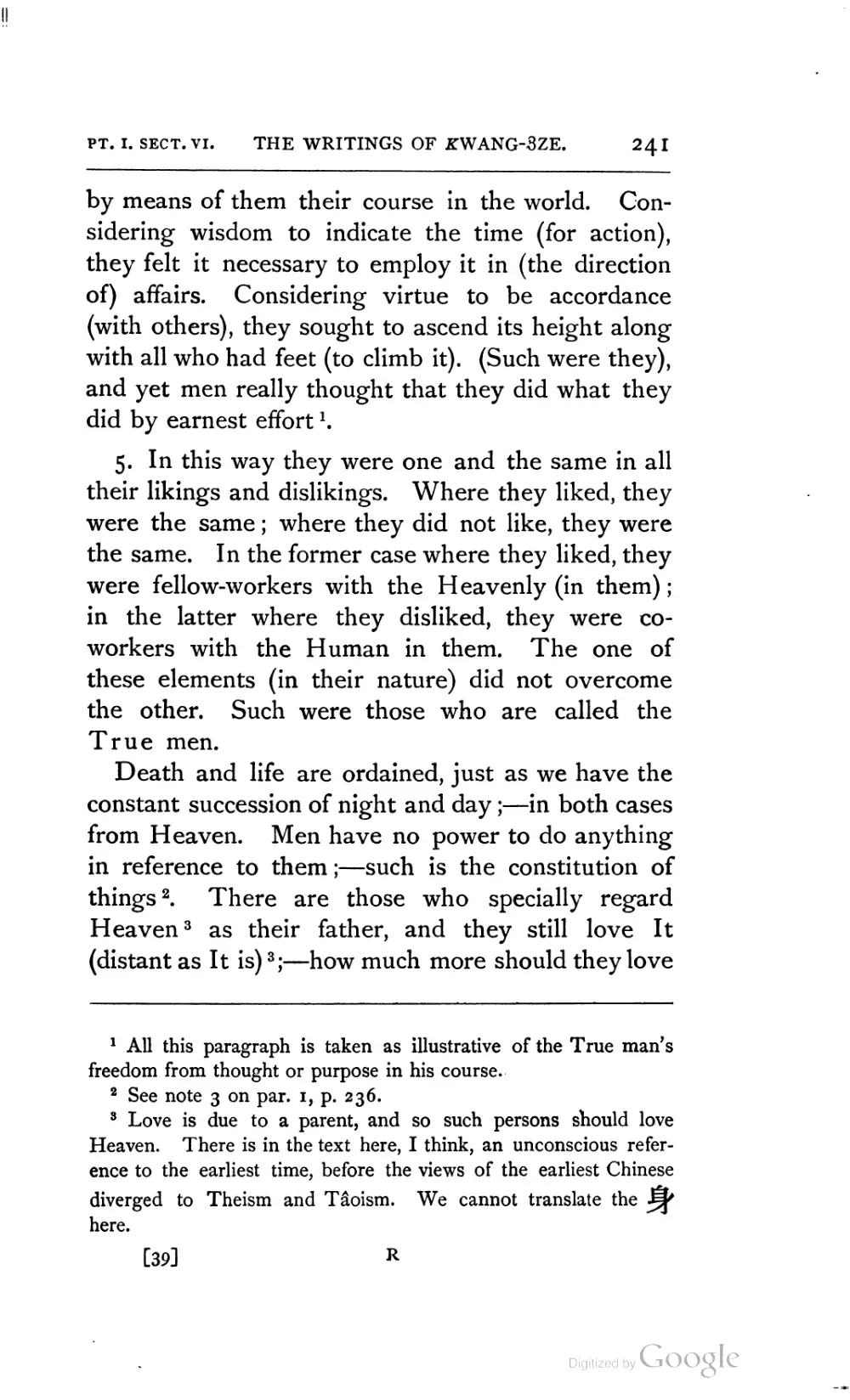
5. In this way they were one and the same in all their likings and dislikings. Where they liked, they were the same; where they did not like, they were the same. In the former case, where they liked, they were fellow-workers with the Heavenly (in them); in the latter, where they disliked, they were co-workers with the Human in them. Neither of these elements (in their nature) overcame the other. Such were those who are called the True men.
Death and life are ordained, just as we have the constant succession of night and day;—in both cases from Heaven. Men have no power to do anything about them;—such is the constitution of things2. There are those who especially regard Heaven as their father, and they still love It (distant as It is)3;—how much more should they love That which stands out (Superior and Alone)1! Some especially regard their ruler as superior to themselves, and will give their bodies to die for him;—how much more should they do so for That which is their true (Ruler)!
When the springs dry up, the fish gather together on the land. Rather than moisten one another there with the damp about them and keep one another wet with their slime, it would be better for them to forget one another in the rivers and lakes2. And when men praise Yao and condemn Kieh, it would be better to forget them both, and seek the renovation of the Tao.
1 This whole paragraph is taken as illustrating the True man’s freedom from thought or purpose in his course.
2 See note 3 to par. 1, p. 236.
3 Love is due to a parent, and so such persons should love Heaven. There is, I think, an unconscious reference in the text here to the earliest time, before the views of the earliest Chinese diverged into Theism and Tâoism. We cannot translate the 身 [Press: the body; the person, oneself] here.
Legge finds here an "unconscious reference" to a time before early Chinese thought "diverged to Theism and Tâoism." This is his own thesis about an original theism, brought to the passage, not drawn from it. The text compares loving Heaven as a father with loving That which stands alone; nothing on the page speaks of an earlier unity of belief.