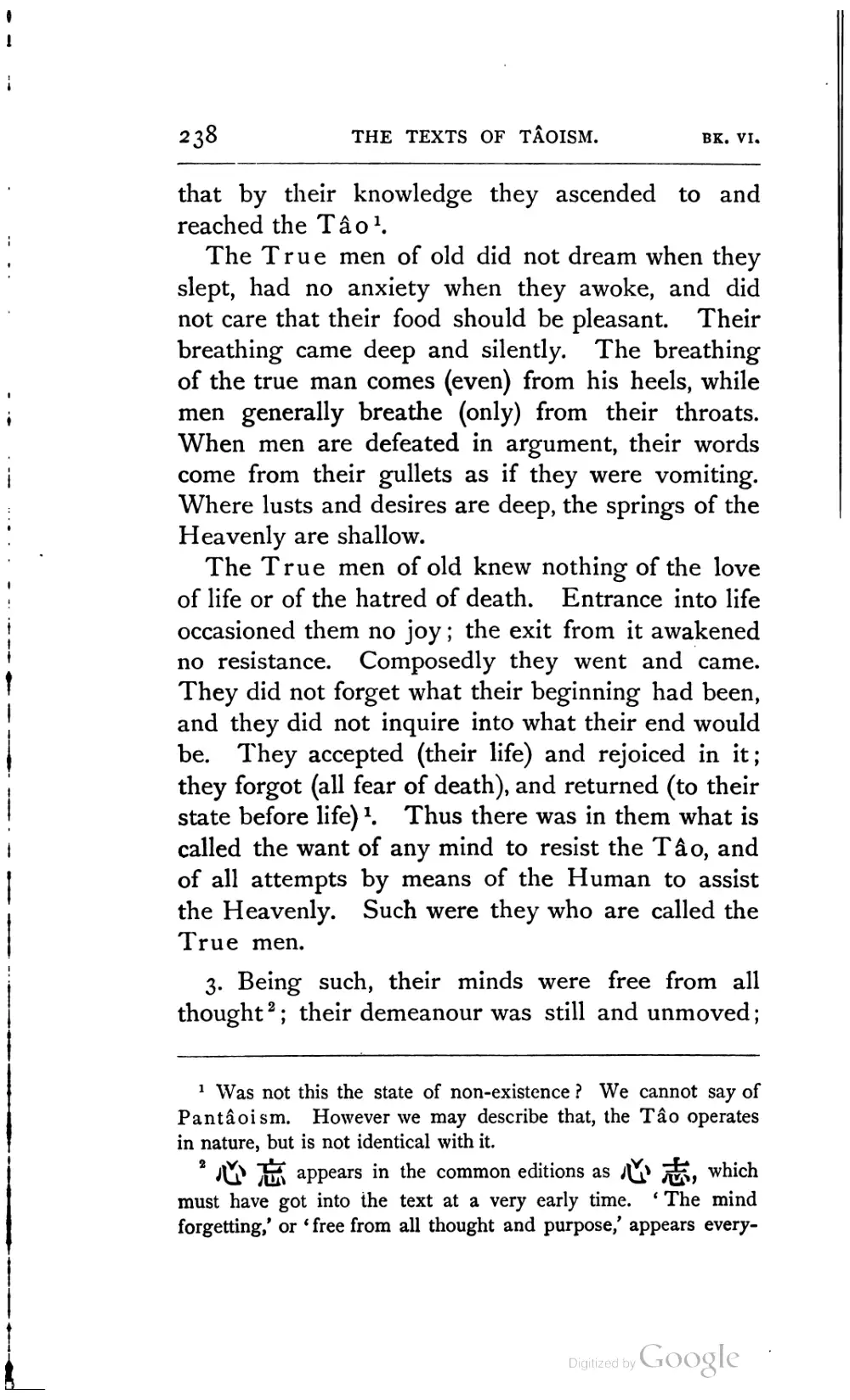
The True man is identified by bodily signs, not doctrine: he does not dream, his breath "comes (even) from his heels," while others breathe from their throats. The next sentence shows the target. Men "defeated in argument" speak "from their gullets as if they were vomiting." Shallow breath belongs to the disputer, and the passage sets the depth of the breath against the shallowness of argument.
The Tâo Teh King — Sacred Books of China Part I, SBE Vol. 39 (trans. James Legge, 1891)
Open to all
page 238
No image is selected for this page; its own page image is shown.
page 238
The True men of old did not dream when they slept, had no anxiety when they woke, and did not care whether their food was pleasant. Their breathing came deep and silent. The breathing of the true man comes (even) from his heels, while men generally breathe (only) from their throats. When men are defeated in argument, their words come from their gullets as if they were vomiting. Where lusts and desires are deep, the springs of the Heavenly are shallow.
The True men of old knew nothing of the love of life or of the hatred of death. Entering into life gave them no joy; the exit from it roused no resistance. Composedly they went and came. They did not forget what their beginning had been, and they did not inquire what their end would be. They accepted (their life) and rejoiced in it; they forgot (all fear of death), and returned (to their state before life)*. Thus there was in them what is called the absence of any mind to resist the Tao, and of every attempt by means of the Human to assist the Heavenly. Such were those who are called the True men.
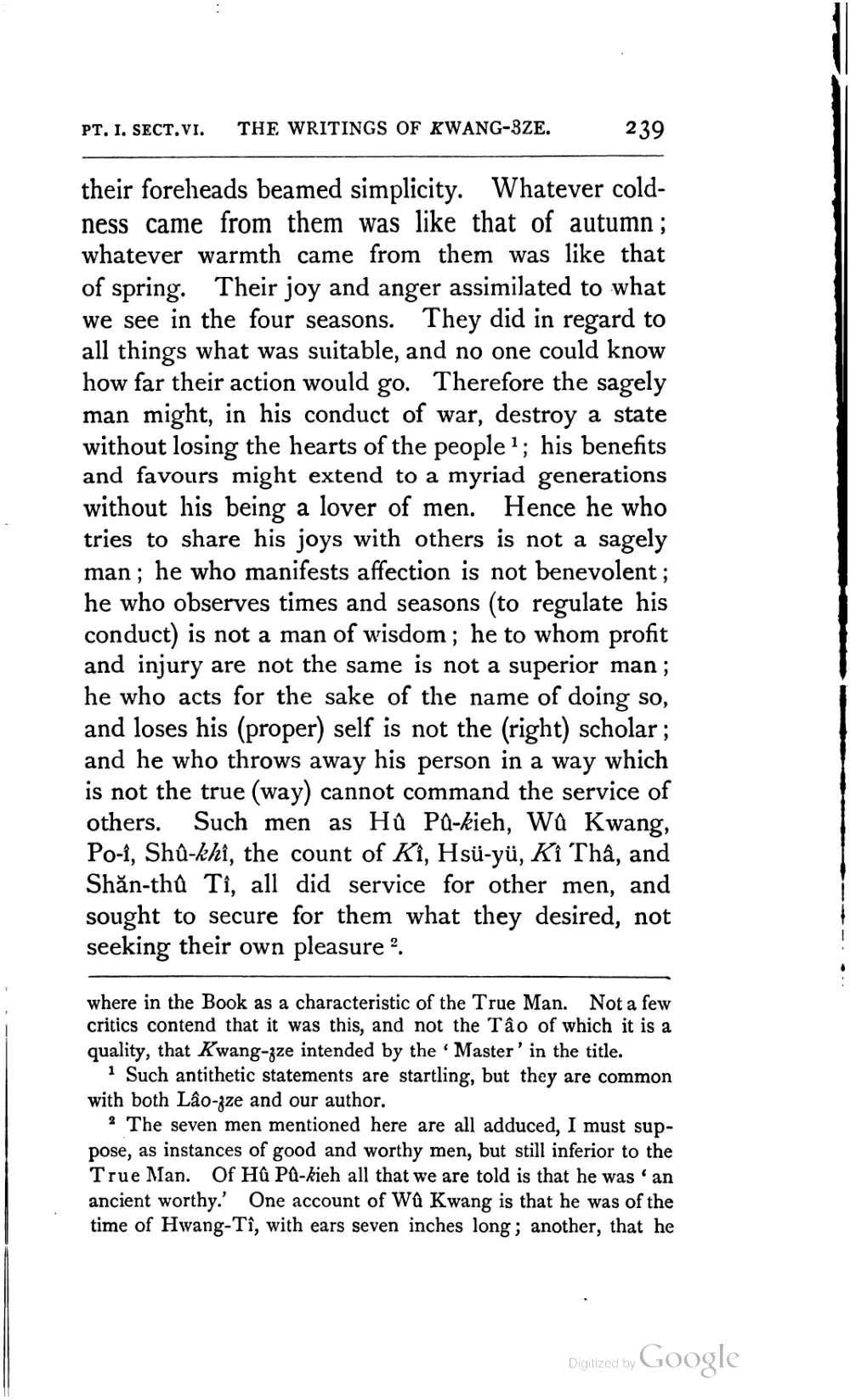
3. Being such, their minds were free from all thought²; their demeanour was still and unmoved; their foreheads beamed simplicity. Whatever coldness came from them was like that of autumn; whatever warmth came from them was like that of spring. Their joy and anger corresponded to what we see in the four seasons. They did what was suitable in regard to all things, and no one could know how far their action would go. Therefore the sagely man might, in his conduct of war, destroy a state without losing the hearts of its people¹; his benefits and favours might extend to a myriad generations without his being a lover of men.
Hence he who tries to share his joys with others is not a sagely man; he who shows affection is not benevolent; he who watches times and seasons (to regulate his conduct) is not a man of wisdom; he to whom profit and injury are not the same is not a superior man; he who acts for the sake of the name of doing so, and loses his (proper) self, is not the (right) scholar; and he who throws away his person in a way that is not the true (way) cannot command the service of others. Such men as Hû Pû-kieh, Wû Kwang, Po-i, Shû-khî, the count of Khî, Hsü-yü, Kî Thâ, and Shan-thû Ti all did service for other men, and sought to secure for them what they desired, not seeking their own pleasure².
* Was this not the state of non-existence? We cannot speak of Pantaoism. However we may describe that, the Tao operates in nature, but is not identical with it.
2 心忘 [Press: the mind forgets] appears in the common editions as 心志 [Press: the mind’s purpose; the will], which must have got into the text at a very early time. ‘The mind forgetting,’ or ‘free from all thought and purpose,’ appears everywhere in the Book as a characteristic of the True Man. Not a few critics contend that it was this, and not the Tao of which it is a quality, that Kwang-ȝze meant by the ‘Master’ in the title.
Legge adopts 心忘, the mind forgetting, against 心志 of the common editions, and his reason is internal: forgetting "appears everywhere in the Book as a characteristic of the True Man." He adds that some critics take this forgetting, not the Tâo, as the "Master" of the Book's title. The emendation changes the line from a mind that is resolute to a mind free of purpose, and the rest of the paragraph supports him.