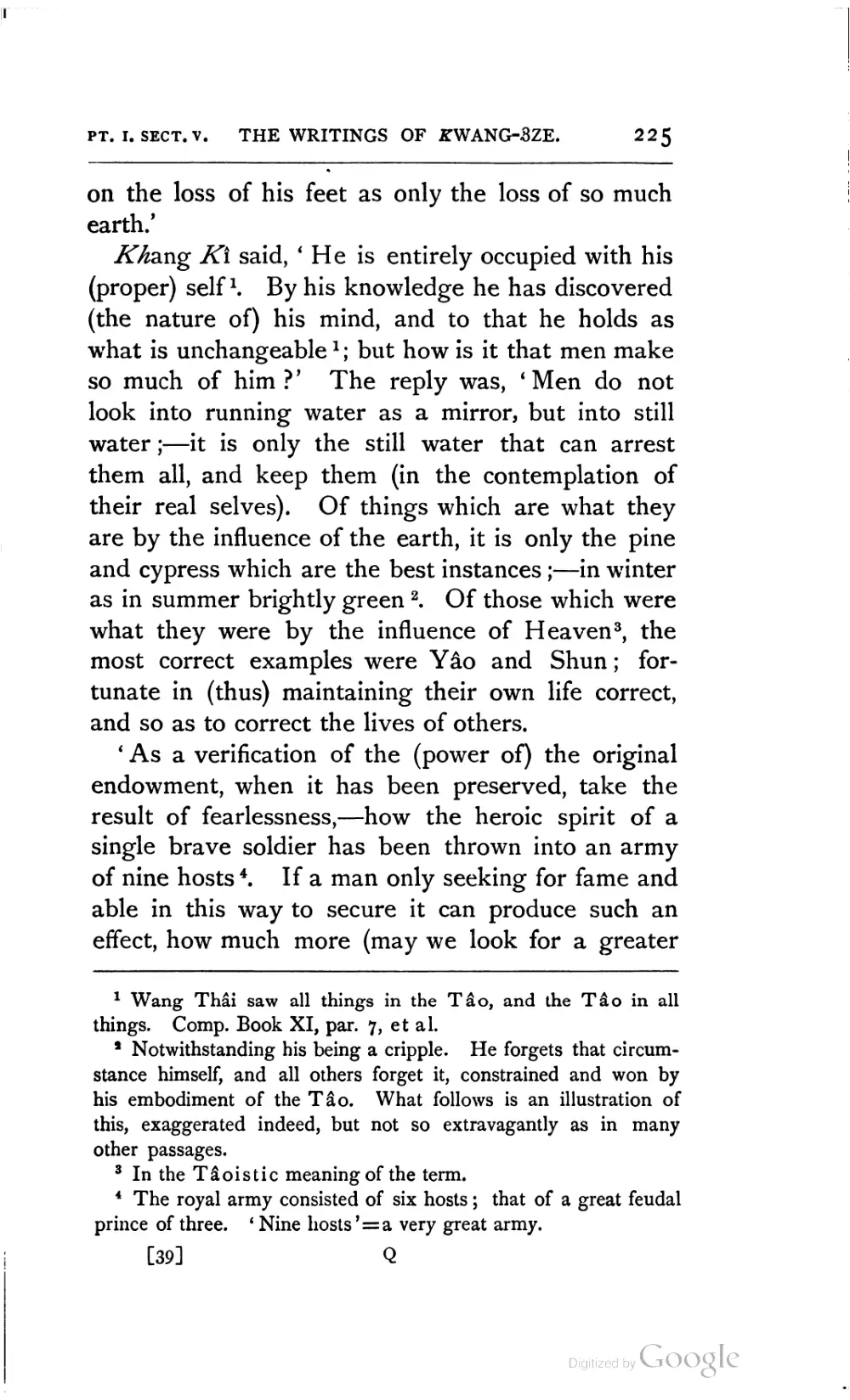
Confucius does not say things are not different; he says that looked at "as they differ," the liver and gall are as far apart as Khû and Yüeh, and looked at "as they agree," all is one. Difference and unity are both ways of looking. Wang Thai chooses the second, and so regards the loss of his feet as "only the loss of so much earth," the same move the butterfly story made with self and other.
The Tâo Teh King — Sacred Books of China Part I, SBE Vol. 39 (trans. James Legge, 1891)
Open to all
page 224
No image is selected for this page; its own page image is shown.
page 224
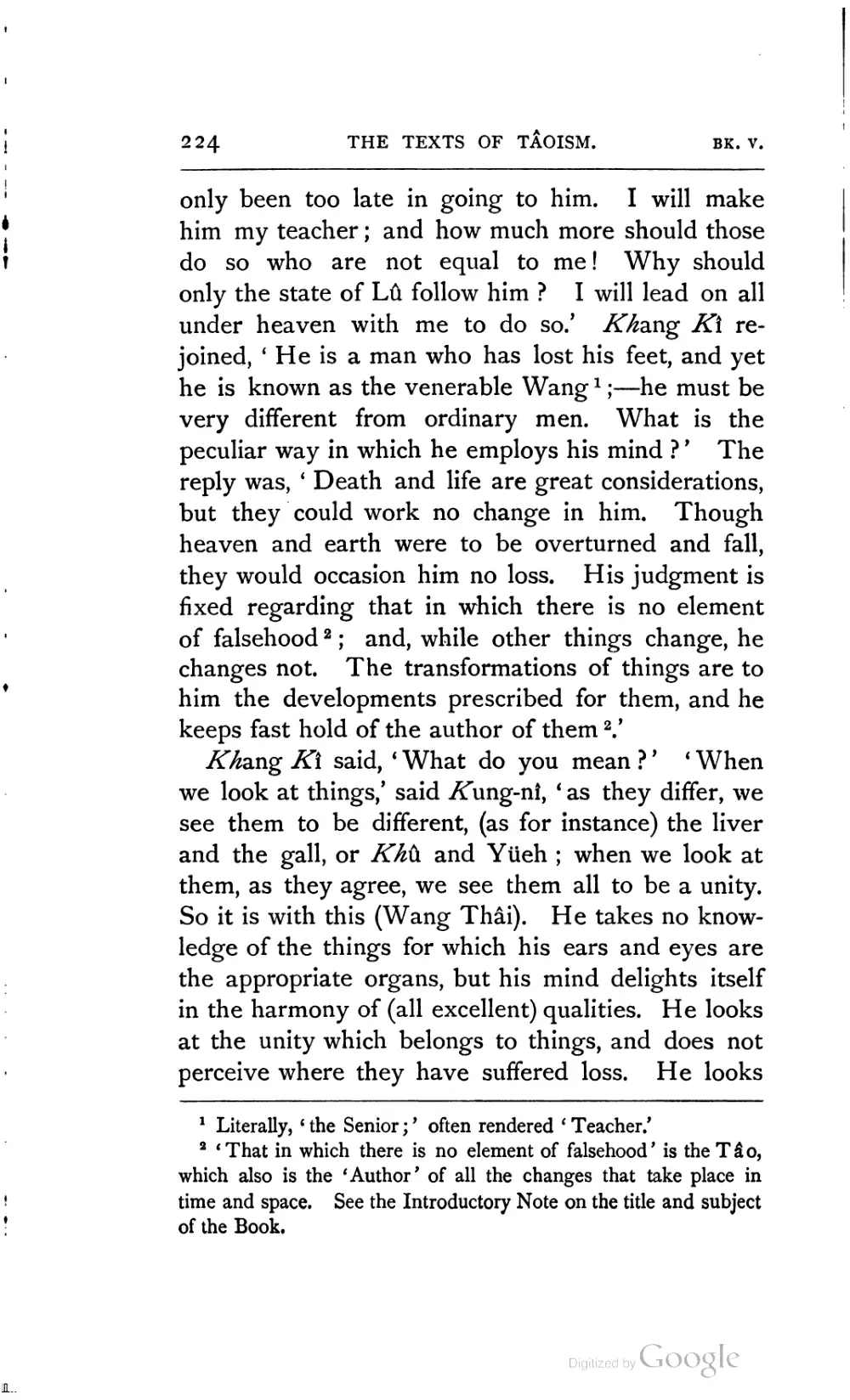
Khang Ki said, ‘What do you mean?’ ‘When we look at things,’ said Kung-nî, ‘as they differ, we see them to be different, (as for instance) the liver and the gall, or Khû and Yüeh; when we look at them as they agree, we see them all to be a unity. So it is with this (Wang Thai). He takes no notice of the things for which his ears and eyes are the appropriate organs, but his mind delights itself in the harmony of (all excellent) qualities. He looks at the unity that belongs to things, and does not perceive where they have suffered loss. He looks on the loss of his feet as only the loss of so much earth.’
1 Literally, ‘the Senior;’ often rendered ‘Teacher.’
2 ‘That in which there is no element of falsehood’ is the Tâo, which is also the ‘Author’ of all the changes that take place in time and space. See the Introductory Note on the title and subject of the Book.