“One and Speech are two; two and one are three” echoes the Tao Teh King's sequence, translated in this volume, in which the Tâo produces One, One produces Two, and Two produces Three. But where Lâo-ȝze's numbers are a cosmogony, Kwang-ȝze's are a reductio: once unity is spoken of, speech is added to it and the counting cannot stop. The same numerals here argue for silence.
The Tâo Teh King — Sacred Books of China Part I, SBE Vol. 39 (trans. James Legge, 1891)
Open to all
page 188
No image is selected for this page; its own page image is shown.
page 188
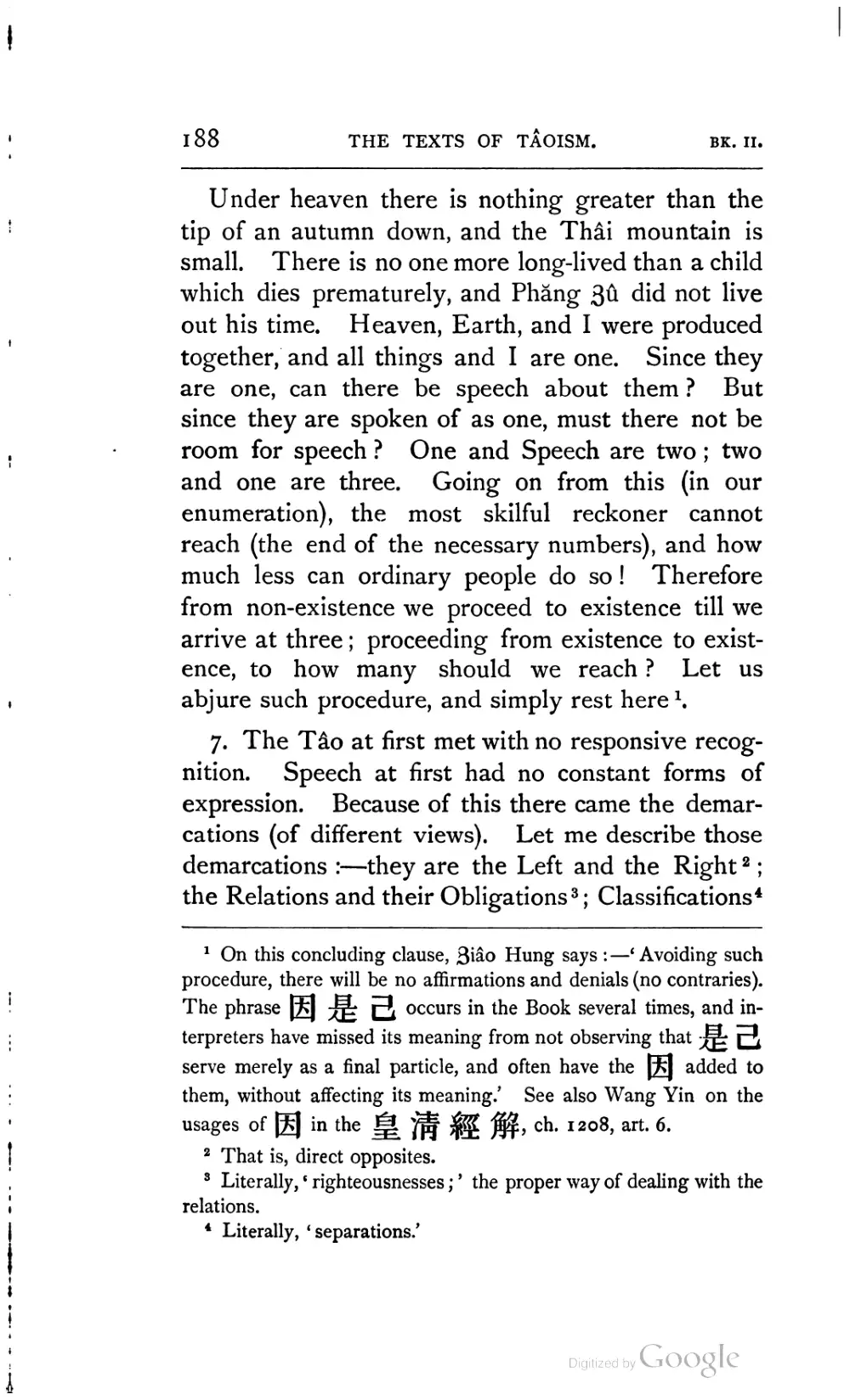
Under heaven there is nothing greater than the tip of an autumn down, and the Thai mountain is small. There is no one more long-lived than a child who dies prematurely, and Phang 34 did not live out his time. Heaven, Earth, and I were produced together, and all things and I are one. Since they are one, can there be speech about them? But since they are spoken of as one, must there not be room for speech? The One and Speech are two; two and one are three. Going on from this (in our counting), the most skilful reckoner cannot reach (the end of the necessary numbers), and how much less can ordinary people do so! Therefore from non-existence we proceed to existence till we arrive at three; proceeding from existence to existence, how many should we reach? Let us renounce such procedure, and simply rest here.
7. The Tao at first met with no responsive recognition. Speech at first had no fixed forms of expression. Because of this there came the demarcations (of different views). Let me describe those demarcations: they are the Left and the Right2; the Relations and their Obligations3; Classifications4 and their Distinctions; Emulations and Contentions. These are what are called ‘the Eight Qualities.’ Outside the limits of the world of men1, the sage occupies his thoughts, but does not discuss anything; inside those limits he occupies his thoughts, but does not pass any judgments.
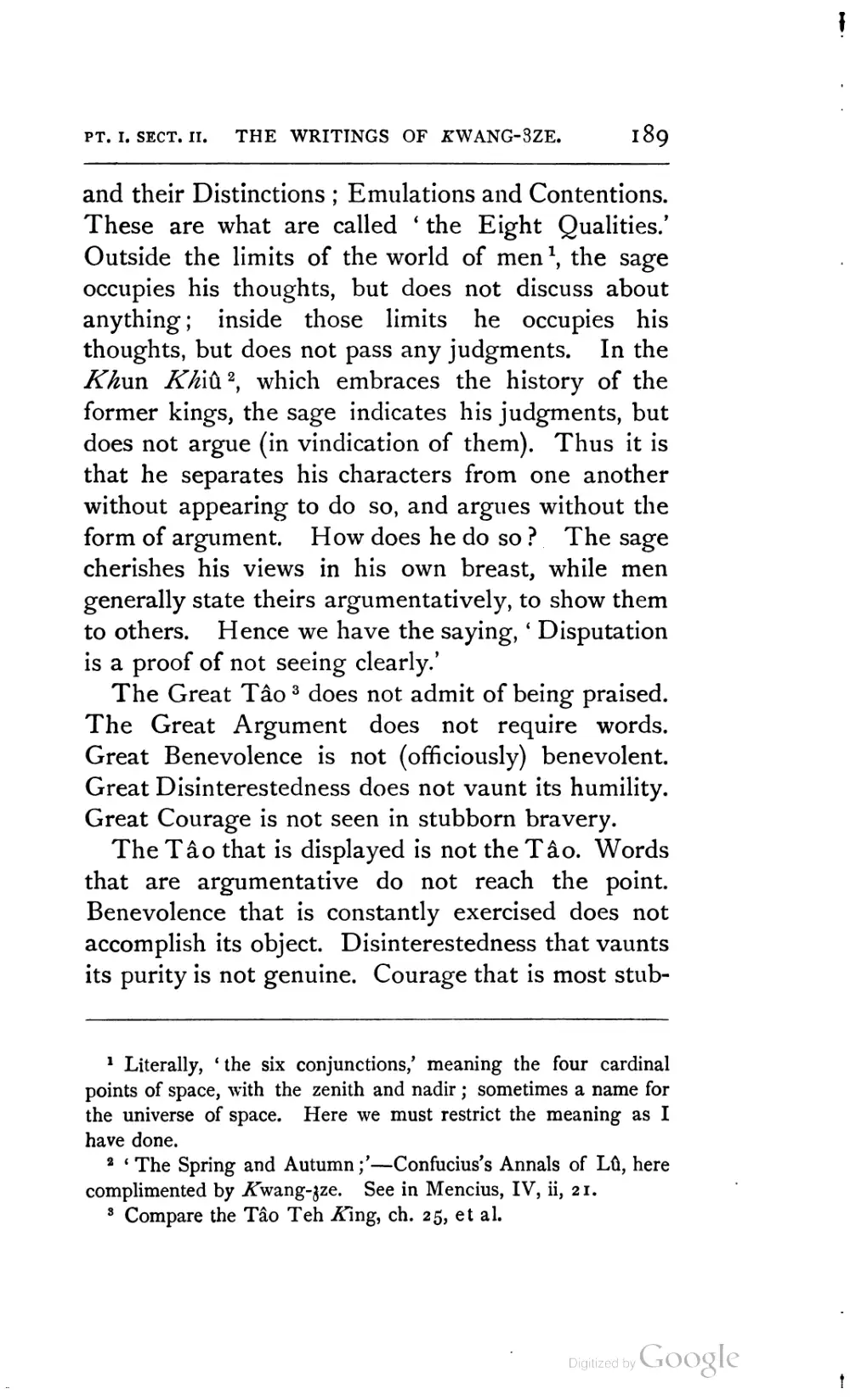
In the Khun Khiû2, which contains the history of the former kings, the sage indicates his judgments, but does not argue (in defence of them). So it is that he separates his characters from one another without appearing to do so, and argues without the form of argument. How does he do so? The sage cherishes his views in his own breast, while men in general state theirs argumentatively, to show them to others. Hence we have the saying, ‘Disputation is a proof of not seeing clearly.’
* On this concluding clause, Ȝiâo Hung says:—‘Avoiding such procedure, there will be no affirmations and denials (no contraries). The phrase 因是己 [Press: following this (and that is all)] occurs in the Book several times, and interpreters have missed its meaning through not observing that 是己 serve merely as a final particle, and often have the 因 [Press: following on, accordingly] added to them, without affecting its meaning. See also Wang Yin on the usages of 因 [Press: because of; to follow upon] in the 皇淸經解 [Press: Huang Qing Jing Jie, ‘Explanations of the Classics of the Imperial Qing’], ch. 1208, art. 6.
* That is, direct opposites.
* Literally, ‘righteousnesses’; the proper way of dealing with the relations.
* Literally, ‘separations.’