Legge's note offers two frames for Ȝe-khî's trance: “a mild form of the Buddhistic samâdhi” and “agnosticism.” Both are his period's categories. The text says only that he “had just now lost” himself, and the section that follows, on the notes of Heaven, makes self-forgetting the condition for hearing what arises of itself, which is not the same as suspending judgment.
The Tâo Teh King — Sacred Books of China Part I, SBE Vol. 39 (trans. James Legge, 1891)
Open to all
page 176
No image is selected for this page; its own page image is shown.
page 176
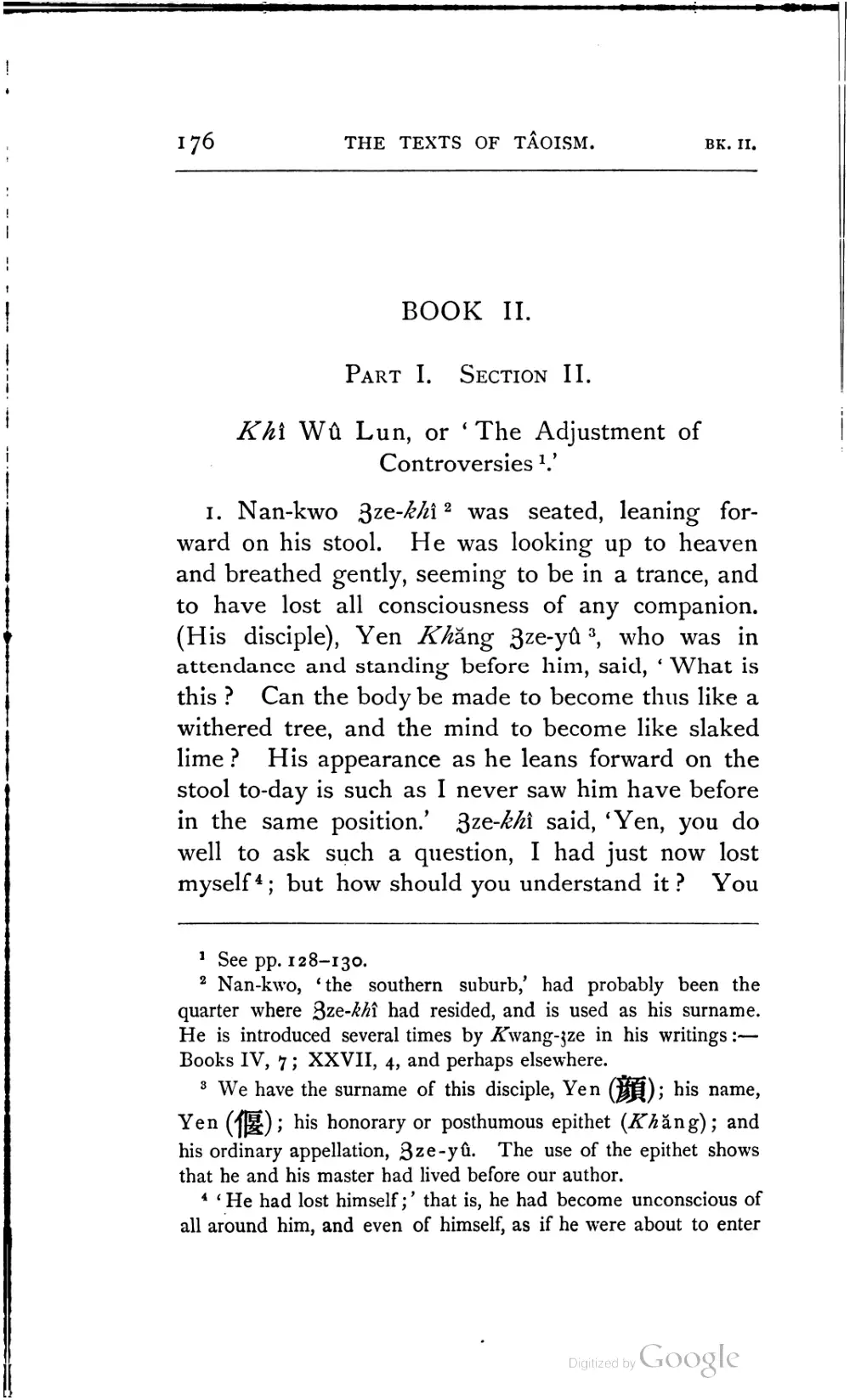
p. 176BOOK II.
Part I. Section II.
Khi Wû Lun, or ‘The Adjustment of Controversies4.’
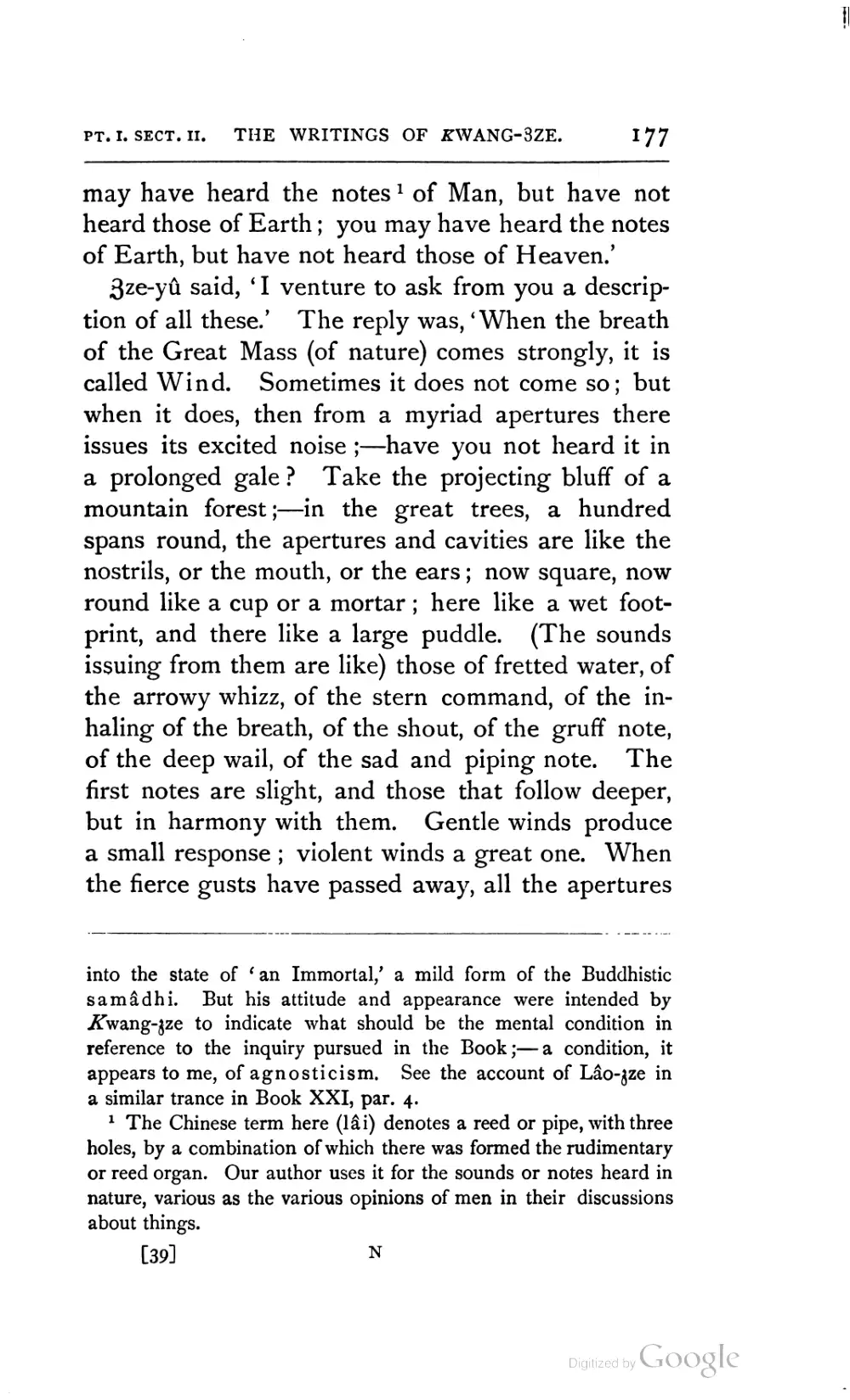
1. Nan-kwo Ȝze-khî2 was sitting leaning forward on his stool. He was looking up to heaven and breathing gently, seeming to be in a trance, and to have lost all awareness of any companion. (His disciple) Yen Khăng Ȝze-yû3, who was in attendance and standing before him, said, ‘What is this? Can the body be made to become like a withered tree in this way, and the mind like slaked lime? His appearance as he leans forward on the stool today is such as I never saw in him before in the same position.’ Ȝze-khî said, ‘Yen, you do well to ask such a question. I had just now lost myself4; but how should you understand it? You may have heard the notes1 of Man, but have not heard those of Earth; you may have heard the notes of Earth, but have not heard those of Heaven.’
1 See pp. 128-130.
2 Nan-kwo, ‘the southern suburb,’ had probably been the quarter where Ȝze-khî lived, and is used as his surname. Kwang-ȝze introduces him several times in his writings:—Books IV, 7; XXVII, 4, and perhaps elsewhere.
3 We have the surname of this disciple, Yen (顏 [Press: Yan (a surname; lit. ‘face’)]); his name, Yen (偃 [Press: Yen, a personal name (literally ‘to lie down’)]); his honorary or posthumous epithet (Khăng); and his ordinary appellation, Ȝze-yû. The use of the epithet shows that he and his master had lived before our author.
4 ‘He had lost himself;’ that is, he had become unconscious of everything around him, and even of himself, as if he were about to enter the state of ‘an Immortal,’ a mild form of the Buddhist samadhi. But Kwang-ȝze meant his attitude and appearance to indicate what the mental condition should be with regard to the inquiry pursued in the Book;—a condition, it seems to me, of agnosticism. See the account of Lâo-ȝze in a similar trance in Book XXI, par. 4.
Legge reasons from the posthumous epithet Khăng that Yen Ȝe-yû and his master “had lived before our author.” The inference is sound and useful. It marks the scene as Kwang-ȝze setting his argument in the mouths of earlier figures, which he does throughout, and it warns the reader not to take the trance as a report of something the author witnessed.