Legge measures the khwăn and phăng against “the kraken and the roc” to convey their scale, but the more useful part of his note is the warning that this is Yü Yen, a story in which a lesson is lodged. It ties the opening fable to his account of ‘Lodged Words’ in the notice on Book XXVII (p. 155): the fish that becomes a bird is not natural history but an idea housed in a narrative.
The Tâo Teh King — Sacred Books of China Part I, SBE Vol. 39 (trans. James Legge, 1891)
Open to all
page 164
No image is selected for this page; its own page image is shown.
page 164
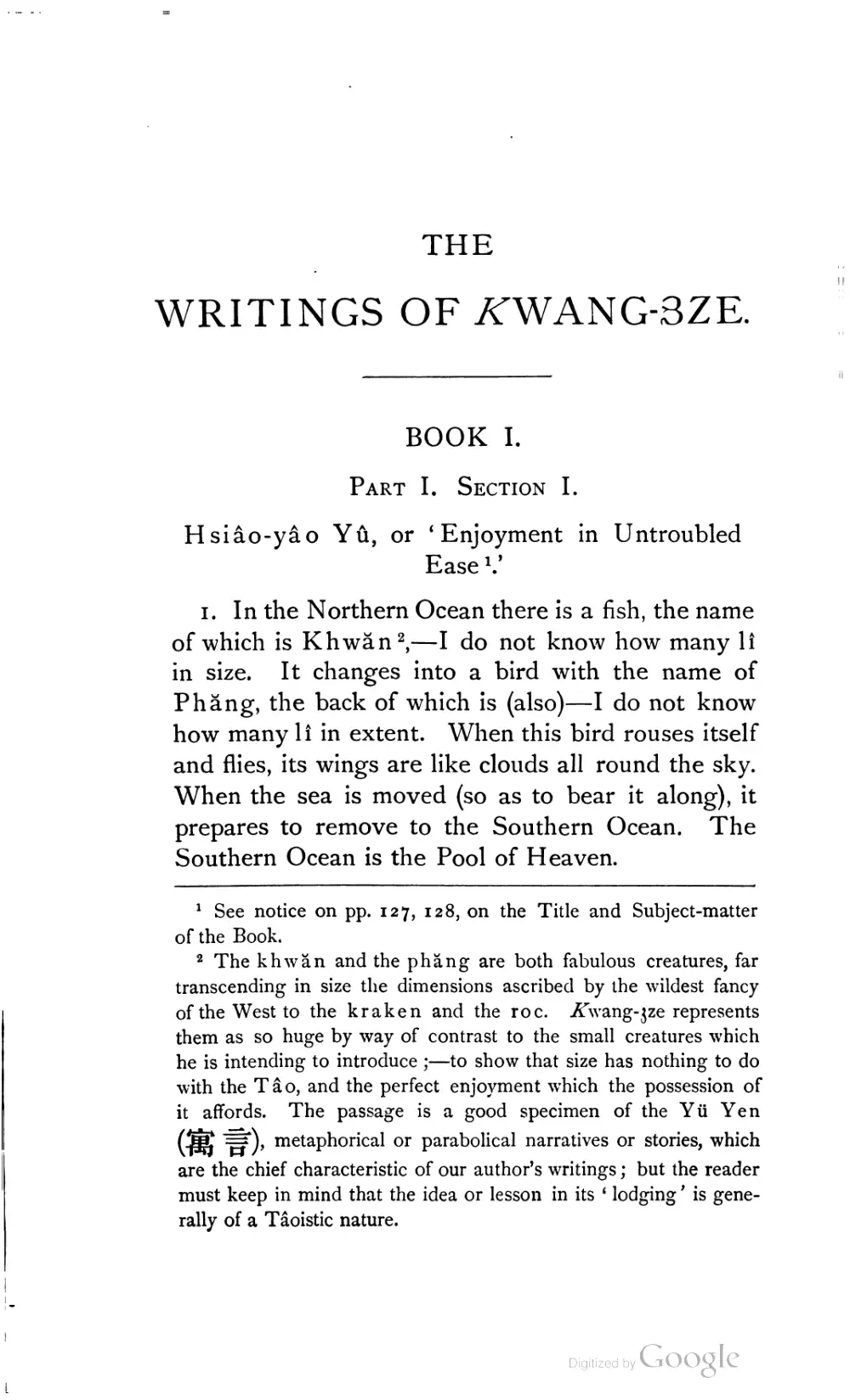
The Writings of Kwang-ȝze.
BOOK I.
Part I. Section I.
Hsiâo-yao Yû, or ‘Enjoyment in Untroubled Ease1.’
1. In the Northern Ocean there is a fish whose name is Khwan2,—I do not know how many li in size. It changes into a bird named Phang, whose back is (also)—I do not know how many li in extent. When this bird rouses itself and flies, its wings are like clouds all round the sky. When the sea is moved (so as to carry it along), it prepares to move to the Southern Ocean. The Southern Ocean is the Pool of Heaven.
1 See the notice on pp. 127, 128, on the Title and Subject-matter of the Book.
2 The khwan and the phang are both fabulous creatures, far exceeding in size the dimensions the wildest fancy of the West has given to the kraken and the roc. Kwang-ȝze makes them so huge by way of contrast with the small creatures he means to introduce;—to show that size has nothing to do with the Tao, and with the perfect enjoyment that possessing it affords. The passage is a good specimen of the Yü Yen (寓言), metaphorical or parable-like narratives or stories, which are the chief characteristic of our author’s writings; but the reader must bear in mind that the idea or lesson ‘lodged’ in them is generally of a Tâoistic nature.