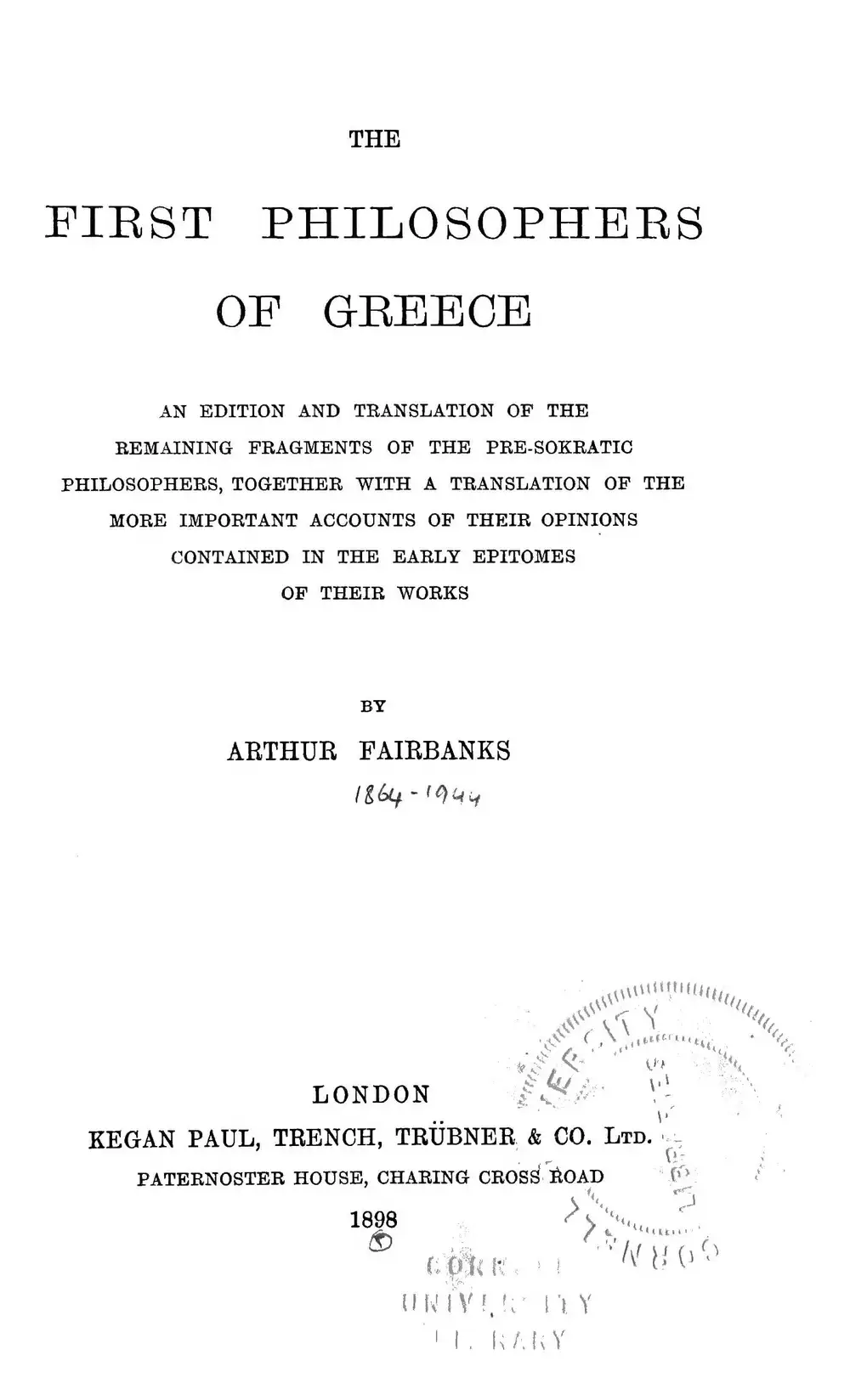
The First Philosophers of Greece — Arthur Fairbanks

Open to allBurnet · Fairbanks · Patrick202 segments · 68 pp
The First Philosophers of Greece — Arthur Fairbanks, photo of the original
Photo of the original
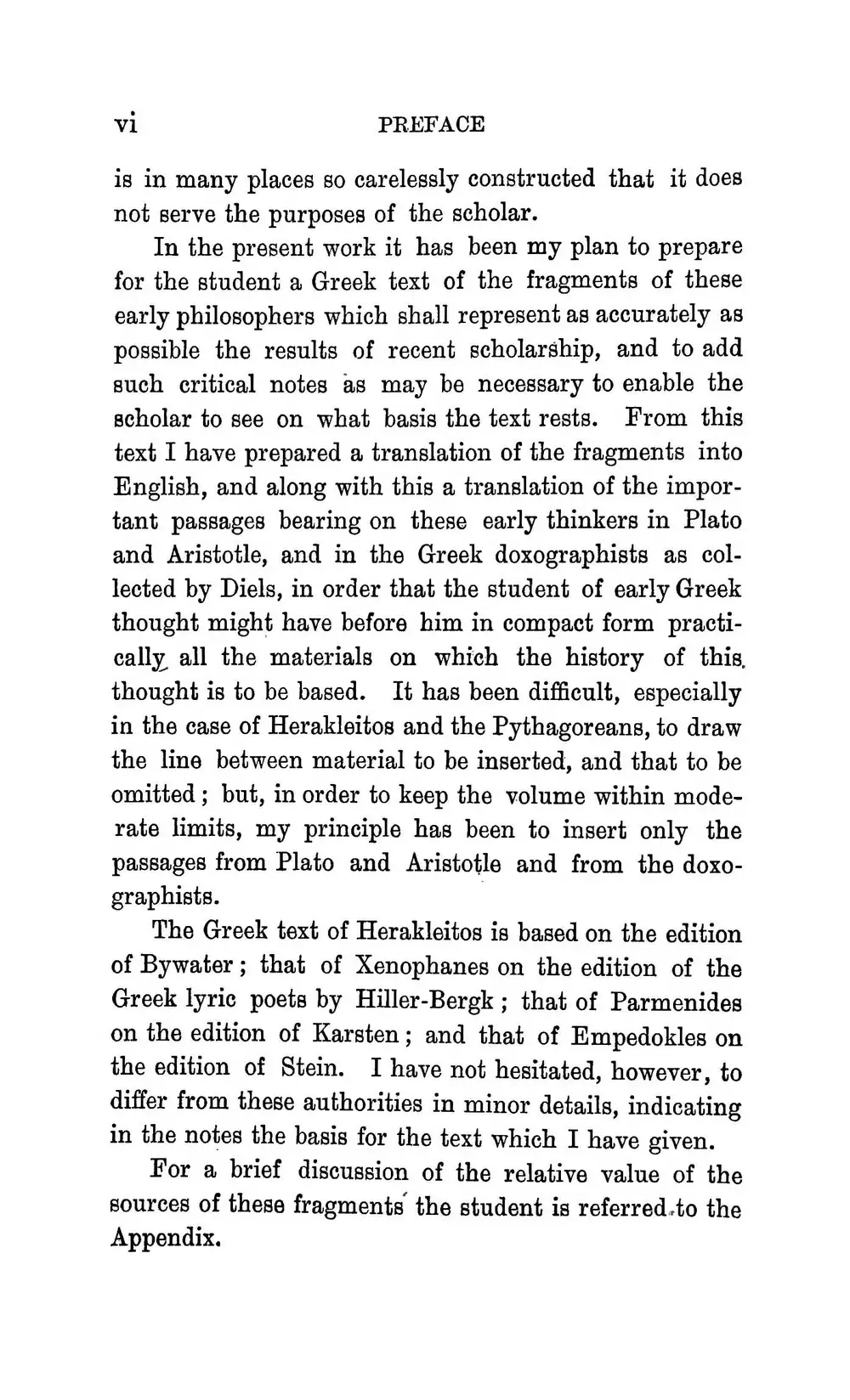
The First Philosophers of Greece — Arthur Fairbanks, photo of the original · p. vi
Photo of the original · p. vi
page 1

rk it has been my plan to prepare for the student a Greek text of the fragments of these early philosophers which shall represent as accurately as possible the results of recent scholarship, and to add such critical notes as may be necessary to enable the scholar to see on what basis the text rests. From this text I have prepared a translation of the fragments into English, and along with this a translation of the important passages bearing on these early thinkers in Plato and Aristotle, and in the Greek doxographists as collected by Diels, in order that the student of early Greek thought might have before him in compact form practically all the materials on which the history of this thought is to be based. It has been difficult, especially in the case of Herakleitos and the Pythagoreans, to draw the line between material to be inserted, and that to be omitted ; but, in order to keep the volume within moderate limits, my principle has been to insert only the passages from Plato and Aristotle and from the doxographists.

The Greek text of Herakleitos is based on the edition of Bywater; that of Xenophanes on the edition of the Greek lyric poets by Hiller-Bergk ; that of Parmenides on the edition of Karsten; and that of Empedokles on the edition of Stein. I have not hesitated, however, to differ from these authorities in minor details, indicating in the notes the basis for the text which I have given.

For a brief discussion of the relative value of the sources of these fragments the student is referred to the Appendix,

PREFACE Vil

My thanks are due to several friends for their kind assistance, in particular to Professor C. L. Brownson and Professor G. D. Lord, who have read much of the book in proof, and have given me many valuable suggestions. Nor can I pass over without mention the debt which all workers in this field owe to Hermann Diels. It is my great regret that his edition of Parmenides’ Lehrgedicht failed to reach me until most of the present work was already printed. Nevertheless there is scarcely a page of the whole book which is not based on the foundation which he has laid. ARTHUR FAIRBANKS.

χαλια University: November 1897.

CONTENTS

ο ae PAGE

  • 1. IONIC SCHOOL: THALES . ; : ; : ‘ II, IONIC SCHOOL: ANAXIMANDROS . ; : ; er 8
  • III. IONIC SCHOOL: ANAXIMENES . : ; : 2 . 17
  • IV. HERAKLEITOS : ‘ : : ‘ ὦ : ο. 228
  • Vv. ELEATIC SCHOOL: XENOPHANES ; ‘ ‘ ; . 65
  • VI. ELEATIC SCHOOL: PARMENIDES . : . : . . 86
  • VII. ELEATIC SCHOOL: ZENO . : ‘ ; ; : . 112
  • VIII. ELEATIC SCHOOL: MELISSOS : : ; i . . 120 ΙΧ. PYTHAGORAS AND THE PYTHAGOREANS . : : . 1382
  • X. EMPEDOKLES ; ; ‘ ; : ͵ . . . 1οί ΧΙ. ANAXAGORAS , ; : . : ; : ; . 2385 APPENDIX. ‘ ; ; : ‘ ; i . . 268

INDEXES . ; te ; ; : . 289 ~

LIST OF ABBREVIATIONS.

Dox. = Diels, Doxographi Graeci, Berlin 1879.

Aet. = Aetw de placitis reliquiae.

Hipp. Phil. = Hippolyti philosophumena. Ticladed τή

Epi. = Epiphanii varia excerpta. Diels, Doz.
Herm. -= Hermiae trrisio gentilium philosophorum.

Simp. Phys.= Simpltctt in Aristotelis physicorum libros quattuor priores edidit H. Diels, Berlin 1882.

Simp. Cael. = Simplicius, Commentary on Aristotle’s De caelo.

For other abbreviations, see list of authors in the Index of sources.

THE

FIRST PHILOSOPHERS OF GREECE

ee

I.
THALES.

Accorpine to Aristotle the founder of the Ionic physical philosophy, and therefore the founder of Greek philosophy, was Thales of Miletos. According to Diogenes Laertios, Thales was born in the first year of the thirtyfifth Olympiad (640 Ε.ο.), and his death occurred in the fifty-eighth Olympiad (548-545 3B.c.). He attained note as a scientific thinker and was regarded as the founder of Greek philosophy because he discarded mythical explanations of things, and asserted that a physical element, water, was the first principle of all things. There are various stories of his travels, and in connection with accounts of his travels in Egypt he is credited with introducing into Greece the knowledge of geometry. Tradition also claims that he was a statesman, and as a practical thinker he is classed as one of the seven wise men. A work entitled ‘Nautical Astronomy’ was ascribed to him, but it was recognised as spurious even in antiquity.

Literature: Ε'. Decker, De Thalete Milesio, Diss. Halle, 1865 ; Krische, Forsch. auf d. Gehiet d. alt. Phil. i, pp. 84-42; V. also Acta Phil. iv. Lips. 1875, pp. 828-880; Revue Philos. Mar. 1880; Archiv f. ᾱ. Geschichte d. Phil. ii. 166, 515.

B

p. 2

(2) PASSAGES RELATING TO THALES IN PLATO AND
IN ARISTOTLE.

Plato, de Legg. x. 899 8. And as for all the stars and the moon and the years and the months and all the seasons, can we hold any other opinion about them than this same one—that inasmuch as soul or souls appear to be the cause of all these things, and good souls the cause of every excellence, we are to call them gods, whether they order the whole heavens as living beings in bodies, or whether they accomplish this in some other form and manner? Is there any one who acknowledges this, and yet holds that all things are not full of gods ?

Arist. Met. 1. 3; 988 b 6. Most of the early students of philosophy thought that first principles in the form of matter, and only these, are the sources of all things ; for that of which all things consist, the antecedent from which they have sprung, and into which they are finally resolved (in so far as being underlies them and is changed with their changes), this they say is the element and first principle of things. 988b18.
As to the quantity and form of this first principle, there is a difference of opinion; but Thales, the founder of this sort of philosophy, says that it is water (accordingly he declares that the earth rests on water), getting the idea, I suppose, because he saw that the nourishment of all beings is moist, and that warmth itself is generated from moisture and persists in it (for that from which all things spring is the first principle of them) ; and getting the idea also from the fact that the germs of all beings are of a moist nature, while water is the first principle of the nature of what is moist./ And there are some who think that the ancients, and they who lived long before the present generation, and the first students of the gods, had a similar idea in regard to nature; for in their poems Okeanos and Tethys werep. 3 the parents of generation, and that by which the gods swore was water,—the poets themselves called it Styx ; for that which is most ancient is most highly esteemed, and that which is most highly esteemed is an object to swear by. Whether there is any such ancient and early opinion concerning nature would be an obscure question; but Thales is said to have expressed this opinion in regard to the first cause.

Arist. de Coelo ii. 18; 294 a 28. Some say that the earth rests on water. We have ascertained that the oldest statement of this character is the one accredited to Thales the Milesian, to the effect that it rests on water, floating like a piece of wood or something else of that sort.'

Arist. de Anima 1. 2; 405 a 19. And Thales, according to what is related of him, seems to have regarded the soul as something endowed with the power of motion, if indeed he said that the loadstone has a soul because it moves iron. i.5; 411 a7. Some say that soul is diffused throughout the whole universe; and it may have been this which led Thales te think that all things are full of gods.

Simpl. in Arist. de Anima 8 r 82, 16.2—Thales posits water as the element, but it is the element of bodies, and he thinks that the soul is not a body at all. 81, 21 p.—And in speaking thus of Thales he adds with a degree of reproach that he assigned a soul to the magnetic stone as the power which moves the iron, that he might prove soul to be a moving power in it; but he did not assert that this soul was water, although water lad been designated as the element, since he said that water is the element of substances, but he supposed soul to be unsubstantial form. 20 r 78, 22. For Thales, also,

I suppose, thought all things to be full of gods, the
gods being blended with them ; and this is strange.
1 Cf. Herm. 1. 6. P. 10 (Dor. 653).

Commentary
page 1 ·
Cross-Estate§001

Fairbanks states a problem of access, not of interpretation: "it has been my plan to prepare for the student a Greek text of the fragments of these early philosophers which shall represent as accurately as possible the results of recent scholarship, and to add such critical notes as may be necessary to enable the scholar to see on what basis the text rests." Then the translation, and with it the passages on these thinkers in Plato, Aristotle and the doxographers as Diels collected them — so a reader can check the histories against their sources. This work is also held as thread:fairbanks_first_philosophers; measured rather than counted, THIS copy is the fuller of the two — 593,108 readable characters against 485,063 — although it carries fewer segments, because the two ingests chunked differently.

is handled the same way as thread:fairbanks first philosophers

Cross-Estate§001

THIS WORK WAS HELD TWICE AND IS NOW HELD ONCE. presocratics:2 additionally carries the index and the publisher's catalogue; the thread copy's unique runs are OCR wreckage. The other entry, thread:fairbanks_first_philosophers, is retired by operator ruling of 2026-09-01: its rows and its text remain in the database and it is no longer served to readers. The comparison was made passage by passage rather than by counting rows — a segment is a chunk, not a quantity of book, and in three of the four pairs the copy with FEWER segments held more text.

is handled the same way as thread:fairbanks first philosophers