September 1945 — "Setiembre" in the Rioplatense spelling; Nos 39 and 40 are absent from the surviving run.
→ ini:4.38
Fetching
One moment.
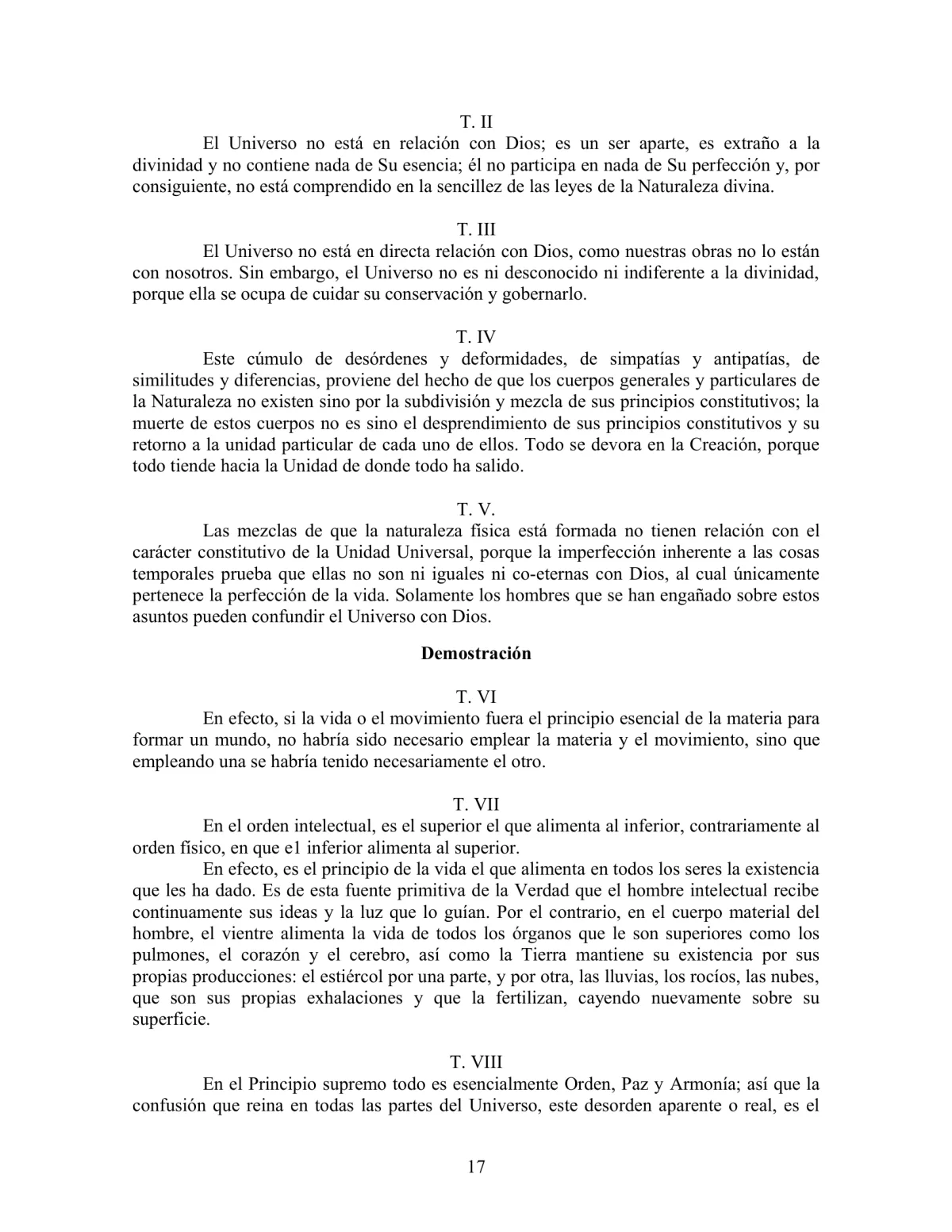
1T. II. The Universe is not in relation with God; it is a being apart, foreign to the divinity, and contains nothing of His essence; it participates in nothing of His perfection and, consequently, is not comprised in the simplicity of the laws of the divine Nature. T. III. The Universe is not in direct relation with God, as our works are not with us.
2Nevertheless, the Universe is neither unknown nor indifferent to the divinity, because she occupies herself with caring for its conservation and governing it.
3T. IV. This accumulation of disorders and deformities, of sympathies and antipathies, of similitudes and differences, comes from the fact that the general and particular bodies of Nature exist only by the subdivision and mixture of their constituent principles; the death of these bodies is nothing but the detachment of their constituent principles and their return to the particular unity of each of them.
4Everything devours itself in Creation, because everything tends toward the Unity whence everything came forth.
5T. V.
6The mixtures of which physical nature is formed have no relation with the constitutive character of Universal Unity, because the imperfection inherent in temporal things proves that they are neither equal nor co-eternal with God, to whom alone belongs the perfection of life.
7Only men who have deceived themselves on these matters can confound the Universe with God.
8Demonstration. T. VI. In effect, if life, or movement, were the essential principle of matter for forming a world, it would not have been necessary to employ matter and movement: employing one, the other would necessarily have been had.
9T. VII. In the intellectual order, it is the superior that nourishes the inferior — contrary to the physical order, in which the inferior nourishes the superior. [Sic: the Spanish prints e1, with a numeral.]
10In effect, it is the principle of life that nourishes in all beings the existence it has given them.
11It is from this primitive source of Truth that the intellectual man continually receives his ideas and the light that guide him.
12On the contrary, in man's material body, the belly nourishes the life of all the organs superior to it — like the lungs, the heart and the brain; as the Earth maintains its existence by its own productions: dung on the one hand and, on the other, the rains, the dews, the clouds, which are its own exhalations and which fertilise it, falling again upon its surface.
13T. VIII. In the supreme Principle everything is essentially Order, Peace and Harmony; so that the confusion reigning in all parts of the Universe — this apparent or real disorder — is the · 17
Our translation, period-faithful. Citable as our translation, never as the source.
September 1945 — "Setiembre" in the Rioplatense spelling; Nos 39 and 40 are absent from the surviving run.
→ ini:4.38
Masthead stereotype unchanged.
Six articles, and the number's centrepiece is textual scholarship: a theorem-form digest of Saint-Martin's second book, translated from the French review Eon.
The chronology approaches Wilhelmsbad: the Swedish protest (Charles of Sudermania's resignation), Joseph de Maistre's Memoir against the templar legend — proposing masonry devote itself to "the religion of humanity" and the reunion of the churches — and the opponents gathering: Bode the Aufklärer, Knigge directing Dittfurth from the shadows for Weishaupt's Illuminati.
→ ini:4.38
The planet-in-house series resumes with MARS through the twelve houses — the course's reference apparatus continuing after the twelve-sign arc; the malefic's catalogue kept with all its period severity (the twelfth house's "capital sentence with long detentions").
The orange monograph: Kapila's longevity serial devotes an entire instalment to one fruit — mineral-salt percentages, uterine therapeutics, the pregnant reader addressed directly, and the closing prescription of two or three glasses of juice daily. The praxis layer carries it.
The Gita Bashya introduction concludes: the six Gitas of the first section mapped, the 26-chapter INTEGRAL MAN, and Subramania's 1922 appeal for "the distinguished support necessary" to print a thousand-page volume — the Mandala's publishing programme documented from Guindy House.
→ ini:4.38
Hamsa Yogui's allegoresis: the blind King as the dark part of man, the Pandavas as the bright, and the Gita as the answer to "WHAT AM I IN THIS BUNDLE OF STRUGGLING ELEMENTS?" — sealed with Delphi's "KNOW THYSELF" and the hermetic "AS ABOVE, SO BELOW": the S.D.M. joining Sanskrit hermeneutics to the Western maxims its Montevideo readers already hold.
The three grades of discipleship (PARI PRASNA, PRANI PATHA, SEVA) with Arjuna typifying all three — the passage the praxis layer carries as the number's second practice text.
The Tableau Naturel, digested in theorems: an anonymous S. I. reduces each chapter of Saint-Martin's second book to numbered theorems with reasonings and axioms — published in Eon (May 1923), translated by Pitágoras. The estate holds the Tableau Naturel itself, repaired this season; this study is the run's reading-guide to it.
→ thread:stmartin_tableau_naturel
The editorial note dates and places the source: composed in Paris "on the advice of some friends", published Lyon 1782 — the year of Wilhelmsbad, the same year the chronology two articles earlier has just reached: the number's quiet symmetry.
The study's honesty about its own source: Theorem V breaks off mid-sentence and the translator's footnote records "a printing error in the original publication: the same paragraph is repeated" — Eon's defect documented, not repaired, exactly as this edition treats its own retype faults.
Principle Liberty and Effect Liberty — the study's central distinction: the faculty of choosing even in slavery versus the freedom of the man who "admits only his own law". Saint-Martin's doctrine of liberty rendered as a two-term scheme a course-student can hold.
The two Causes: Evil as an inferior cause powerless against essence, able only to "insinuate her disordered action into particular Beings" — Pasqually's cosmology speaking through Saint-Martin's more abstract register; the chronology's doctrine and the study's doctrine are one lineage shown at two removes.
The strangest theorem printed this year: Evil's relation to Good given as arithmetic — "in quantity, nine to one; in intensity, zero to one; in duration, seven to one" (T. XXIX) — Saint-Martin's number-doctrine transmitted without softening or explanation.
The chemistry serial opens on the Adepts who render poisons innocuous by tuning wavelengths — "the modus operandi must remain secret" — then pivots, without blinking, to Marfori's university pharmacology textbook: the column's standing method of setting occult claim and academic source side by side.
Marfori quoted honestly to the edge of the argument: Schmiedeberg's stereochemistry preferred, and the confession that "we still do not know the reason why the molecule of one substance acts in a determinate manner" — the serial rests its occult wavelength theory exactly on academic ignorance, cited fairly.
The toxicology taxonomy — exogenous/endogenous, caustic/toxic, mithridatism among the defences — period pharmacology systematised for the lay reader before the promised turn to foods.
GIDEE prospectus stereotype at page 24.
→ ini:3.30
Library back cover and imprint close the number.
Mars in the sixth house sorted by sign-quality — anginas in fixed signs, tuberculosis in common, burns in cardinal — the medical astrology layer at its most systematised.
The orange's percentages run improbably high (38-40 % potassium salts) — the serial's enthusiasm outrunning its chemistry; the figures are printed as transmitted.
Arjuna's three states close the introduction: confession of ignorance, self-offering, obedient combat "completely detached from personal motives" — the karma-yoga core the Mandala's edition builds its discipleship grades upon.
Theorems X-XIV: man passive in both sensible and intellectual ideas, yet retaining "the faculty of examining… judging… adopting or rejecting" — Saint-Martin's anthropology compressed to its hinge between dependence and freedom.
Theorem VII's image — the belly nourishing the superior organs as dung and dews nourish the Earth — the Tableau's earthy physiology of the intellectual order, kept whole in the digest.
"It is in the motive that Evil can reside, and not in the object" (T. XX) — the study's ethical centre: evil located in intention, God impassible, man the sole author of his corruption.