La Iniciación: Mensuario del Grupo Independiente de Estudios Esotéricos
The Initiation: Monthly of the Independent Group of Esoteric Studies
La Iniciación · Año II, Nº 18 · October 1943
Gate passedSeeker and aboveModern transcription — not a facsimileGIDEE / Orden Martinista de América del SurOperator ruling: no copyright implications asserted for this work. Uruguay life+50 (Leo d. 1970 → PD 2020); US URAA restoration assessed at ~2041 in the collection plan and overridden by the operator.342 of 342 segments translated · 27 ppsha 0e7003cc4bba…
primary
derivedpage 6
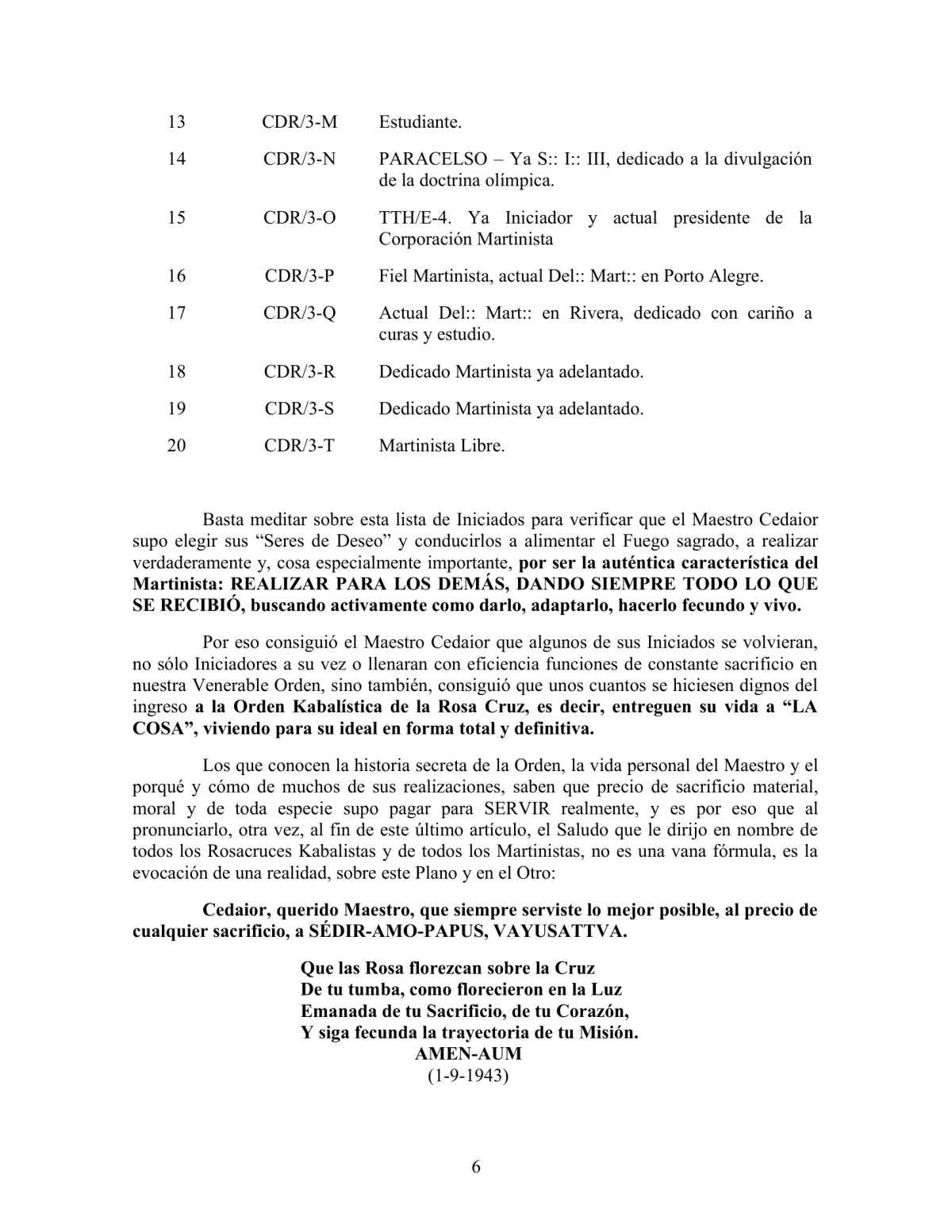
113 CDR/3-M Student.
214 CDR/3-N PARACELSO — Already S∴I∴ III, devoted to the spreading of the Olympic doctrine.
315 CDR/3-O TTH/E-4.
4Already an Initiator and present president of the Martinist Corporation. 16 CDR/3-P A faithful Martinist, present Mart∴ Delegate in Porto Alegre.
517 CDR/3-Q Present Mart∴ Delegate in Rivera, devoted with affection to cures and study.
618 CDR/3-R A devoted Martinist, already advanced.
719 CDR/3-S A devoted Martinist, already advanced.
820 CDR/3-T A Free Martinist.
9It is enough to meditate on this list of Initiates to verify that Master Cedaior knew how to choose his "Beings of Desire" and lead them to feed the sacred Fire, to realise truly and — a specially important thing, being the authentic characteristic of the Martinist — TO REALISE FOR OTHERS, ALWAYS GIVING ALL THAT WAS RECEIVED, actively seeking how to give it, adapt it, make it fecund and alive.
10Thus Master Cedaior obtained that some of his Initiates became not only Initiators in their turn, or filled with efficiency offices of constant sacrifice in our Venerable Order, but also that a few made themselves worthy of entry into the Kabbalistic Order of the Rose-Cross — that is, gave their lives to "THE THING", living for their ideal totally and definitively.
11Those who know the secret history of the Order, the personal life of the Master, and the why and how of many of his realisations, know what price of material, moral and every kind of sacrifice he knew how to pay in order truly to SERVE; and that is why, in pronouncing once more, at the end of this last article, the Salute I address to him in the name of all the Kabbalist Rosicrucians and of all the Martinists, it is no vain formula but the evocation of a reality, on this Plane and on the Other: Cedaior, beloved Master, who always served as well as possible, at the price of any sacrifice, SÉDIR-AMO-PAPUS, VAYUSATTVA.
12May the Roses flower upon the Cross of your tomb, as they flowered in the Light that streamed from your Sacrifice, from your Heart — and may the trajectory of your Mission continue fecund.
13AMEN-AUM (1-9-1943) · 6
Our translation, period-faithful. Citable as our translation, never as the source.
Commentarywhole issue ·
Cross-estate[P-V]citesini:2.18:10:001
The Key of the human Sphinx, full-page: three totemic columns — INVOLUTION (parrot over ape over boar), NORMAL (eagle over man over lion over ox), EVOLUTION (dove over angel over dog over horse). Jehel's three prose sphinxes on the facing page are this plate read aloud: every animal he names stands drawn in its column. Extracted upright into the imagery layer.
→ ini:2.18:9:004
Historical[P-V]echoesini:2.18:1:001
Wrapper photographs continue (cover, masthead, prospectus, back cover), transcribed by hand; the back cover changes — see the note at 27:001.
→ ini:2.16-17
Historical[P-V†]ini:2.18:2:006
The masthead holds its Nº 16-17 form (Kapila with SDM in his degrees); the roster is otherwise unchanged.
Historical[P-V†]ini:2.18:3:002
The SUMARIO calls this the \"7th article\" of the biography where Nº 16-17 carried the 5th — the 6th either never existed or the count skipped; the series numeration forks again, and citation stays by issue.
Historical[R]ini:2.18:4:005
The Fermat claim: Cedaior is said to have solved \"the famous theorem called Fermat's — the dividing of a cube into two and into three cubes\", to be published some day. Fermat's Last Theorem for n=3 (no cube is the sum of two cubes) was settled by Euler; a claimed positive \"solution\" would be a claimed refutation, and none was ever published. Recorded as the family's report; the mathematics stands against it.
Cross-estate[P-V]ini:2.18:4:006
Lorelair the astrologer, confirmed from inside: world-event predictions, evolution-biology by the astrological way, and the lineage claim that Saint-Yves, Barlet and Papus had reintroduced \"the real astrology\" into Martinism's high degrees — the exact franchise Surya's course in these pages inherits. Her working method — observation, meditation, intuition, almost without predecessors' bases — is the run's own description of its most productive mind.
Historical[P-V]citesini:2.18:5:003
\"Left his de Mascheville vehicle\" — the biography closes with the family name in print as the body the Master wore: the third naming across the run (after the Nº 11 identification and the back-cover language lessons). The valediction at 6:011-013, dated 1-9-1943, salutes SÉDIR-AMO-PAPUS, VAYUSATTVA — the four masters of the whole biography in one line — and gives the memorial verse.
→ ini:2.13:26:001
Cross-estate[P-V]citesini:2.18:5:005
The South American chain completed: initiates 7–20, from JEHEL (CDR/3-G, \"present President of the Grand Council\") through coded names (XBRGS/B-4, BRDDL/C-4, XLRLR/D-4, TTH/E-4) to the delegates of São Paulo, Curitiba, Porto Alegre and Rivera. With Nº 13's European six, the full CDR chain of twenty is now printed. XLRLR/D-4 reads as Lorelair's own code; the cipher pattern (vowels stripped) matches SDR2H for Sédir's line.
→ ini:2.13:8:003
Cross-estate[P-V]ini:2.18:7:005
Papus at length: the sphinx exposition is quoted verbatim across two pages — the ox, lion, eagle and the divine unity; three unconsciouses under one conscious; the four evangelists as the sphinx's animals. The passage is from Papus's constitution-of-man teaching (Traité élémentaire / ABC illustré d'occultisme family); \"the Master of Clarity\" is the run's standing epithet for him.
Comparative[P-V]citesini:2.18:9:004
Jehel's three sphinxes — Normal, \"Involved\", Evolved — are the plate at page 10 read as first-person meditations: ox/lion/eagle at their stations; pig, boar, monkey and parrot as the degenerations; horse-to-Pegasus, dog, angel and dove as the ascents. The closing question — \"is it the Holy Spirit, or my spirit sanctifying itself?\" — is the run's theology in one line.
→ ini:2.18:10:001
Cross-estate[P-V]citesini:2.18:11:004
Burgoyne quoted by Papus, verified against our shelf: the Saturn exposition opens the interpretation course with \"J. Burgoyne, the Rosicrucian and Author of The Light of Egypt\" — and that book stands on this shelf in the original (560 segments, acquired at Nº 29's citation). The kabbalistic Saturn (SHEBO, Cassiel, the hermit, the Tarot) is Light of Egypt doctrine faithfully carried.
→ burgoyne:1
Historical[S-V]ini:2.18:12:017
Julevno's medical Saturn (bones, joints, spleen, right ear, knees; the chronic illnesses) and the well/ill-disposed portraits are the standard French-manual apparatus; the physiognomic Saturnian of p. 13 likewise. The course's promise to cite sources each time is being kept — Burgoyne, then Julevno, named per block.
Historical[P-V]ini:2.18:13:012
Saturn's period, printed as 29 years 167 days — the true sidereal period is ~29 years 167 days: the figure is exact. The 5-day stationary intervals bracketing retrogradation are likewise sound observational astronomy. The course's numbers keep verifying.
Historical[I]ini:2.18:14:001
Practice instruction, reproduced as printed and not endorsed: Padahasthasana with its Fig. 14 announced — the fourth consecutive asana figure missing from our witness. The sanskrit apparatus of p. 15's footnotes (Apana-Vayu, Sushumna with Ida and Pingala, Tamas) is the course's first technical-gloss set, kept as set.
Historical[I]ini:2.18:16:010
The rejuvenation series turns homiletic: the science of Nºs 12–15 gives way to the sermon — the 60-year-old woman with her dyes, the \"punishment\" of accelerated ageing, the Supreme Architect. Reproduced as printed; the period misogyny of the example is the author's, and the note marks it rather than smooths it.
Historical[S-V]ini:2.18:18:003
D'Arsonval, quoted and real: Jacques-Arsène d'Arsonval, the great electrophysiologist, did champion physical agents in therapeutics; a version of this pronouncement circulates in the electrotherapy literature (the printed date 1881 fits his early career). The appeal to him closes the scientific case exactly as Charles Henry opened it in Nº 15: real savants, enlisted at their most vitalist.
Cross-estate[P-V]citesini:2.18:19:007
The Suddha funnel explodes: 55 → 82 in a month, with 45 on the first exercise — the twenty August aspirants of Nº 16-17's note arrived, and more behind them. Brazil jumps 6 → 27. The run's numbers now show a school in genuine expansion, and the ledger (documents 423–469) keeps pace.
→ ini:2.16-17:15:007
Comparative[S-V]ini:2.18:19:009
The Suddha extracts, sourced: \"Continuation of the notes of Pandit K. T. Srinivasachariar\" — the actual editor of the Suddha Dharma Mandalam's Sanskrit publications (the Mahābhārata-derived Suddha canon). Bhagavan Narayana, Yoga Devi as sakti, Naradeva as secretary: the Mandalam's own theology, translated faithfully — with its women Siddhas paragraph, which the feminine-college thread of the run will want.
Comparative[C]ini:2.18:21:006
The Gita as the integral revelation and all other scriptures as partial expositions — the Suddha extract's strongest claim, carried without editorial softening; the run's universalism here speaks with an Indian accent rather than its usual French one. The dharma/adharma relativity doctrine (p. 20) was read in full against the excision standard and stands: its vocabulary is of peoples and times, not racial hierarchy.
Comparative[S-V]ini:2.18:22:005
Wronsky on Hegel: thesis-antithesis-synthesis, the Absolute as limit of an unlimited process, Pure Being possessing all qualities and none — a competent popular Hegel with the essay's own paradox-savouring style; the \"new edition of the Philosophy of Spirit\" peg dates the piece to the wartime Spanish-language Hegel revival. \"Pure Being is greater than the sum of its parts\" is Wronsky's coinage, not Hegel's.
Cross-estate[P-V]ini:2.18:24:003
Kapila's ode to Youth (dated 6-4-43) closes the number in verse, the literary twin of his rejuvenation series: the poem asks the arcanum the articles argue — purity as the price of youth's protection. The title's printed slip (\"treasure\" in the SUMARIO, \"secret\" at the head) stands.
Historical[P-V]echoesini:2.18:27:001
The BIBLIOTECA MARTINISTA appears: Papus's Tarot of the Bohemians and Divinatory Tarot and Lévi's Book of the Sages, edited by Publicidad \"Ateneo\" of Buenos Aires, with reservations through the run's own Casilla 317 — the movement has become a publisher. Lévi's Transcendental Magic already stands on this shelf; the Spanish editions advertised here are the network's distribution arm, promised to grow.
→ ini:2.16-17:22:007
Cross-estate[P-V]citesini:2.18:6:011
The valediction: \"Cedaior, beloved Master, who always served… SÉDIR-AMO-PAPUS, VAYUSATTVA\" — the biography's four masters gathered into one salute, followed by the memorial quatrain and AMEN-AUM, dated 1-9-1943. The seven-part series that began in Nº 11 closes here; the reader can now walk it end to end.
→ ini:2.11
Comparative[S-V]ini:2.18:8:009
Papus's four-fold sphinx — four ages, the four moral forces (\"to know, to dare, to will, to keep silent\"), four cardinal points, four evangelists — is the classical occult tetrad (the \"four powers of the Sphinx\" of Lévi's school) in his clearest popular form; the Holy Family sleeping between the Sphinx's paws is his emblem of tradition joining tradition.
Comparative[C]ini:2.18:15:002
The footnote apparatus (Apana-Vayu as the lower breath, Sushumna with Ida and Pingala, Tamas as the whole family of heaviness) gives the course its first proper Sanskrit glossary — three terms the praxis crosswalk should carry for every later asana entry.
Comparative[C]ini:2.18:17:008
The one-sentence programme — diet, breath, sublimated emotion, balanced intellect, intense spiritual life — is the run's complete hygiene of youth in a single period; everything the asana and pranayama courses teach in pieces stands here as one integral claim.
Comparative[P-V]ini:2.18:20:008
Read in full against the excision standard: the passage's catalogue of \"classes, castes, groups, sections and nationalities\" as the harvest of prejudice is the Suddha text at its most explicitly anti-sectarian; the flagged \"race-groups\" sentence (20:005) is descriptive comparative religion inside that argument. Both stand.
Comparative[C]ini:2.18:23:011
\"Pure Being is greater than the sum of its parts\" — Wronsky ends his Hegel excursus with an aphorism of his own minting, and marks the piece \"The end\": the only essay in the run to close itself formally. His Transcendent Psychology series continues; this was a side-path, as the title said.
Comparative[C]ini:2.18:25:002
The poem's answer to its own question — purification of body, mind and soul as the price of Youth's protection — is the rejuvenation series compressed to a couplet; ode and treatise close the number as one argument in two registers.
Historical[P-V]correctsini:2.18:26:007
The prospectus repeats Nº 16-17's (1st floor, the three branches) with one correction: the La Plata contact is now spelled Montegnacco — the third spelling in three numbers (Montegnaco, Montegracco, Montegnacco) for the same count; the plates disagree among themselves and all three stand marked.