La Iniciación: Mensuario del Grupo Independiente de Estudios Esotéricos
The Initiation: Monthly of the Independent Group of Esoteric Studies
La Iniciación · Año II, Nº 11 · March 1943
Gate passedSeeker and aboveModern transcription — not a facsimileGIDEE / Orden Martinista de América del SurOperator ruling: no copyright implications asserted for this work. Uruguay life+50 (Leo d. 1970 → PD 2020); US URAA restoration assessed at ~2041 in the collection plan and overridden by the operator.268 of 268 segments translated · 19 ppsha fcc6204806c9…
primary
derivedpage 5
1Commentaries on the First Degree of Martinism (Continued). Teachings of Jehel, S∴I∴
2I continue commenting on the Ceremonial of Initiation to the Third Degree of Masonry, that is, that of Master Mason (see number 9 and earlier of “LA INICIACIÓN”): 49th) — We saw also that King Solomon (king of Justice, Member of the Secret Sanctuary of the SACRED EMPIRE — a term masons ought to meditate on, if they knew the works of Saint-Yves d'Alveydre and the labours of Archytas, disciple of Pythagoras, the history of RAM…) has applied to each assassin the VERY PENALTY that his troubled conscience had made him ask for.
3The interpretation of this is complex, for it refers to the action of the Law of Cause and Effect (Karma) on the THREE PLANES.
4Let us see. 1st, Physical and Social Plane: always and unavoidably we shall place ourselves, in relation to the “Companions” (“colleagues” of life, of evolution), so that through them we shall receive the just reward — that is, apparent recompense or apparent punishment; in reality, COMPENSATION for our acts of every kind.
5This will happen to everyone, at every moment, minute by minute, for small things as for great.
62nd, Rapid Liquidations: each time we have the HAPPINESS the happiness [Sic: the phrase is set twice in the original] of being brought before an impartial Judge (an Initiate, a Master, or our own CONSCIENCE in a state of impartiality), we shall then receive the opportunity of seeing fulfilled RAPIDLY — sometimes INSTANTANEOUSLY — events that come to compensate faults committed earlier, and which, without that intervention, could not have been liquidated except across long periods of trials and difficulties.
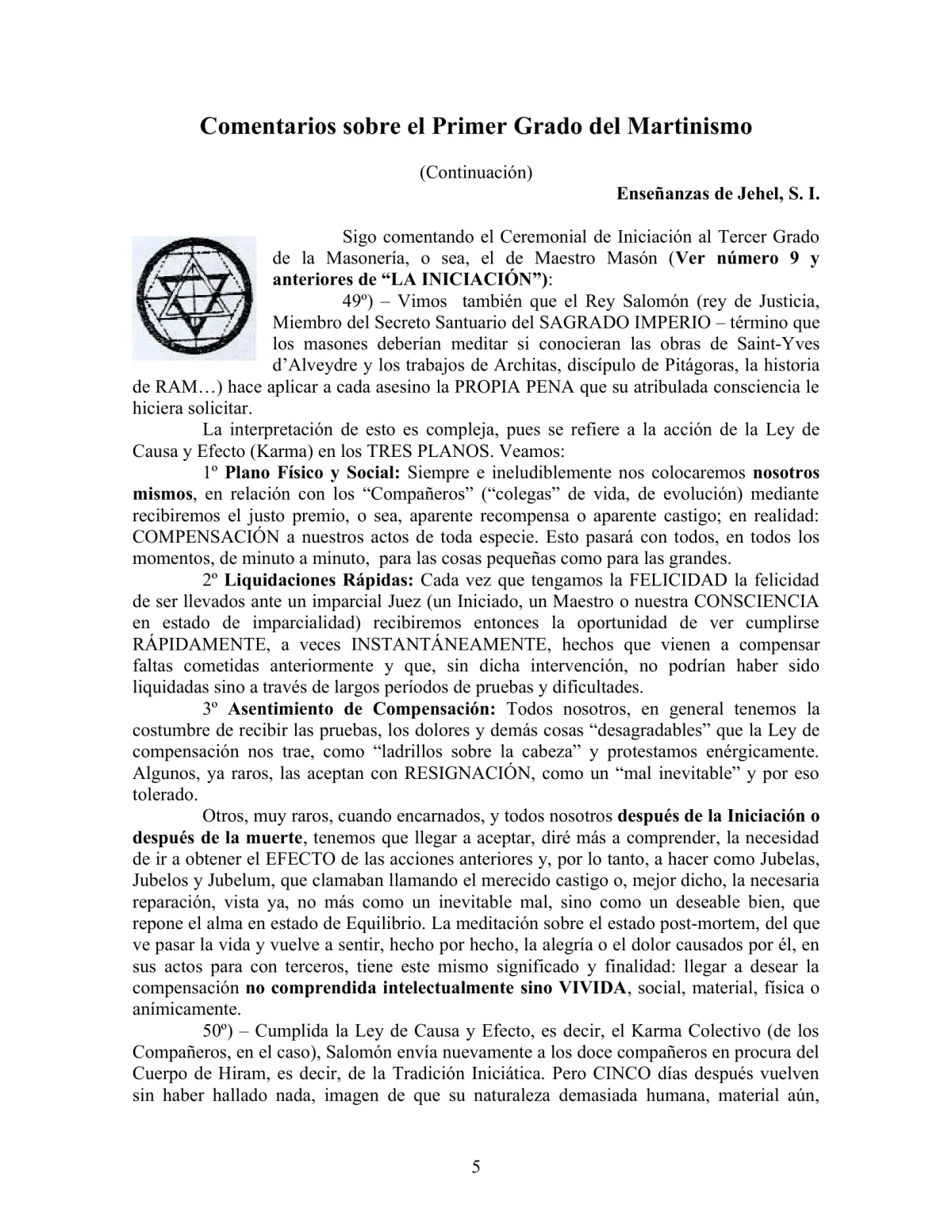
The Seal of Solomon, here the seal of the Order: a six-pointed star with a further inverted triangle set within it, ringed by a dotted circle and enclosed in a heavy band. The house device, cut for several issues and standing at the head of the initiatic articles. This is the symbol the review of the GIDEE exhibition in Nº 11 describes hanging above the Picture of the Adept, the Martinist Order being present in the rooms 'only through its marvellous symbol'.La Iniciación (GIDEE, Montevideo), page 5
73rd, Assent to Compensation: all of us, in general, are in the habit of receiving the trials, the pains and the other “disagreeable” things that the Law of compensation brings us as “bricks on the head”, and we protest energetically.
8Some, already rare, accept them with RESIGNATION, as an “unavoidable evil” and therefore tolerated.
9Others, very rare while incarnate — and all of us after Initiation or after death — must come to accept, I will say more, to understand, the necessity of going to obtain the EFFECT of prior actions, and therefore to do as Jubelas, Jubelos and Jubelum did, who cried out calling for the deserved punishment, or better said the necessary reparation, seen now no longer as an unavoidable evil but as a desirable good, which restores the soul to a state of Equilibrium.
10Meditation on the post-mortem state — in which one watches life go past and feels again, fact by fact, the joy or the pain caused by oneself in one's acts towards others — has this same meaning and end: to come to desire the compensation, not understood intellectually but LIVED, socially, materially, physically or in the soul.
1150th) — The Law of Cause and Effect having been fulfilled — that is, the Collective Karma (of the Companions, in this case) — Solomon sends the twelve companions out again in search of the Body of Hiram, that is, of the Initiatic Tradition.
12But FIVE days later they return having found nothing: an image of the fact that their nature, too human and still material, · 5
Our translation, period-faithful. Citable as our translation, never as the source.
Commentarywhole issue ·
Cross-estate[P-V]ini:2.11:1:002
The promise made in Nº 10 is kept here. That number could carry only five lines on Cedaior's death because it was already at press; this one opens with the life, written by his son. Read the two together: Nº 10 p. 1 announces, Nº 11 pp. 1–3 accounts for.
Historical[P-V]ini:2.11:1:003
The author states his double position plainly — first Master and father — and it is the reason this biography is worth more than a memorial. Jehel is Leo Costet de Mascheville; Cedaior is Albert Raymond Costet de Mascheville. The magazine's editor is writing about his own father.
Comparative[I]ini:2.11:1:004
An unusual admission for a commemorative piece: there are reserves, and the reason is given — people are still alive whose work is bound to the Master's, and the rule forbids exposing them "while the actors of the Silent Service are alive". The gaps in this biography are declared rather than concealed.
Historical[S-V]ini:2.11:1:005
1 September 1872, Valence, in the house that had been Bayard's. The date and place are consistent with the caption on p. 4 and with every later reference in the run. "saens peur et sans reproche" is a compositor's slip for sans peur et sans reproche — Bayard's standing epithet — and is marked in the translation.
Historical[S-V]ini:2.11:1:011
Charles Dancla (1817–1907) was a real and eminent French violinist and pedagogue whose methods were indeed in worldwide use; free lessons from him to a nine-year-old is the kind of claim that is checkable in principle. The Press has not found independent confirmation.
Cross-estate[P-V]ini:2.11:1:014
The hinge of the whole life, stated in one sentence: the passage through Lyon "was the awakening of his initiatic career, for it was there that he came to know Master Amo." Amo is Maître Philippe of Lyon — Philippe Nizier, named in full at Nº 10 p. 5 and listed at Nº 10 p. 17 among the Masters most often seen by members of the Order. Three issues now converge on him; he remains the outstanding gap in the Press's holdings.
Comparative[I]ini:2.11:2:002
A detail that earns the reader's trust: to the despair of his professors he played nights in a second-rank orchestra to feed himself. Hagiography does not usually record that its subject disappointed his teachers.
Historical[P-V]ini:2.11:2:007
1895, Egypt, on official mission from the French government — officially to study ancient instruments and the acoustics of the primitive civilisations. The article then says outright that a mission of the Orders took him there too, and defers it. The military service of 1891–1895 ends exactly where this begins.
Historical[P-V]ini:2.11:2:011
His reason for leaving Europe in 1910 is given as disgust at European life "and at the racial hatreds already showing themselves". The statement is a repudiation, not a doctrine — and it is worth recording that the founder's stated motive for crossing the Atlantic was revulsion at racial hatred, four years before the first war and thirty before the second.
Cross-estate[P-V]ini:2.11:2:014
*1919: The Laws of Vayú.* The Press holds a complete English translation of this work; here is its author dating its publication himself, in the same sentence in which he breaks up his household and leaves alone for the Andes. The book and the rupture are the same event in the telling.
Comparative[C]ini:2.11:2:017
The "naturist and olympic colonies" are the practical arm of The Laws of Vayú — "on the basis explained in his book". The caption on p. 4 lists him as founder of the "Olympic Family". Every attempt failed, and the article says so without softening it.
Comparative[C]ini:2.11:3:001
"From 1924 to 1942 (note the inversion of the figures)." The numerological aside is the writer's own; the dates are ordinary. The same habit appears at Nº 10 p. 11, where 1,122 documents are read for "the influence of the numbers 11 and 22". Marked because the arithmetic elsewhere in both issues is careful.
Historical[P-V]ini:2.11:3:004
The date is impossible as printed. "In 1921 he fixes his residence definitively in Porto Alegre" — but p. 2 has him arriving at Mendoza in 1921 and staying until 1924, when a mission takes him to Brazil; and p. 2 also gives the last ten years of his life in Rio Grande do Sul, which from a death in 1943 means from about 1933. Porto Alegre is in Rio Grande do Sul. The figure is most likely 1931 or 1933 with a digit dropped.
Comparative[P-V]ini:2.11:3:007
Reported as spoken a few days before his death, in good health: "I have finished what I had to do this time round; I am going to take a look up there and will come back presently to continue." The article dates the sequence precisely afterwards — instructions on the 12th, first symptoms on the 14th — which makes the claim checkable in structure even where it is not verifiable in substance.
Cross-estate[P-V]ini:2.11:3:012
16.55, 22 January 1943. Nº 10 gave only the day; here is the hour. Pulmonary congestion, then uraemia, at the Quinta de Boa Saúde under Dr. Pereirinha. The heavy rain at the burial is offered as fulfilling his remark that he would "stir things a little up above, to break the drought" — reported by the magazine, not evidenced.
Cross-estate[P-V]ini:2.11:3:013
The five Masters he is said to have served: AMO – PAPUS – VAYÚ – SATTVA – SEDIR. Compare Nº 10 p. 17, where the five most often seen or felt by members are Amo, Maharshi, Papus, Subrahmaniayananda and Aurobindo. Amo and Papus stand in both lists. Sedir — Yvon Le Loup — was a real member of Papus's circle, and a book of his is on sale from the Order on the back page of Nº 29.
Historical[P-V]ini:2.11:4:001
The portrait plate, and the densest single line of evidence in the issue. The caption lists him as President of the Kabbalistic Order of the Rose-Cross, Bishop of the Gnostic Church, Honorary President of the Martinist Order of South America, founder of the "Olympic Family and College of the Gy", and — printed without comment among the rest — M∴S∴T∴, O∴T∴O∴, Neo-Pythagorean, 33∴. The O.T.O. attribution is the magazine's own claim about its founder and is recorded here as such; the Press has not corroborated it.
Cross-estate[S-V]ini:2.11:5:002
Three sourcing threads in one parenthesis: Saint-Yves d'Alveydre (1842–1909), whose synarchic writings are the source of the "Sacred Empire" language; Archytas of Tarentum, the Pythagorean; and "the history of RAM", the legendary legislator of Saint-Yves's own reconstruction. The first is public domain and not yet held.
Comparative[P-V]ini:2.11:5:009
The three ruffians of the masonic legend — Jubelas, Jubelos, Jubelum — are read here not as villains but as models: they call for their own punishment, and the reader is told he must come to do the same, seeing reparation "no longer as an unavoidable evil but as a desirable good". The moral inversion is the point of the article.
Comparative[I]ini:2.11:6:006
The best-argued passage in the commentary: the nine Masters find the Truth, measure it, mark it with acacia — and then do not touch it. They veil it again and report to the one who may authorise its use. Discovery is separated from authority as a matter of discipline, not of secrecy for its own sake.
Comparative[P-V]ini:2.11:7:003
The raising of Hiram is read as requiring collaboration between the poles — "of Strength and of Beauty, of the Mind and of the Heart, of Man and of Woman" — before the Spirit of Truth may enter the work. Set this beside Nº 10 p. 4, where the magazine defends the initiation of women, and p. 11 of this issue, where it does not.
Historical[P-V]ini:2.11:8:001
A table error caught by the table itself. The exaltation list prints "ASCENDING Node… in SAGITTARIUS" and then "ASCENDING Node… in GEMINI"; the second must be the descending node, because the debility table lower on the same page gives the ascending node its fall in Gemini and the descending node its fall in Sagittarius. Falls are opposite exaltations, so the two halves of the page contradict each other unless the second heading is a misprint.
Comparative[I]ini:2.11:8:003
A course in judicial astrology admitting that it does not know something: the degrees of maximum exaltation for Uranus and Neptune "have not yet been determined with precision", and the table prints question marks rather than filling them in. Uranus and Neptune were the two planets unknown to the tradition the rest of the table comes from.
Comparative[R]ini:2.11:9:007
The instruction to build from 5 or 10 seconds to 27 minutes in a forward bend held with the breath retained, and the warning that failing to increase gradually "could produce serious disorders", are reproduced as printed and are not endorsed. The posture is Janu Sirsasana and is correctly described; the duration is not a modern recommendation.
Cross-estate[P-V]ini:2.11:9:012
The course is building deliberately: this asana is said to make Paschimottanasana easier, and Paschimottanasana was the subject of Nº 10 p. 8. Eight postures in, the sequence is cumulative rather than miscellaneous.
Comparative[R]ini:2.11:10:013
Claims of restoring a person of 70 to the appearance of 40, with regeneration of tissue and correction of physical defects, are reproduced as printed and are not endorsed. They are offered as a trailer for a series on rejuvenation, and the writer grounds them on "venerable Gurus who KNOW" rather than on any record.
Comparative[I]ini:2.11:11:002
This passage is at odds with the magazine's own stated position. Here the mission of woman is "to beautify the life of man"; feminine charm is called a duty and a sacred law, and the pages that follow tell a story of a wife who gains weight and loses her husband. Yet Nº 10 p. 14 lists among the Order's directives a welcome "without the predominance of one sex over the other", and Nº 10 p. 4 defends the initiation of women against the branch that excluded them. The Press publishes the passage as printed and records the contradiction rather than resolving it: a body can hold a stated principle and a house prejudice at once, and the run shows both within four weeks.
Cross-estate[P-V]ini:2.11:11:001
"Weary of learning, wish at last to know" is quoted here as Papus's. It is the masthead motto of the magazine itself, printed on the cover of every number — see the cover of Nº 29, where it stands under the title. The Press has traced the line to L'Initiation in 1889, where it is attributed to Morin rather than to Papus.
Comparative[P-V]ini:2.11:12:008
The list of definitions of matter is a genuine and rather good piece of argument: Lavoisier, Le Bon, C. G. Darwin, Sullivan, Eddington (printed "EDDIGTON"), Puig and Einstein are set side by side to show that they do not agree. "Einstein: a form of energy" beside "Le Bon: not eternal, and may disappear for ever" is a fair statement of a real disagreement of the period.
Comparative[I]ini:2.11:13:011
The sharpest sentence in the philosophical article, and it cuts both ways: "The materialists ask of religion: 'Show us God'; religion replies: 'Show us matter.'" The author's point is that neither survives the demand for experimental proof.
Cross-estate[S-V]ini:2.11:14:003
The works cited are real and the argument is not absurd: Louis Lambert, La Peau de chagrin, La Recherche de l'Absolu and Les Proscrits do carry Swedenborgian and illuminist material, and Balzac's interest in Saint-Martin and Swedenborg is documented. What is asserted beyond that — a formal Martinist initiation — the article itself admits rests on "relative proofs" and no original document. "Ursule Mirodet" is a misprint for Ursule Mirouët.
Cross-estate[P-V]ini:2.11:15:003
Balzac's own roll of the mystical tradition, quoted from Les Proscrits: Jacob Boehme, Swedenborg, Martines de Pasqually, Saint-Martin, Molinos, Madame Guyon, Bourignon and Krüdener. The Press holds Boehme's Aurora; the passage is a direct bridge from the Lycaeum's shelf to this run.
Historical[S-V]ini:2.11:15:015
The dates given in passing are right: Molinos died in Rome in 1692, Boehme in 1624. The claim in the next line — that Swedenborg initiated Martines de Pasqually in London — is chronologically very hard, and the article attributes it to Papus, Mercier and Besuchet rather than asserting it directly. Recorded as the magazine's citation, not as fact.
Historical[P-V]ini:2.11:16:002
A prose poem by MAYA, dedicated "to the much-loved Vyasa, blue messenger of the year 1935". Maya and Vyasa are both house sigils; the masthead of Nº 29 identifies Maya as a writer and Vyasa as kabbalist, mystic and mathematician. The dedication dates their association to at least 1935, seven years before the magazine began.
Comparative[I]ini:2.11:16:013
The closing image sets Gautama beneath the Bo tree and the Christ beside the Cross reading the same book — Nature. It is the magazine's eclecticism stated as an image rather than as a policy, and it is the more persuasive for it.
Cross-estate[P-V]ini:2.11:17:001
This review completes the exhibition Nº 10 p. 15 reported. Where that number gave counts and names, this one gives the works: the Martinist Order present "only through its marvellous symbol", suspended above the Picture of the Adept. Two issues, two halves of one record.
Cross-estate[P-V]ini:2.11:18:008
The titles of Sadananda's pictures, which Nº 10 could only count: "The Etheric Temple", "The Midnight of the Yogi", "The Adoration of the Portal", "The Full Moon of Vaysak" — Wesak — and "The Birth of the Inner Christ in the Heart of Man". With Jemard's "Smile of the Clay", the "Deva in the Hospital" and the "Deva of the Peace of the Fields", this is the fullest inventory of GIDEE artwork in the run. None of it is known to survive.
Cross-estate[S-V]ini:2.11:19:007
"ORA et LABORA", attributed to "the great Kunrath" — Heinrich Khunrath (c. 1560–1605), whose Amphitheatrum Sapientiae Aeternae carries the words in its celebrated engravings. The same spelling recurs at Nº 29 p. 7, where Khunrath is called "the Rosicrucian Emperor", so it is the magazine's house form rather than a single slip.