Honoré de Balzac — the mystical works

The Exiles (Les Proscrits)

Open to allHonoré de Balzac (1799–1850)Translated in full · 19 pp
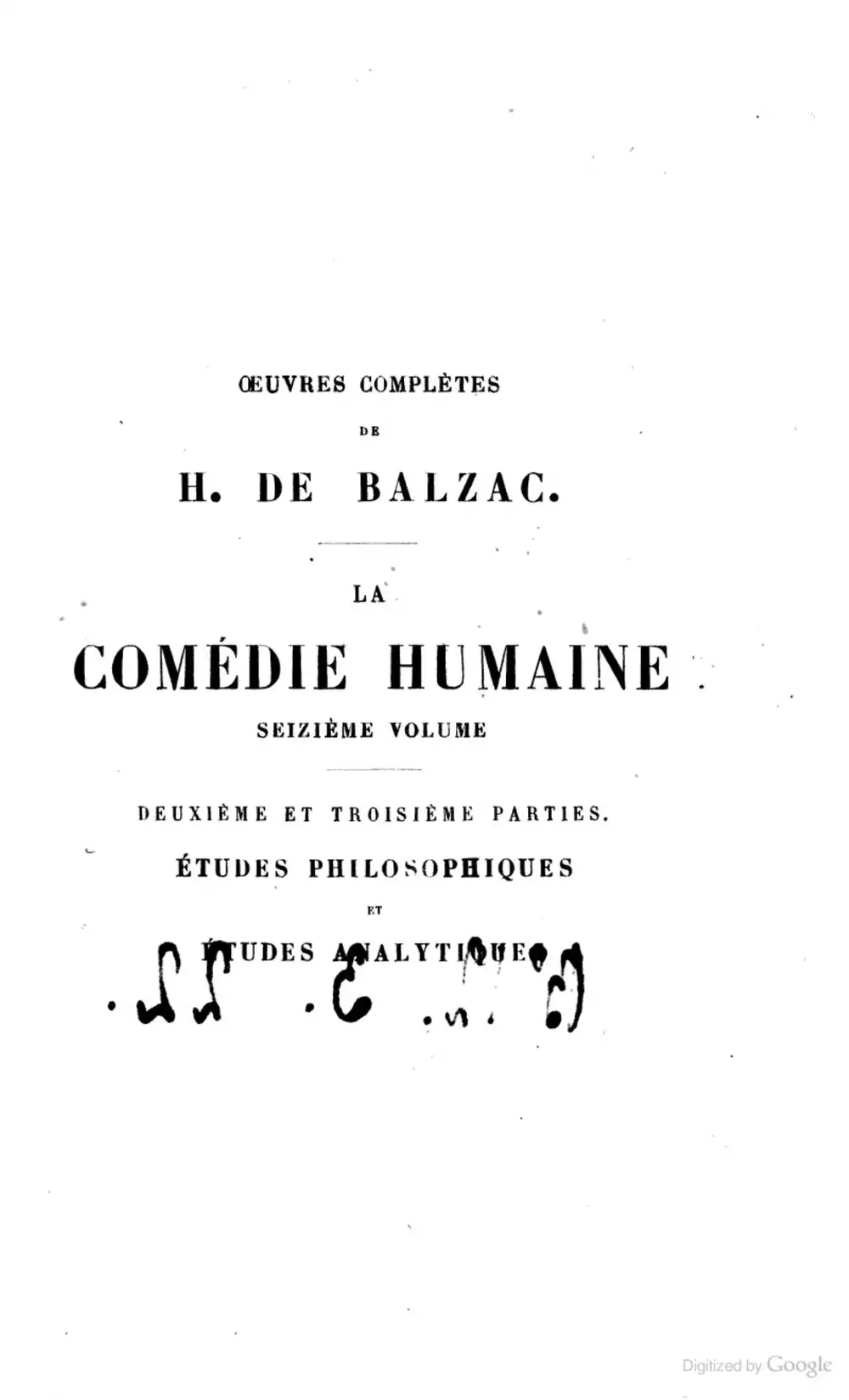
The Exiles (Les Proscrits), photo of the original
Photo of the original
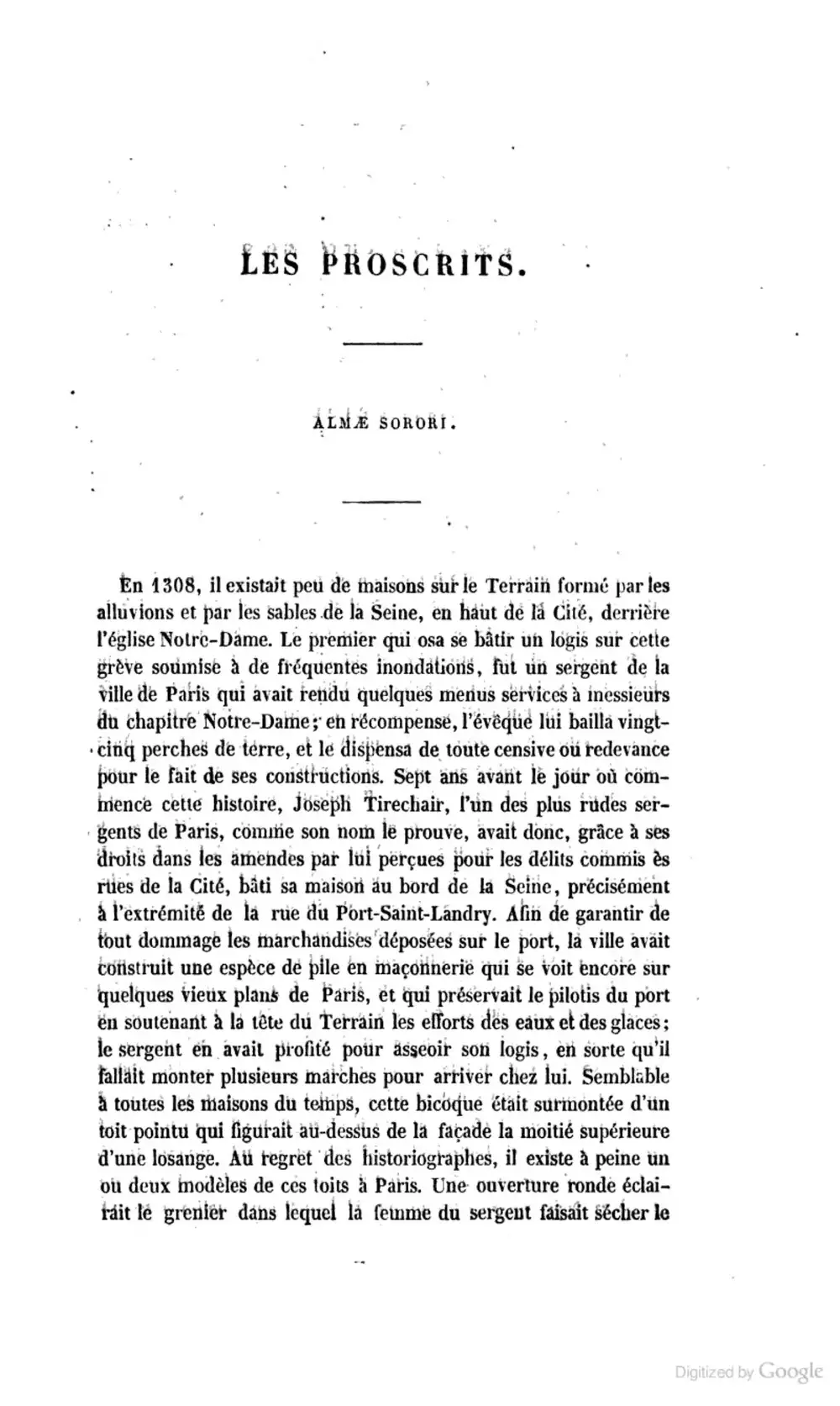
The Exiles (Les Proscrits), photo of the original · p. 79
Photo of the original · p. 79
page 1

Seven years before the beginning of this narrative, Joseph Tirechair, one of the sternest of Paris constables, as his name (Tear Flesh) would indicate, had, thanks to his share of the fines collected by him for delinquencies committed within the precincts of the Cité, been able to build a house on the bank of the Seine just at the end of the Rue du Port-Saint-Landry. To protect’ the merchandise landed on the strand, the municipality had constructed a sort of breakwater of masonry, which may still be seen on some old plans of Paris, and which preserved the piles of the landingplace by meeting the rush of water and ice at the upper end of the Island. The constable had taken advantage of this for the foundation of his house, so that there were several steps up to his door.

Like all the houses of that date, this cottage was crowned
(815)

:

p. 816

by a peaked roof, forming a gable-end to the front, of half a diamond. To the great regret of historians, but two or three examples of such roofs survive in Paris. A round opening gave light to a loft, where the constable’s wife dried the linen of the Chapter, for she had the honor of washing for the Cathedral—which was certainly not a bad customer. On the first floor were two rooms, let to lodgers at a rent, one year with another, of forty sous Parisis each, an exorbitant sum, that was however justified by the luxury Tirechair had lavished on their adornment. Flanders tapestry hung on the walls, and a large bed with a top valance of green serge, like a peasant’s bed, was amply furnished with mattresses and covered with good sheets of fine linen. Each room had a stove called a chauffe-doux; the floor, carefully polished by Dame Tirechair’s apprentices, shone like the woodwork of a shrine. Instead of stools, the lodgers had deep chairs of carved walnut, the spoils probably of some raided castle. Two chests with pewter moldings, and tables on twisted legs, completed the fittings, worthy of the most fastidious knights-banneret whom business might bring to Paris.

The windows of those two rooms looked out on the river. From one you could only see the shores of the Seine, and the three barren islands, of which two were subsequently joined together to form the He Saint-Louis; the third was the Ile de Louviers. From the other could be seen, down a vista of the Port-Saint-Landry, the buildings on the Gréve, the Bridge of Notre-Dame, with its houses, and the tall towers of the Louvre, but lately built by PhilippeAuguste to overlook the then poor and squalid town of Paris, which suggests so many imaginary marvels to the fancy of modern romancers.

p. 817

Commentary
page 1 ·
Cross-Estate§001

Les Proscrits in French, dedicated “Almae sorori”, and it opens on a piece of Parisian topography rather than on a character: in 1308 there were few houses on the silt and sand behind Notre-Dame, and the first man to build there was a city sergeant granted twenty-five perches of land by the bishop, free of dues. THREE FRENCH ISSUES AND ONE ENGLISH OMNIBUS: balzac:1, :2 and :3 are Séraphîta, Louis Lambert and The Exiles, and thread:balzac_seraphita_en is Wormeley’s English of all three in one volume. The archive holds this author twice over in two languages, and that correspondence is stated nowhere but here.

is translated as thread:balzac seraphita en