La Iniciación: Mensuario del Grupo Independiente de Estudios Esotéricos
The Initiation: Monthly of the Independent Group of Esoteric Studies
La Iniciación · Año VI, Nº 68 · December 1947
Gate passedSeeker and aboveModern transcription — not a facsimileGIDEE / Orden Martinista de América del SurOperator ruling: no copyright implications asserted for this work. Uruguay life+50 (Leo d. 1970 → PD 2020); US URAA restoration assessed at ~2041 in the collection plan and overridden by the operator.230 of 230 segments translated · 26 ppsha 8ce46b5da7a8…
primary
derivedpage 19
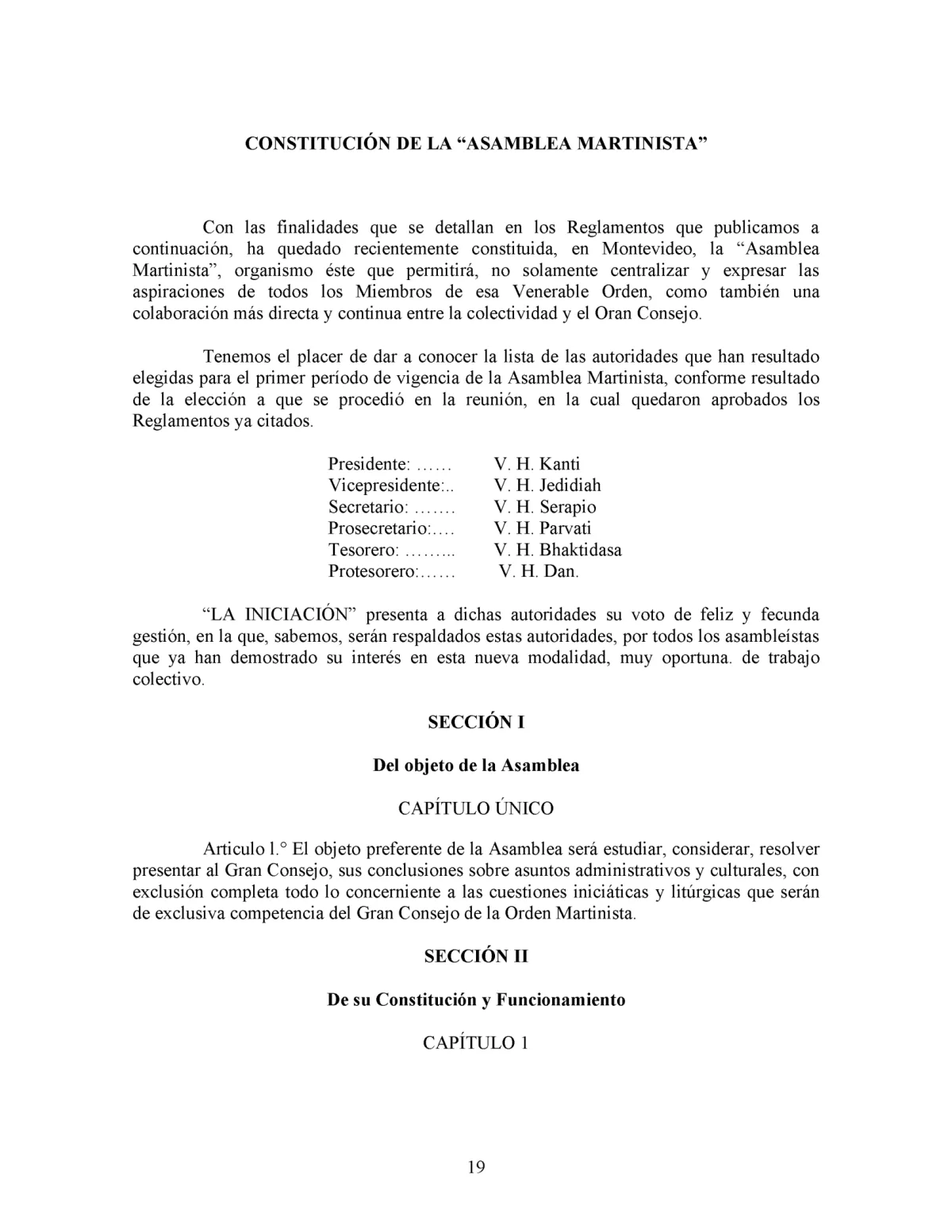
1CONSTITUTION OF THE "MARTINIST ASSEMBLY"
2With the purposes detailed in the Regulations we publish below, there has recently been constituted in Montevideo the "Martinist Assembly" — a body that will permit not only the centralising and expressing of the aspirations of all the Members of that Venerable Order, but also a more direct and continuous collaboration between the collectivity and the Grand Council.
3We have the pleasure of making known the list of the officers elected for the first period of the Martinist Assembly, following the result of the election held at the meeting in which the Regulations already cited were approved.
5"LA INICIACIÓN" offers these officers its wish for a happy and fruitful administration, in which, we know, these officers will be supported by all the assembly members who have already shown their interest in this new and most opportune modality of collective work.
6SECTION I On the object of the Assembly SOLE CHAPTER
7Article 1. The preferential object of the Assembly shall be to study, consider, resolve and present to the Grand Council its conclusions on administrative and cultural matters, with the complete exclusion of everything concerning initiatic and liturgical questions, which shall be of the exclusive competence of the Grand Council of the Martinist Order.
8SECTION II On its Constitution and Functioning CHAPTER 1
Our translation, period-faithful. Citable as our translation, never as the source.
Commentarywhole issue ·
Historical[P-V]ini:6.68:1:003
Nº 68 (December 1947) is the last issue the archive holds — and the run's most ethically consequential. It is also a COMPOSITE: only this cover leaf and the three other wrapper pages are photographed original paper; the body (pages 3–24 of the scan) is a modern retype. The wrapper leaves, moreover, do not belong to this number.
Historical[P-V]ini:6.68:2:001
This masthead is not from Nº 68. It still prints 'Redactor Jefe: Pitágoras' (a post vacated by his resignation in Nº 58 and gone from the plate by Nº 63), the full pseudonymous collaborator roster with degree-strings (replaced by the collective formula in Nº 47), and the overseas rate of 1.20 dollars (raised to 1.80 in Nº 47). The leaf is from Volume IV or early Volume V. Recorded rather than passed off: the label disagrees with the thing it labels.
Historical[P-V]ini:6.68:2:004
For all that, the roster is worth having in the corpus at full strength: sixteen collaborators with their degrees and specialities — SEVAKA kabbalist and philologist, JEHEL a 33∴, ASURI KAPILA yogi and chemist, PITAGORAS physician, LORELAIR and MAYA and MARTHA among the women — the fullest single statement of who wrote the review.
Historical[P-V]ini:6.68:3:002
The SUMARIO of the genuine December 1947 number: the sexual-magic article, the astrology course on conjunctions of significators, the sixth Dialogue of the Ninth Sphere, and the Constitution of the new 'Martinist Assembly'.
Historical[P-V]ini:6.68:4:001
'SEXUAL MAGIC AND MAGIC OF PURITY', by an unnamed S∴I∴, is the review's most direct intervention in the safeguarding of its own members. The dedication states the purpose exactly: 'to all those who, for whatever motive, might go astray OR BE LED ASTRAY BY THIRD PARTIES'. It is dated by a planetary configuration rather than a calendar date — written on a day of the conjunction of Venus with Jupiter.
Comparative[P-V]ini:6.68:4:003
The opening indictment is aimed inward: most Western Orders have abandoned evocative ritual because it was being worked by people who cannot be magi — 'still carnivorous and omnivorous, still sensual or at least sexual, still proud, ambitious, obstinate in opinions'. The article's authority comes from having said this about its own side first.
Historical[P-V]ini:6.68:5:005
The central claim, printed in capitals: FEW GROUNDS ARE SO FAVOURABLE TO SUCH MISTAKES AS THE CIRCLES IN WHICH HUMAN BEINGS SEEK TO ACCOMPLISH THE FIRST STEPS OF THE PATH. The author anticipates the indignation and answers it: the intention to seek elevated things is not the same as having realised them, and intellectual culture is not purity.
Historical[P-V]ini:6.68:6:006
The mechanisms are named without euphemism. The 'polarisation' pretext — that one must polarise oneself to realise elevated things, and the pole is conveniently whichever woman is nearest. The past-life pretext — feeling the attraction of 'the husband or wife of another incarnation' while the spouse of THIS one waits at home. And the plain sentence: every time a 'brother' or 'sister', under whatever pretext, induces you to amorous or sexual life, at that moment the purpose pursued is to satisfy his own sexual desire and nothing more.
Comparative[P-V]ini:6.68:7:003
The typology of offenders is unusually careful for 1947: the ingenuous who are talked into it; those 'more abnormal than scoundrels' who half-believe their own justifications; and those 'more scoundrels than abnormal' who have simply 'put on sheep's clothing' in the esoteric setting — 'the same animal in disguise'. The consequences catalogued are 'intimate dramas, possessions and madnesses, suicides or losses of social and moral position'.
Comparative[P-V]ini:6.68:8:002
The doctrinal core: one cannot LEAP from sensuality to universal love; chastity is transmutation, never imposition or pretence. The vegetarian analogy makes it concrete — he who 'wants to be' vegetarian before the moment has come will look at the hams in the delicatessen window. The Orders therefore classify disciples honestly instead of extracting vows they cannot keep.
Historical[P-V]ini:6.68:9:003
The rule stated for the married disciple is fidelity plus natural, spontaneous reduction of sexuality — and the guard clause is the article's ethical signature: that must be neither advised nor imposed by third parties, nor even forced by the interested parties themselves. Chastity is like goodness: no one acquires it by decree, his own or another's.
Comparative[P-V]ini:6.68:9:009
The self-examination proposed is unsparing and non-judgemental at once: chaste from birth, or sensual? — the great majority, the text says plainly, will answer the second, solitary acts included. From that honest answer, and not from pretension, the practical counsel follows.
Comparative[P-V]ini:6.68:10:003
The counsel to the reader turns the review's own observational discipline (Nº 63's attention exercises) toward consent: study your internal reactions, 'confess to yourself and warn yourself in time' when a presence, a contact or a glance awakens desire in you — or when you sense desire in the other. Self-knowledge here is a safeguarding tool.
Historical[P-V]ini:6.68:10:007
The counterweight to the whole indictment: ceremonial magic has not been abolished, it has been relocated. 'The Priest of any religion — pure of heart, chaste of body and of mind, who loves his parishioners impersonally — IS a Ceremonial Magus', as much when he counsels and consoles as when he celebrates a sacrament. The 'psychic force' of one Father Pinto is cited as having its roots in exactly those virtues.
Comparative[P-V]ini:6.68:11:007
The article ends by defining the alternative it named in its title. The magic of purity: purity of intention in beginning study; purity of position and conduct within it; purity of feeling toward fellow travellers; and real purity of veneration toward the Masters — 'not making of their texts or teachings PRETEXTS for fantasies'. The pun on texto/pretexto carries the whole argument.
Historical[P-V]ini:6.68:12:002
The astrology course reaches its last recorded instalment: the conjunctions of the significators, credited to 'the observations made by the great astrologers there have been' — the traditional-authority mode rather than the psychological one, and the harshest delineations in the run.
Historical[P-V]ini:6.68:13:004
The Saturn conjunctions read like a mediaeval judicial catalogue — prison, dying in misery, breaking a limb, persecution by libels. Surya has been running this course since Volume III; here it is at its most fatalistic, and least modernised.
Comparative[P-V]ini:6.68:14:012
The closing NOTE restores the course's saving principle: none of these effects holds absolutely, since any other planet's aspect modifies them — 'a favourable aspect of the Sun will improve the person's character'. Configuration, not destiny; the qualification the whole series depends on.
Historical[P-V]ini:6.68:15:002
The sixth Dialogue of the Ninth Sphere opens with the disclosure the earlier dialogues withheld: Antaeus had come to Magister from the edge of suicide. The metal structure, the ships' sirens, the blackish-green water beneath his feet, and 'the generous, warm and providential hand' that changed the course of his destiny — the frame narrative of the whole series is a rescue.
Comparative[P-V]ini:6.68:15:009
The question that governs the dialogue — why must pain be the unimpeachable guide of our existing? — is answered first in the modern register (pain as the opposite pole of pleasure) and then, for the Initiate, ceremonially: the answer must be earned by a rite, not merely stated.
Historical[P-V]ini:6.68:16:003
The rite is described in full and is the most detailed ceremonial the run prints: the lights lowered, a servant in a white tunic setting an onyx vessel at the crossing of the pantacle's two diameters, a blue flame, a pastorale played, three flowers — a rose, a lily and a lotus — laid in the eastern angle, and the atmic sign traced in the air. The room is 'transfigured into a Temple'.
Comparative[P-V]ini:6.68:17:002
The kabbalistic answer: Kether, the one without a second, is neither thinking nor sentient until a subject knows it — so it manifests as Hocma and Binah, and 'knows itself as Individual, but does not know itself as Person. It thinks, but does not feel'. The whole emanation exists so that feeling may become possible.
Comparative[P-V]ini:6.68:18:001
And therefore pain: the Soul, union of Kether and Malkuth, can only feel itself through contrast — 'to be cold in order to feel heat; to be in darkness in order to see light'. Pain is the most elevated manifestation of the Ancient of Days' loving charity, and the dialogue ends in benediction: Blessed be thou, pain… because thou revealest Love to us! The seed of Universal Pain germinates, it says, at the invisible centre of the Bread of Life — as in the philosophers' Stone.
Historical[P-V]ini:6.68:19:002
The last document of the run is constitutional: the founding of a 'Martinist Assembly' in Montevideo, with its first officers named — President Kanti, Vice-President Jedidiah, Secretary Serapio, Assistant Secretary Parvati, Treasurer Bhaktidasa, Assistant Treasurer Dan. After Nº 62's 'glass politics' and Nº 63's 'little for few', the Order gives its members a formal deliberative body.
Comparative[P-V]ini:6.68:19:007
The dividing line is drawn in Article 1: the Assembly handles administrative and cultural matters, 'with the complete exclusion of everything concerning initiatic and liturgical questions', which stay with the Grand Council. Democratic form for the outer organisation, initiatic authority untouched — the settlement the two Martinism articles were working toward.
Historical[P-V]ini:6.68:20:006
Article 6 is the striking one: Grand Council members sitting in the Assembly 'shall lose their official investiture', voting like any martinist present. The governing body deliberately disarms itself inside the chamber it created.
Comparative[P-V]ini:6.68:21:001
But Article 13 keeps the balance: Assembly resolutions become obligatory only after Grand Council approval — and Article 14 requires the Council to give REASONS when it rejects or amends them. Accountability without surrendering authority.
Historical[P-V]ini:6.68:22:001
The qualification rules define the Order's actual working membership: dues paid (or formally exempted) and habitual attendance at ceremonies; free martinists need their Initiator's authorisation. Three months' arrears or three consecutive absences cost the vote — the same administrative discipline the news pages of Nº 50 announced.
Historical[P-V]ini:6.68:23:002
Among the Assembly's attributions, the most consequential is (f): 'to censure the martinists whose conduct harms the Martinist Order.' Set beside the sexual-magic article at the front of this same number, it is the enforcement clause for the warning: the collectivity is given a formal power to call its own members to account.
Historical[P-V]ini:6.68:24:007
The electoral rules close the run: one-year terms, re-election for at most two consecutive periods, elections each April, oral voting when more than one list stands. The last thing La Iniciación prints in this archive is a procedure for changing its own leadership.
Historical[P-V]ini:6.68:25:001
This GEIDE plate is likewise photographed from an earlier issue: six courses only (no S. DEVI, no second and third year astrology), and the La Plata address at Calle 60 Nº 987, superseded by Calle 4 Nº 639 during 1946. It shows the school at an earlier moment than the number it is bound into.
Historical[P-V]ini:6.68:26:001
The final leaf, also an earlier state: the two Buenos Aires libraries without the Pryse and Castellot titles that Nº 50 had already announced. Four wrapper leaves from an earlier year, wrapped around a December 1947 body — the archive's copy of the run's last surviving number is, quite literally, assembled from what remained.