La Iniciación: Mensuario del Grupo Independiente de Estudios Esotéricos
The Initiation: Monthly of the Independent Group of Esoteric Studies
La Iniciación · Año V, Nº 50 · June 1946
Gate passedSeeker and aboveGIDEE / Orden Martinista de América del SurOperator ruling: no copyright implications asserted for this work. Uruguay life+50 (Leo d. 1970 → PD 2020); US URAA restoration assessed at ~2041 in the collection plan and overridden by the operator.295 of 295 segments translated · 40 ppsha 0fab92020477…
primary
derivedpage 21
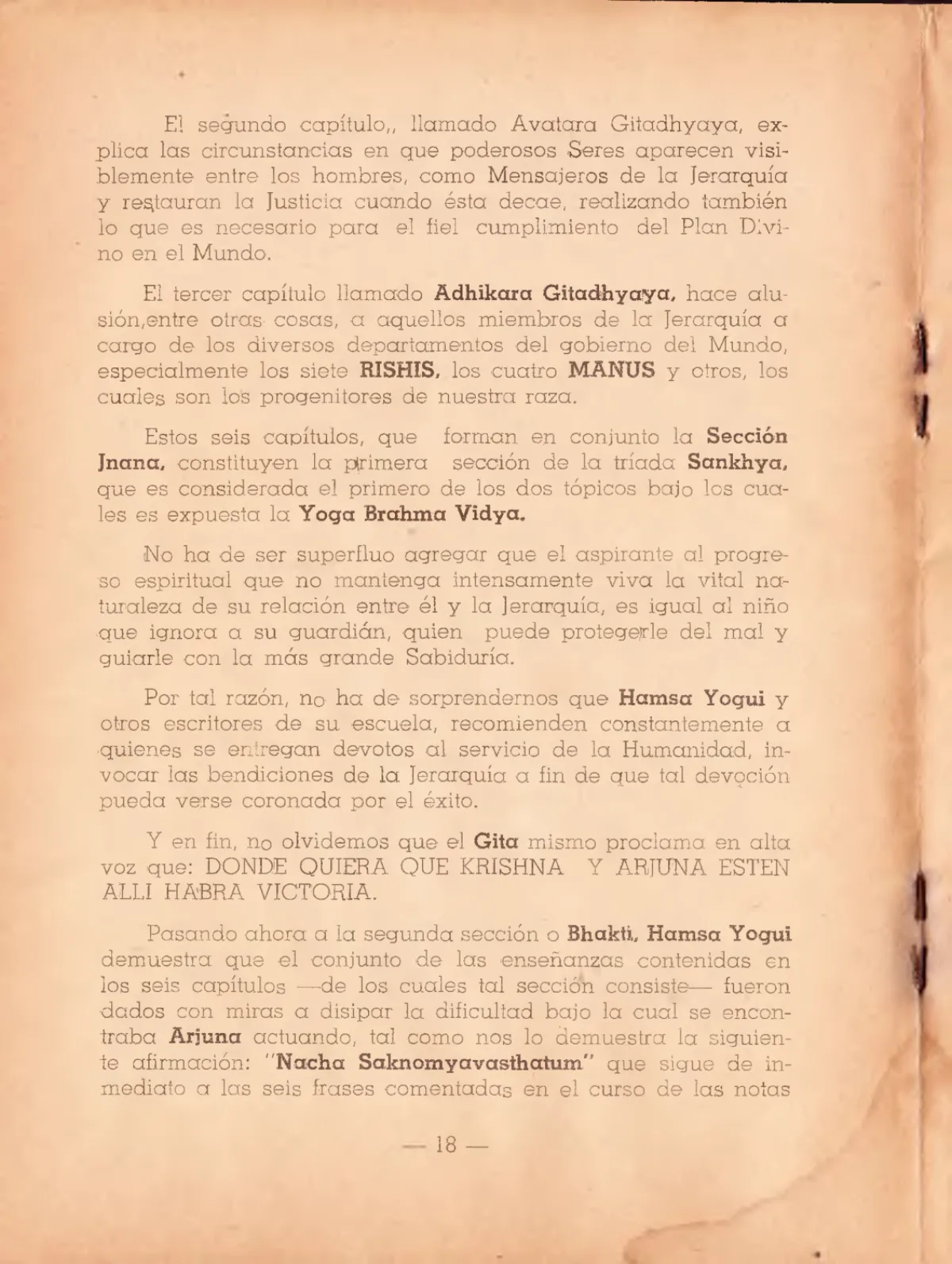
1The second chapter, called Avatara Gitadhyaya, explains the circumstances in which powerful Beings appear visibly among men, as Messengers of the Hierarchy, and restore Justice when it declines, accomplishing also what is necessary for the faithful fulfilment of the Divine Plan in the World.
2The third chapter, called Adhikara Gitadhyaya, alludes, among other things, to those members of the Hierarchy in charge of the various departments of the government of the World, especially the seven RISHIS, the four MANUS and others, who are the progenitors of our race.
3These six chapters, which together form the Jnana Section, constitute the first section of the Sankhya triad, which is considered the first of the two topics under which the Yoga Brahma Vidya is expounded.
4It will not be superfluous to add that the aspirant to spiritual progress who does not keep intensely alive the vital nature of the relation between himself and the Hierarchy is like the child who ignores its guardian, who can protect it from evil and guide it with the greatest Wisdom.
5For that reason, it should not surprise us that Hamsa Yogui and other writers of his school constantly recommend to those who give themselves devotedly to the service of Humanity to invoke the blessings of the Hierarchy, so that such devotion may be crowned with success.
6And finally, let us not forget that the Gita itself proclaims aloud that: WHEREVER KRISHNA AND ARJUNA ARE, THERE WILL VICTORY BE.
7Passing now to the second section, or Bhakti, Hamsa Yogui demonstrates that the whole of the teachings contained in the six chapters — of which that section consists — were given with a view to dissipating the difficulty under which Arjuna found himself acting, as the following affirmation shows us: "Nacha Saknomyavasthatum", which immediately follows the six phrases commented upon in the course of the notes
Our translation, period-faithful. Citable as our translation, never as the source.
Commentarywhole issue ·
Historical[P-V]ini:5.50:1:001
The back cover's lists have grown since the retyped issues' frozen stereotype: both libraries now split PUBLISHED from IN PREPARATION, J. Castellot's 'Treatise on Alchemy' joins the Martinist list, and Kier's list adds James M. Pryse's 'The Apocalypse Unsealed' at 3.50 — with Kier's street address, Talcahuano 1075, printed for the first time.
Historical[P-V]ini:5.50:2:001
Nº 50 survives as the only original-paper issue of Volume V in this archive — actual 1946 stock, scanned in colour. The cover compositor omitted the volume numeral: it reads 'Año — Junio 1946 — N.º 50', while the inner title page prints 'Año V'. Transmitted as printed.
Historical[P-V]ini:5.50:3:001
The inside-cover masthead is the original printing that the retyped issues (Nºs 47–49) reproduced — and it confirms their fidelity down to the compositor's numeral zero in 'URUGUAY0'. What the retypes carried as a curious typo is the authentic state of the plate.
Historical[P-V]ini:5.50:4:002
The title page numbers itself '— 1 —': the printed issue counts its pages from here, so the scan's forty images map to thirty-six printed pages plus covers. The SUMARIO announces two new serials — Jehel's 'Living Reality of Symbolism' and Barlet's 'Synarchy' — beside the continuing courses.
Historical[P-V]ini:5.50:5:001
A page the retypes never carried: the distribution directory. Agents and bookshops in ten countries — Kier and Saborido in Buenos Aires; four addresses across Brazil (Porto Alegre, São Paulo, Belo Horizonte, Rio); the Librería Orientalista in Santiago; Cali, Bucaramanga and Barranquilla in Colombia; San José, México D.F., Panamá and Caracas — the concrete map of the review's continental reach in mid-1946.
Historical[P-V]ini:5.50:6:001
Jehel opens 'Living Reality of Symbolism' with a method statement: read with the intellect, then 'see' in space with the abstract mind, then meditate each part into the individual life — three steps from concept to realisation. The series is headed by the Kabbalistic Rose Cross pentagram, extracted here from this original impression.
Comparative[P-V]ini:5.50:7:007
The article turns the review's own cover into its meditation object: 'take the cover of the review and look at the sun represented there' — the sunburst as an abstract point determined by converging rays. The magazine teaches with its own body; no other article in the run does this so literally.
Comparative[P-V]ini:5.50:8:006
The dialectic of the point — concrete sphere shrunk without vanishing, abstract void where infinite rays converge, and the measureless translucent sphere that contains all — walks the reader from geometry to metaphysics along the classical line: the point, the 'consciousness of being', and the sphere whose centre is everywhere.
Historical[P-V]ini:5.50:9:003
The exercises are a guided practice printed in full: 'I, without what surrounds me… AM A POINT THAT HAS CONSCIOUSNESS OF BEING… I AM……AM………M……' — dissolving the affirmation syllable by syllable — followed by 'I AM NOT' (the soap-bubble consciousness) and 'I AM AND I AM NOT' (the pendulum of breath). The closing note asks that they be performed daily until the next number: the review as a correspondence course in meditation.
Historical[P-V]ini:5.50:10:001
'Ch. Barlet' is François-Charles Barlet (Albert Faucheux, 1838–1921), Saint-Yves' direct disciple and the elder statesman of the Papus circle — the same Barlet whom Nº 47's memorial quoted as witness to the Saint-Yves–Keller marriage. The editorial footnote gives the provenance: translated by Pitágoras from La Gnose, March 1910, No. 5, pages 79 to 82 — the review's third text drawn from Guénon's short-lived journal, after the Demiurge serial.
Comparative[P-V]ini:5.50:11:007
Barlet compresses Saint-Yves' three Missions into a single scheme: three social functions — spiritual, common, political — from which follow Authority (essence Fraternity, the Priesthood), the Electorate (essence Liberty), and Power (essence Equality, doubly bound). The French Revolutionary triad is redistributed: each term becomes the essence of a distinct social organ rather than a slogan of one.
Comparative[P-V]ini:5.50:12:005
The observation on Economy — unity 'establishes itself from below' on the plane of personal interests, while the other functions come 'from above' — grounds the synarchic scheme's most liberal feature: economic life is left to the widest liberty of the Electorate, while mental life binds only conscience, through Authority.
Historical[P-V]ini:5.50:13:001
The closing table gives the whole constitution at a glance: three electoral Colleges, three Councils drafting Law (candidates vetted by Authority through examinations), and three Ministers — the Primate, the Sovereign Justiciar (head of the Executive), the Grand Econome — with the priestly hierarchy 'educated by Initiation' and crowned by a supreme Pontificate above. Saint-Yves' Europe of Nº 47, rendered as an organisational chart.
Historical[P-V]ini:5.50:14:002
The astrology course continues its planets-in-signs cycle: after Saturn in Nº 49, Jupiter, 'the most benefic planet' — with the compositor contributing 'AIRES' for Aries and 'PICIS' for Pisces, transmitted as printed.
Historical[P-V]ini:5.50:15:002
The delineations keep the course's textbook cast; the note that Jupiter's influence 'will be most felt after the middle of life' and the power of 'the 15 degrees' of Cancer (its exaltation degree in the classical lists) show the traditional dignities running under the modern psychological prose.
Comparative[P-V]ini:5.50:16:004
Jupiter in Sagittarius 'in its own sign' — the course's moral polarity is at its plainest here: the same planet gives honours and a broad philosophic mind, or gambling, litigation and sectarian fanaticism, entirely according to aspect. Character is configuration, not fate: the course's constant teaching.
Historical[P-V]ini:5.50:17:003
The Jupiter cycle closes with Aquarius and Pisces; the misprint 'Jújiter' passes the compositor's hand. With Saturn and Jupiter done, the sign-by-sign march has ten planets to go — a serial designed to run for years.
Historical[P-V]ini:5.50:18:001
The Suddha Gita commentary resumes after its one-issue interruption (Nº 49 gave its pages to the Pilgrim of the Full Moon), under the order's OM seal. The doctrine of Avatars manifesting 'in epochs of great cyclic changes', and of the Brahmic Power's asuric and Daivi phases, frames the Kurukshetra story as perpetual history.
Historical[P-V]ini:5.50:19:004
The six Sanskrit phrases of Arjuna's collapse — trembling limbs, parched mouth, quivering body, bristling hair, the slipping bow, burning skin — are tabulated as the keys to the six chapters: the Suddha method of reading physiology as esoteric architecture, each symptom a doorway.
Comparative[P-V]ini:5.50:20:002
Hamsa Yogi's advice to read the chapters backwards, beginning from KAIVALYA GITADHYAYA — the goal first, then the causes, then the discipline — inverts the narrative into a curriculum: teleology as pedagogy, the same reverse-engineering the review applies to symbols generally.
Historical[P-V]ini:5.50:21:002
The Hierarchy chapter names the seven RISHIS and four MANUS as 'progenitors of our race' — the Suddha school's cosmological frame for humanity as a whole (raza here means the human stock in the theosophical idiom, not any people among peoples). Kept as self-cosmology under the estate's excision rule.
Comparative[P-V]ini:5.50:22:006
The Bhakti section's six topics — Kama, Iccha, Sankalpa, Chinta, Dhyana, Bhakti — ladder desire itself into devotion: the commentary reads Arjuna's want of will-power not as weakness to condemn but as the exact material the Master's analysis transmutes. Deva and Asura are aspects of the one aspirant.
Historical[P-V]ini:5.50:23:005
The instalment breaks off announcing the Maya Gita as 'of the highest importance' — the serial's cliffhanger discipline, carried across the interruption of Nº 49 and pointing into Volume VI.
Historical[P-V]ini:5.50:24:002
The chromotherapy course begins its colour-by-colour pharmacopoeia. Under RED: Dr. Potheau of Nice, and — misprinted 'Reghault' — the Regnault the series has cited since Nº 48; the claims are the French photo-therapy literature of 1900–1930 transmitted whole.
Historical[P-V]ini:5.50:25:002
Niels Finsen of Copenhagen is real and canonical: his Institute of Phototherapy won the 1903 Nobel Prize in Medicine for light-treatment of lupus vulgaris. The red-glass smallpox wards, Regnault's 1902 communication on Sino-Indochinese practice, and Dubard's 1904 fuscine-bandage control — 'the effect is not chemical but vibratory' — are the course's evidentiary spine for red.
Comparative[P-V]ini:5.50:26:002
Red's absence and excess are read across the three bodies — haemoglobin in the physical, benevolence in the astral, optimism in the psychic — the tidy triple bookkeeping the course established in Nºs 47–49, now applied colour by colour as a clinical table.
Historical[P-V]ini:5.50:27:008
Orange's disease-list carries the course's characteristic posology — 'after 20 days employ purple for 6 days' for diabetes — dosing colour like a drug, with alternations and antidotes; the pharmaceutical form is borrowed whole from the dispensary.
Historical[P-V]ini:5.50:28:009
Yellow closes the instalment with its bactericidal claim against Koch's bacillus (printed 'Kock') and a disease-list crediting Dr. White — colour therapeutics presented throughout with laboratory citations, the review's constant strategy of scientific dress for hermetic content.
Historical[P-V]ini:5.50:29:001
Sister Fátima's meditation was read at Papus Centre N.º 5 on 10 May 1946 — the third Centre lecture printed this volume (after Saint-Yves in Nº 47 and Ramakrishna in Nº 48). It is also a document of practice: the work began as an inspiration to PAINT the alchemical phoenix, and the text meditates the painting part by part.
Comparative[P-V]ini:5.50:30:001
The phoenix's pyre is built of moral matter: the imperfect cross of Good and Evil that cannot touch the circle of Divinity at the four cardinal virtues, burned by 'small and very few flames' of consciously accepted sorrow. Alchemy is read entirely as inner regeneration — no laboratory residue remains.
Comparative[P-V]ini:5.50:31:006
'All... through: INRI. AMEN' — the meditation ends on the alchemical reading of INRI (Igne Natura Renovatur Integra, nature renewed entire by fire), the quaternary 'written with flaming fire at the highest point of the symbol'. The rose materialising over KETHER in the following dialogue answers this ending across the page-break: the issue's two literary pieces are a diptych.
Historical[P-V]ini:5.50:32:001
'Dialogues of the Ninth Sphere', Dialogue II — the author signs 'Wrowski' here and 'Wronski' in the SUMARIO, a lodge-name honouring the Polish messianist mathematician Hoene-Wroński, whom Éliphas Lévi revered. The dialogue form: Magister initiates the disciple Anteo in a narrative that is in fact a ritual transcript.
Comparative[P-V]ini:5.50:33:004
The vision sequence is precise practice under narrative veil: three interlaced spheres (blue, red, yellow) in a triangle at the brow; seven colour-spheres arrayed along the spine; the gesture to the brow with 'Per into' answered by AUM, to the solar plexus with 'Malkuth' answered by AMN. This is the Kabbalistic Cross with the sephirothic names, written as a tale — the closest the review has come to printing ceremonial magic.
Historical[P-V]ini:5.50:34:001
The ritual completes: Guedulah at the left, Geburah at the right, the column of light, the three-knotted rod dividing it into the four letters of the Name — then KETHER traced by the sceptre and the rose shedding petals of dew. The rainbow between the columns bears the four Powers of the Sphinx: To Will, To Dare, To Know, To Keep Silent. Dedicated to the glory of the G∴A∴D∴U∴ — the Masonic Great Architect.
Historical[P-V]ini:5.50:35:001
The NOTICIARIO covers 15 April to 15 May 1946: Jehel lecturing on Masonic-Rosicrucian-Gnostic symbolism the first Tuesday of each month, Asuri Kapila on 'Lama Initiations and Initiates of Tibet' the third Thursday; and the Spiritualist Congress on Reincarnation organising in Buenos Aires under the Argentine Spiritist Federation with theosophists and martinists cooperating — the continental spiritual milieu in motion.
Historical[P-V]ini:5.50:36:006
The Suddha news closes the loop opened in Nº 49: the Full Moon of Vaysak was celebrated in all seven ashramas — Montevideo, Buenos Aires, Porto Alegre, Curitiba, São Paulo, Belo Horizonte, Rio de Janeiro — 'in bond with the Great Ceremonial performed in India, in the Sacred Woods of Badari'; and the practice census counts 103 disciples across nine practice-grades. The order's administrative page doubles as a demographic record; note too the Martinist discipline above it — identity cards, activity cards for 1946, automatic inactivity — and the memorial for V.H. PYTHOS of Belo Horizonte, whose five orphaned children the continent's brothers are asked to pray for.
Historical[P-V]ini:5.50:37:001
The Maha Boddhi Sangha news names Upasika as 'President of the Maha Boddhi Sangha on this continent', travelling to Buenos Aires and Santa Fe 'in the company of her distinguished husband' and working with the Martinist brothers — the review's Buddhist teacher (her course runs on the back-cover roster) was also its travelling ambassador. Correspondence to 'H. Upasika', Casilla 317: every order in the ecosystem shares the one Montevideo post-box.
Historical[P-V]ini:5.50:38:004
A full-page advertisement for 'Perfumes Lin-Yu-Tang' — devotional incense-perfumes 'of India and Tibet' in four formats up to a two-hour meditation coil — sold by the firm of Léo de Mascheville, Casilla 317, Montevideo, and through Kier in Buenos Aires, under a halftone Ganesha. The Mascheville family enterprise appears here under its civil name in the review's own pages: the group's spiritual and commercial economies ran through the same post-box.
Historical[P-V]ini:5.50:39:004
The subscription form — a cut-out coupon with lines for remittance number, month, name, street, city and country — assumes the continental readership the page-2 directory maps; nothing like it survives in the retyped issues.
Historical[P-V]ini:5.50:40:003
The original G∴E∴I∴D∴E∴ plate is richer than the stereotype the retypes carried: full weekly timetables (Jehel Tuesdays 20 h, Asuri Kapila Thursdays 19 h…), Surya teaching three year-levels of astrology, a NEW teacher — Sister S. DEVI, Astrology 1st year — a public-lectures line, and the La Plata contact moved to Calle 4, N.º 639. The retypes' plate froze an earlier state; the original shows the school as it actually ran in mid-1946.