The SUMARIO leads with institutional history: the reform dossier occupies pages 4 through 11 — a third of the number given to the Order's own constitutional documents.
Fetching
One moment.
Fetching
One moment.
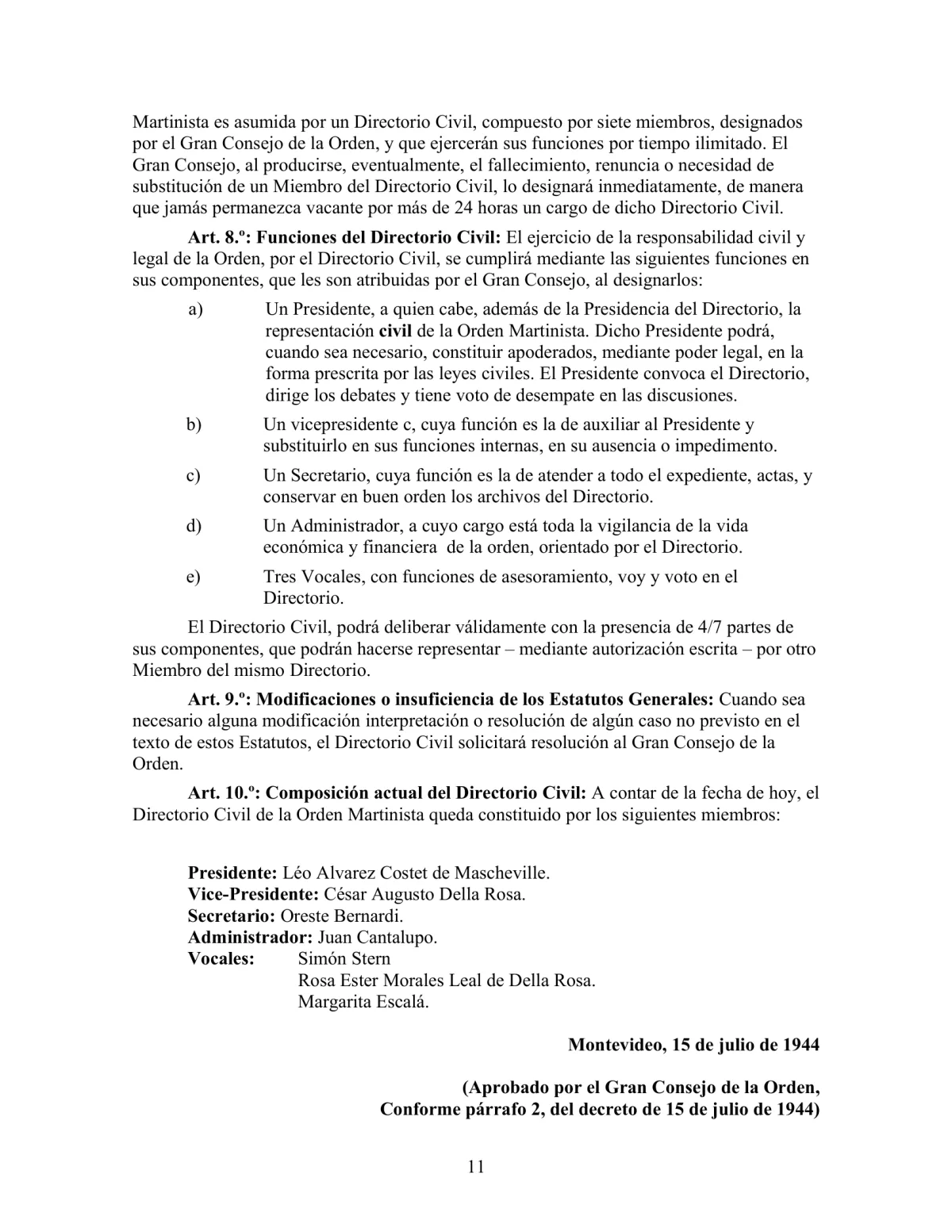
1Order is assumed by a Civil Directorate, composed of seven members, designated by the Grand Council of the Order, who will exercise their functions for unlimited time.
2The Grand Council, upon the eventual death, resignation or need for substitution of a Member of the Civil Directorate, will designate him immediately, so that no office of the said Civil Directorate ever remains vacant for more than 24 hours.
3Art. 8.º: Functions of the Civil Directorate: The exercise of the civil and legal responsibility of the Order by the Civil Directorate will be fulfilled through the following functions among its components, attributed to them by the Grand Council on designating them: a) A President, to whom falls, besides the Presidency of the Directorate, the civil representation of the Martinist Order.
4The said President may, when necessary, appoint attorneys, by legal power, in the form prescribed by the civil laws.
5The President convokes the Directorate, directs the debates and has the casting vote in discussions.
6b) A Vice-President, whose function is to assist the President and substitute him in his internal functions, in his absence or impediment. c) A Secretary, whose function is to attend to all correspondence and minutes, and to keep the archives of the Directorate in good order. [Sic: a stray letter follows Vice-President in the Spanish.]
7d) An Administrator, in whose charge is all the vigilance of the economic and financial life of the Order, oriented by the Directorate.
8e) Three Voting Members, with functions of counsel, voice and vote in the Directorate. [Sic: the Spanish prints voy, for voz.]
9The Civil Directorate may deliberate validly with the presence of 4/7 parts of its components, who may have themselves represented — by written authorisation — by another Member of the same Directorate.
10Art. 9.º: Modifications or insufficiency of the General Statutes: When some modification, interpretation or resolution of some case not foreseen in the text of these Statutes is necessary, the Civil Directorate will request resolution from the Grand Council of the Order.
11Art. 10.º: Present composition of the Civil Directorate: Counting from today's date, the Civil Directorate of the Martinist Order is constituted by the following members: President: Léo Alvarez Costet de Mascheville.
12Vice-President: César Augusto Della Rosa.
13Secretary: Oreste Bernardi.
14Administrator: Juan Cantalupo.
15Voting Members: Simón Stern, Rosa Ester Morales Leal de Della Rosa,
16Margarita Escalá.
17Montevideo, 15 July 1944. (Approved by the Grand Council of the Order, in conformity with paragraph 2 of the decree of 15 July 1944.) · 11
Our translation, period-faithful. Citable as our translation, never as the source.
The SUMARIO leads with institutional history: the reform dossier occupies pages 4 through 11 — a third of the number given to the Order's own constitutional documents.
The reform dossier: the Grand Council asked the review for extra pages to print the Introduction, the Decree of 15 July 1944 and the General Statutes in full. The stated 40-page expansion survives as 28 in this retype — the retype consolidates, it does not cut the documents. "Martinist Order of South America" becomes simply MARTINIST ORDER.
The renaming is grounded in "the voluminous and very well documented work on the History of Martinism" Pitágoras has been writing for three years — the chronology serial running in these very numbers is its published spine.
→ martinez-de-pasqually
The four-point contrast with Lyon: the European successor organisation (masons only, no women, no occultism, no East) against this Order's four counter-declarations — women initiated equally, all investigation admitted, East and West equivalent. The Río de la Plata Martinism defining itself against Papus's European heirs, by correspondence with them.
Masthead stereotype unchanged; the number opens straight into the Order's reform dossier.
March 1945; the wrapper drops the "de" from its date line this month.
→ ini:4.34
"There are no more lodges" — the whole masonic vocabulary is swept out: Centres are "true Temples", Study Groups are officialised, protocolary titles reduced to "Venerable" as "an ideal to realise". Degrees now by examination or by merit up to the third.
The identity reform: recognition by Identity Card and "constructive, cordial, altruistic acts", explicitly renouncing secret words and handshakes — "a cultural and spiritual society that is not secret". A de-occultation of membership mechanics rare for 1945.
Jehel's closing figure — "Let us be the gardener, the garden and the tree" — and the reform's motto: "speak less and realise more: the means are these".
The Decree, dated Montevideo 15 July 1944, signed by the working Grand Council: JEHEL president, ASURI KAPILA vice-president, PITÁGORAS secretary, SURYA administrator — the review's four pseudonymous pillars holding the Order's four offices.
Article 6 of the Statutes: membership unlimited, "no distinctions of race, colour, sex, nationality or religion will be made" — the excision scan flagged the sentence; it is the boundary's opposite: an explicit anti-discrimination clause, printed 1945.
The Civil Directorate names civil names: Léo Alvarez Costet de Mascheville president — the Mascheville family continuing at the head after Cedaior's death — with Della Rosa, Bernardi, Cantalupo (the review's own administrator), Stern, Morales Leal de Della Rosa and Escalá. Three of seven are women. The fullest civil-name roster the run has printed.
Willermosism opens: the chronology restarts at Lyon 1730 — the silk-trade apprenticeship, the unidentified 1750 lodge, Venerable at 22, the Parfaite Amitié and the Grand Mother Lodge of the Regular Masters. The compositor's numerals wander again (WILLERMOS1SMO), mirrored with glosses.
→ ini:4.34
The Chevaliers de l'Aigle Noir Rose Croix (1763) — astrological, kabbalistic and alchemical masonry, with the future Cohens (Bacon de la Chevalerie, Rozier, Paganucci, Monge) already assembled — the column's argument that Willermoz's Lyon was Cohen soil before Pasqually arrived.
CAPRICORN: Burgoyne's harshest sign-reading — sin, the scapegoat, "material servitude", natives on "the initial steps of true spirituality" — printed without softening; the course keeps its source's severity as faithfully as its praise.
→ thread:light_of_egypt_v1
Julevno's Capricorn portrait — "subtle, malign, ingenious, envious" — with the course's standing caveat: "very good aspects modify such indications". The severity is doctrinal, not personal.
The sixth face's "effeminate, libertine person… all by way of pastime" — the old authors' moralising typology transmitted verbatim; the course's historical honesty extends to its sources' prejudices.
Baddha Padmasana — the asana course resumes with the bound lotus: numbered steps, the 7-7-7 breath with OM, the "half posture" for the first two months, and nine claimed benefits — keyed to the charcoal plate on the next page.
The Baddha-Padmasana plate — the fifth asana figure of Kapila's series, charcoal like the Nº 34 mudras, captioned in the block. Registered to the imagery layer; the 40-minute-to-an-hour target printed beside it.
The Buddhist calendar promised in Nº 34 arrives: Maitreya on 1 January, Mitra Deva's birth on 16 January (the S.D.M. date folded into the Buddhist year), Nirvana day, Wesak, the White Lotus day for Blavatsky ("Upasika"), Bodhidharma, Amitabha, Tson-Kha-Pa — with fasting hours in Uruguayan time throughout.
→ ini:4.34
Lhasa and Kumbum's "Feast of the flowers" for Tson-Kha-Pa, the Uposatha fast-days, Ceylon's Poson for Mahinda — the calendar's reach is genuinely pan-Buddhist, assembled from the standard orientalist literature into a devotional almanac.
The Avatara serial, part II: Rinkhana's Daivi Prakriti vesture, the Kshatriya household of Maharashtra, birth at the Full Moon of Pushya — dated 16 January 1919 here where the calendar page prints 1916: the order's own sources disagree by three years, and both printings are preserved.
The ten-verse Mangala Sloka sung at the child's entry into the Maha Guha — "to instruct the race in the truths… of the Ancient Dharma": reviewed under the boundary; "the race" is humanity entire, and the passage is kept as the order's liturgy.
The Prakriti footnote is the serial's doctrinal core: Maya as Brahma-Sakti "never illusion", the three vestures (Daivi, Kalyani, Sarupa) — and the argument that Mitra Deva, though a smaller amsa than Rama or Krishna, is freer, because his vesture is higher: "the mission of the other great Avataras was for one race; the object of the present Advent is… the whole world, composed of many races."
The science serial turns meteorological: barometric pressure, mountain sickness read through aviators and the pneumatic chamber, anoxaemia and acapnia — 1940s aviation physiology cited to Bert, Viault, Jacquet and Galeotti.
The altitude-adaptation account is textbook-accurate for its date: apparent hyperglobulia resolving into true marrow hyperactivity after 8-10 days — the column at its most soberly scientific, no hermetic key this month.
Dhyâna's poem "To Be" closes the number: the drop that would be sea — "to wish to be much and to be little" — the Literary Part's smallest and most exact devotional lyric to date.
GIDEE prospectus stereotype at page 27.
→ ini:3.30
Library back cover and imprint carry forward; the reform number closes the same as its neighbours.