October 1944; the sunburst cover of the Nº 28 redesign carries forward.
→ ini:3.28
Fetching
One moment.
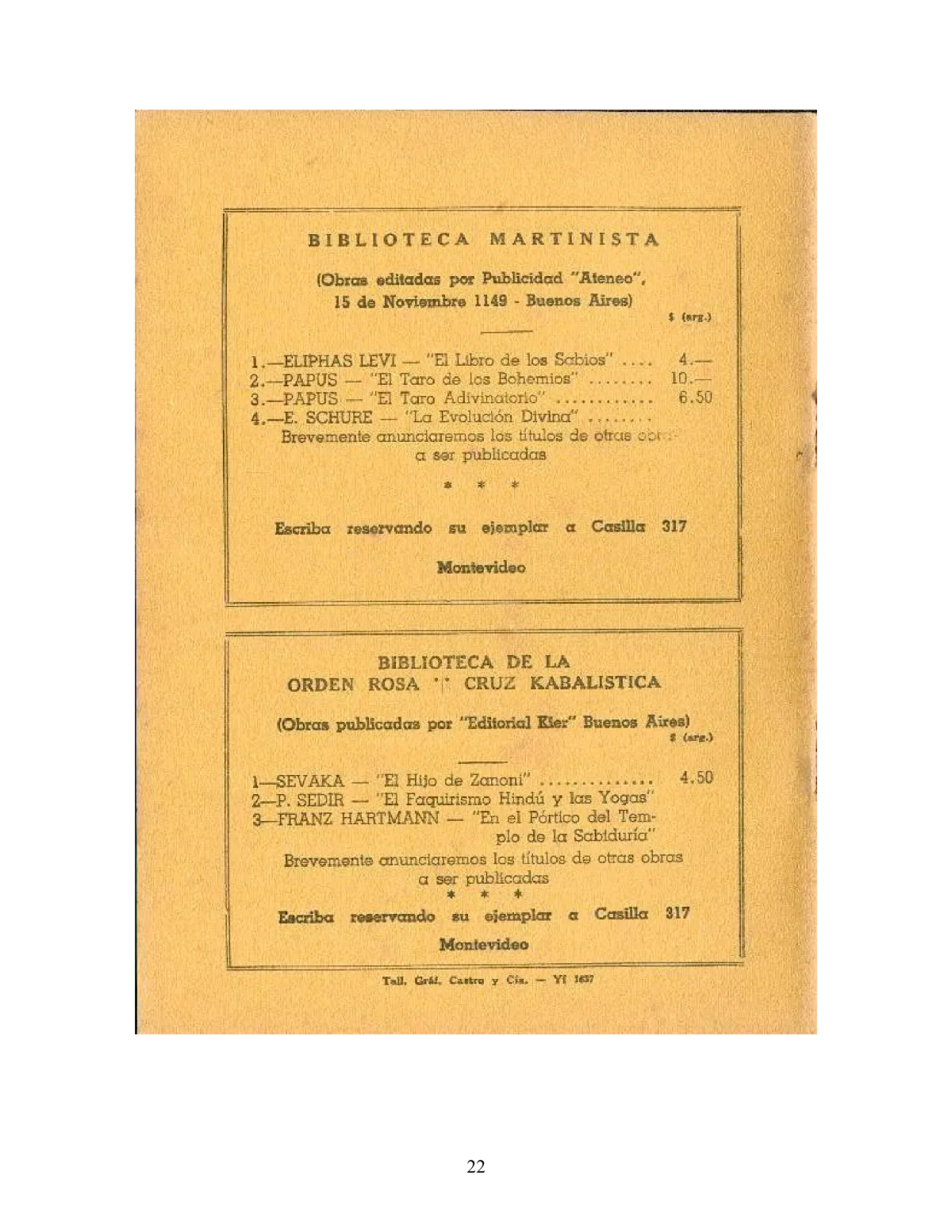
1MARTINIST LIBRARY (Works published by Publicidad "Ateneo", 15 de Noviembre 1149 - Buenos Aires). $ (arg.) 1.—ELIPHAS LEVI — "The Book of the Sages" .... 4.— 2.—PAPUS — "The Tarot of the Bohemians" ........ 10.— 3.—PAPUS — "The Divinatory Tarot" ............ 6.50 4.—E. SCHURE — "The Divine Evolution" ........
2Shortly we shall announce the titles of other works to be published
3Write reserving your copy to Casilla 317 Montevideo
4LIBRARY OF THE KABBALISTIC ROSE CROSS ORDER (Works published by "Editorial Kier", Buenos Aires). $ (arg.) 1—SEVAKA — "The Son of Zanoni" .............. 4.50 2—P. SEDIR — "Hindu Fakirism and the Yogas" 3—FRANZ HARTMANN — "In the Pronaos of the Temple of Wisdom"
5Shortly we shall announce the titles of other works to be published. Write reserving your copy to Casilla 317 Montevideo
6Tall. Gráf. Castro y Cía. — Yi 1637. · 22 [Editorial gloss: the printer’s job number is of marginal legibility.]
Our translation, period-faithful. Citable as our translation, never as the source.
October 1944; the sunburst cover of the Nº 28 redesign carries forward.
→ ini:3.28
The contributors' closing line is reset this number: the roll of friendly Orders now runs Suddha Dharma Mandalam, Asiatic Brothers of the Brilliant Mystery, Maha Boddhi Sangha, Ramana Ashrama and Ramakrishna Ashrama (printed "Ramakrishnka") before the Rose-Cross and Martinist Orders — and the Martinist Order drops its "of South America" qualifier.
→ ini:3.28
Seven articles across the three standing parts; the SUMARIO leads with a homage — Pasqually's name at the head of the number, above even the astrology course.
The Pasqually homage, written for the 170th anniversary of his death (Port-au-Prince, 20 September 1774). Pitágoras builds it from the biographical fragments the Martinist line preserves: the abbé Fournier's "sorcerer or the devil himself", Adolphe Franck's "found everywhere or nowhere", the missing portrait. Every quoted phrase is a real crumb of the Pasqually dossier.
"The Martinists of today… pass as thou didst among men… unknown… invisible" — the review folds its own membership into Pasqually's posture; the estate holds Pasqually's Treatise on the Reintegration of Beings, the doctrinal source this homage assumes.
→ martinez-de-pasqually
LEO, fifth instalment of the zodiac course: Burgoyne's "Light of Egypt" is again the named source — the sign as the heart of the Grand Man, the "fluidic circulatory system of humanity", the ruby talisman.
→ thread:light_of_egypt_v1
The esoteric planisphere sets Judah in Leo, quoting Jacob's blessing ("Judah is a lion's whelp") and pointing to Genesis 44 — Judah's appeal to Joseph — as the specimen of "leonine eloquence": the course's standing method of reading the twelve tribes as the twelve signs.
The decanate scheme is credited to Julevno (Jules Éveno), the French manual astrologer, and the six five-degree "faces" to Dr. Salmón — the course's usual splice of the Franco-Uruguayan manual tradition onto Burgoyne's kabbalistic frame.
Regulus, "the Lion's Heart", placed at the 28th degree with the vibration of Mars and Jupiter — fixed-star doctrine entering a course that has so far worked only with signs, decanates and faces.
Kapila opens against the perennial shortcut: no Instructor can "pour in" a key that opens chakras. The Master "must only point out the road" — the anti-thaumaturgic line the review's yoga teaching has held since the first courses.
The night-work doctrine: the Yogi active in the astral while the body sleeps, "chelas or Guru or Adept" succouring the sick — but the ladder starts on the ground: "to be an Invisible Protector, one must begin by being a visible protector", with the golden rule quoted as the entry precept.
The examination of conscience turns economic: the neglected resource is time — "is each hour of waking consciousness truly valued?" — and the student is told to reclaim the hours of the night for study. Discipline framed as accounting, ending in the salute PEACE TO ALL BEINGS.
The S.D.M. serial continues its Generalities: Náráyana's three teaching manifestations — Dakshinamurti (the young master under the Banyan who "teaches by silence"), Nara-Náráyana, and the four Kumaras. Self-cosmology of the order, printed as the members received it.
→ ini:3.28:17:010
Nara as "representative of Humanity on the globe, presenting to Náráyana the particular necessities of the race" — reviewed under the excision boundary and kept: "the race" here is the human race entire, the order's own cosmology, not an evidence-claim about any people.
The footnote is the historically anchorable point of the whole instalment: it distinguishes the Sapta Rishi Subrahmanya from Sri Subrahmanya Iyer (Swami Subrahmanyananda), retired Chief Justice of Madras and the S.D.M.'s "External Initiator" — the real jurist through whom the Mandalam went public.
The roll of the thirty-two Siddhas prints only thirty names — a lacuna the editorial gloss documents rather than repairs. Six of the thirty-two carry the feminine principles and serve as Sri Yoga Devi's vehicles.
The radiesthesia serial's animal evidence: ants siting their nests over underground water, and Dr. Dosel's Clermont guinea-pigs surviving strychnine on favourable rock — 1944 géobiologie lore reported as laboratory fact.
The cancer-etiology canon of interwar radiesthesia in one page: Lakhowsky 1927, Kritzinger 1929, von Pohl's topographic surveys, the "cancer house" doctrine — the same names the French and German dowsing societies were citing; the column transmits the literature wholesale.
The column polices its own field: neutralising apparatus from Regnault-Larvaron and Nussbaumer's "Repulsor" are credited, but "charlatans… propagating marvellous apparatus completely ineffective" are called out — the serial's recurring gesture of scientific self-respect.
A new serial begins: Apex A∴M∴'s "Notes for a Study of Philosophy" — a philosophy primer from first etymology (philo/sophia, fixed by Pythagoras) toward Logic. The review adding a fourth register to its initiatic, scientific and literary parts.
The primer's founding principle — "As it is in the Universe, so it is in the Self" — is the Hermetic macrocosm-microcosm axiom restated as epistemology: the equality of Universe and Self is what licenses self-reflection as a road to knowledge of the whole.
The serial's close — philosophical contemplation dissolving egoism into "the BROTHERHOOD formed by the Human Race, making us Citizens of the World" — reviewed under the excision boundary and kept: universalist humanism, the opposite pole of the doctrine the boundary excises.
Ramanuja's ladder — stone, animal, Initiate, Master — with the thought-form doctrine attached: the Initiate "thinks by creating ideas with form, colours and force". The vocabulary of Besant and Leadbeater's Thought-Forms, absorbed into the review's literary page.
The closing meditation instruction — losing the physical world's "apparent reality" in active silence until the inner voice of the Ego is heard — is the page's practice payload, signed AUM et AMÉN.
The GIDEE prospectus carries forward, but trimmed: the Buenos Aires branch paragraph of Nº 27 is gone — only La Plata remains beside Montevideo. Six teachers listed, UPASIKA still holding the Buddhism chair created in Nº 26.
→ ini:3.27
Library advertisements repeat; the Castro y Cía imprint prints a new job number, of marginal legibility in this copy.