La Iniciación: Mensuario del Grupo Independiente de Estudios Esotéricos
The Initiation: Monthly of the Independent Group of Esoteric Studies
La Iniciación · Año III, Nº 29 · September 1944
Gate passedSeeker and aboveModern transcription — not a facsimileGIDEE / Orden Martinista de América del SurOperator ruling: no copyright implications asserted for this work. Uruguay life+50 (Leo d. 1970 → PD 2020); US URAA restoration assessed at ~2041 in the collection plan and overridden by the operator.324 of 324 segments translated · 25 ppsha 02b36ea2e5e0…
primary
derivedpage 24
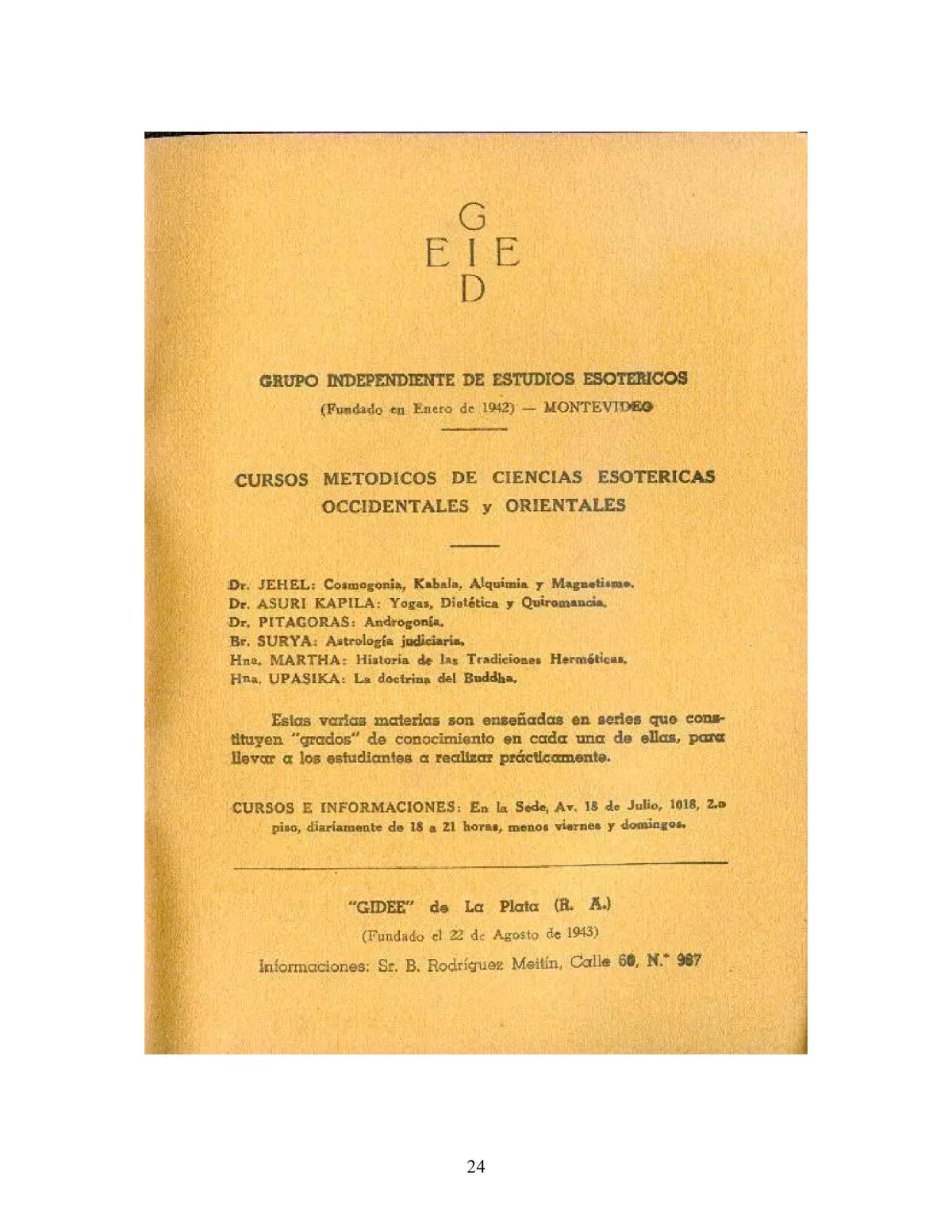
1G E I D
2INDEPENDENT GROUP OF ESOTERIC STUDIES (Founded in January 1942) — MONTEVIDEO
3METHODICAL COURSES IN THE WESTERN and EASTERN ESOTERIC SCIENCES
4Dr. JEHEL: Cosmogony, Kabbalah, Alchemy and Magnetism.
5Dr. ASURI KAPILA: Yogas, Dietetics and Chiromancy.
6Dr. PITÁGORAS: Androgony.
7Br. SURYA: Judicial Astrology.
8Sister MARTHA: History of the Hermetic Traditions.
9Sister UPASIKA: The doctrine of the Buddha.
10These various subjects are taught in series constituting “grades” of knowledge in each of them, so as to bring the students to practical realisation.
11COURSES AND INFORMATION: at the Seat, Av. 18 de Julio 1018, 2nd floor, daily from 18 to 21 hours, except Fridays and Sundays.
12“GIDEE” of La Plata (Argentine Republic). (Founded on 22 August 1943.) Information: Sr. B. Rodríguez Meitín, Calle 60, Nº 987.
1324
Our translation, period-faithful. Citable as our translation, never as the source.
Commentarywhole issue ·
Historical[P-V†]ini:3.29:4:001
Correio do Povo was a major daily newspaper in Porto Alegre. The byline establishes that Lorelair — Emma Costet de Mascheville, S∴I∴, astrologer to the Gran Consejo — was publishing astrology in the secular mass press by June 1944, under her initiatic name.
Comparative[P-V†]ini:3.29:4:003
The article opens by refusing divination as the purpose of astrology: it should not be "desvirtuada como simple medio de adivinación" but serve "el conocimiento de nosotros mismos y de la época en la que vivimos." Astrology as self-knowledge rather than prediction is stated here in 1944, in a newspaper column, thirty-six years before Luz e Sombra sets out the same position at book length.
Historical[P-V†]ini:3.29:4:004
A dated forecast with a fifteen-month horizon: harmonious vibrations affording "un estado de paz, entre septiembre y octubre de 1945," written June 1944. Japan surrendered on 2 September 1945; the United Nations Charter entered into force on 24 October 1945.
Cross-estate[P-V†]scoresini:3.29:4:004
The author returns to this forecast in La Iniciación Nº 42, October 1945, in an article titled "La Conjunción de Júpiter, Neptuno, Sol y Mercurio: profecía astrológica cumplida," assessing it against events. Forecast and public self-assessment are a paired practice in this periodical, not a single episode.
→ ini:4.42:4:001
Historical[P-V]ini:3.29:4:006
The printed text reads "el hombre en Alemania y Rusia" in a list of wartime afflictions. "El hambre" — hunger — is evidently intended. The reading is marked rather than emended, so the page and the transcription agree.
Historical[P-V†]ini:3.29:6:001
A second forecaster in the same issue. Jehel — Leo Costet de Mascheville, president of the Gran Consejo — published a long prediction in the supplement of La Tribuna Popular on 7 May 1944, and reviews it here point by point, separating what has been borne out from what remains outstanding. Both senior officers of the Order were forecasting in the secular press and auditing themselves in print.
Comparative[P-V†]ini:3.29:6:013
The forecast reads "PAZ EUROPEA PROBABLE EN ABRIL 1945." Germany surrendered on 8 May 1945. The parenthetical narrowing to "las 48 horas antes o después del 11 de abril" is explicitly disclaimed as arrived at by other means than astrology.
Comparative[P-V†]ini:3.29:3:002
The contents page credits the article to "Lorelair, S. I. y Jehel, S. I."; the article itself carries Lorelair's byline alone. Both readings are preserved as printed. Attribution in this periodical is recorded at two places that do not always agree.
Historical[I]ini:3.29:5:014
The article turns from world events to individual guidance, listing birth-date cohorts said to be affected and offering conduct advice. Mundane forecasting and personal counsel sit together in one column — the format of the newspaper astrology page it was written for.
Comparative[P-V]ini:3.29:12:004
The instruction refers the reader to "figure Nº 22" — the asana course was illustrated, and the numbering shows at least twenty-two figures across the series. No plate of the figures survives in the numbers the Press holds.
Cross-estate[P-V]ini:3.29:1:002
The masthead motto stands on the cover of every number: "To all those who, weary of learning, wish at last to know." Nº 11 p. 11 quotes it as Papus's. The Press has traced the line to L'Initiation in 1889, where it is attributed to Morin, not to Papus — the magazine inherited the motto along with the model, and lost the attribution on the way.
Historical[P-V]ini:3.29:2:002
The colophon names the whole staff: Director Dr. Jehel; Chief Editor Pitágoras; Secretary Maya; Administrator and responsible editor Juan Cantalupo; the office at Uruguay 1787, Montevideo. Cantalupo is the only contributor who appears under an ordinary name rather than a sigil — he handles the money and signs as legally responsible, which is exactly the role that cannot be pseudonymous.
Historical[P-V]ini:3.29:2:004
The contributor list is the single most useful page in the run for identification: sixteen sigils, each with a discipline and a set of order qualifications. SEVAKA kabbalist and philologist; JEHEL kabbalist, mystic and chemist with SDM, HABM and 33∴; ASURI KAPILA mystic, yogi and chemist; PITÁGORAS kabbalist, hermetist and physician; SURYA astrologer. Every sigil the reader meets in the articles can be resolved against this table.
Historical[P-V]ini:3.29:2:012
Four of the sixteen contributors are women — LORELAIR (astrologer, mystic), MAYA (writer), MARTHA (educationist and poet), and, from the course list on p. 24, UPASIKA, who teaches the doctrine of the Buddha. Set against Nº 11 p. 11, where a contributor tells women their mission is to beautify the life of man, the masthead shows women teaching and writing in the same body in the same period.
Cross-estate[P-V]ini:3.29:2:021
The affiliations claimed in one line: Suddha Dharma Mandalam, Asiatic Brothers of the Brilliant Mystery, Maha Boddhi Sangha, Ramana Ashrama, Ramakrishna Ashrama, Kabbalistic Order of the Rose-Cross, Martinist Order. The Ramana Ashrama entry corroborates Nº 10 p. 14, which listed it among the currents the Order served in 1942 — and behind both stands the traveller's account in Nº 1, pp. 22–25.
Historical[P-V]ini:3.29:2:023
The economics, printed openly: two Uruguayan gold pesos a year at home, one dollar twenty abroad, twenty centésimos for the current number and thirty for a back number, subscriptions always for 12 months. With Nº 10's balance sheet this is enough to reconstruct the magazine's finances from its own pages.
Cross-estate[S-V]ini:3.29:7:002
Heinrich Khunrath (printed "KUNRATH"), called here "the Rosicrucian Emperor", and his Amphitheatrum Sapientiae Aeternae — the engraved plates of which do carry the kabbalistic figure the article describes, the Hebrew Shin set within the divine name. Nº 11 p. 19 cites the same author with the same spelling. Public domain and not yet held.
Comparative[P-V]ini:3.29:8:002
A precise citation of the Pistis Sophia tradition: the opening of the Treasury of the Light at the 24th Mystery, and the Aeon Jesus putting the zodiacal doorkeepers to flight. The article then translates the same event into three registers — theological, kabbalistic and initiatic — in three consecutive one-line sentences. It is the clearest statement of the magazine's comparative method anywhere in the run.
Cross-estate[P-V]ini:3.29:8:006
Amo, Ramakrishna, Maharishi named together as the Seers for whom the process is real. Amo — Maître Philippe of Lyon — appears again, as at Nº 10 p. 17 and Nº 11 pp. 1 and 3. The Ramakrishna and Ramana ashrams are both on the masthead two pages earlier, so these are affiliations the magazine claims, not names borrowed for prestige.
Cross-estate[S-V]ini:3.29:10:002
The article names its own source: J. Burgoyne, author of The Light of Egypt — Thomas H. Burgoyne of the Hermetic Brotherhood of Luxor. The whole Cancer passage above is quoted from it, and readers are told to meditate on it as revealing "between the lines" more than astrology. A public-domain work, directly cited, and not yet held.
Comparative[S-V]ini:3.29:9:008
The identification of Cancer with Zebulun rests on Genesis 49:13 — "Zebulun shall dwell at the haven of the sea" — and the article quotes it accurately to justify placing the crab's house at the shore. The zodiac-to-tribes scheme is a standing feature of the esoteric planisphere the course works from.
Comparative[C]ini:3.29:10:014
Three different authorities are stacked on one page: Burgoyne for the sign, Julevno for the decanates, and Dr. Salmon — William Salmon, the seventeenth-century English writer — for the faces. The course is a compilation, and to its credit it says whose material each section is.
Comparative[R]ini:3.29:11:003
The face-by-face character readings run from "envious and discontented, proud, without intelligence" to "a common or obscure profession, at times a vile or contemptible one". These are reproduced as printed and are not endorsed: they are traditional fortune-telling formulae attached to five-degree arcs, and the magazine's own Nº 29 p. 4 opens by refusing divination as astrology's purpose.
Comparative[R]ini:3.29:13:006
Arrest of greying and baldness, with the hair returning to its natural colour, is listed among the benefits of a standing forward bend. Reproduced as printed and not endorsed. It belongs with the rejuvenation claims trailed in Nº 11 p. 10 by the same author, Asuri Kapila.
Comparative[S-V]ini:3.29:14:007
The vitamin articles are a genuine surprise: the account of vitamin A — epithelial integrity, xerophthalmia, night blindness, its role in lactation — is substantially correct by the standards of 1944 and by modern ones. An esoteric monthly running accurate nutritional biochemistry beside kabbalah is the run's characteristic mixture, and here the science half holds up.
Historical[P-V]ini:3.29:16:002
Hard numbers for the South American Suddha Dharma Mandalam at 31 July 1944: 91 disciples across seven grades of practice — 25, 17, 17, 12, 10, 6, 4 — and across four countries: Argentina 50, Brazil 11, Uruguay 28, Paraguay 2. Both breakdowns total 91 exactly. The register runs to 1,121 documents. This is the most precise membership figure anywhere in the run.
Historical[P-V]ini:3.29:16:004
Sister ISIS is appointed Secretary for Buenos Aires and Province, with authority to deal with all disciples in the zone. A named woman holding delegated administrative authority over a whole country's membership, recorded in the Order's own bulletin.
Comparative[P-V]ini:3.29:17:006
Seven initiations are promised and the list appears to name six — "Yoga Devi, Aditya, Agni, Sukra, Vayú y Prithivi" — unless "Yoga" and "Devi" are two, which the count requires and the punctuation does not show. Vayú among them is worth marking: it is the name Cedaior took for his 1919 book, The Laws of Vayú.
Comparative[I]ini:3.29:17:013
The image chosen for initiation is an electrical installation: the wiring must be sound and the circuit complete before the connection to the mains means anything, and if there is a break, no amount of connection will help. A 1944 Hindu-derived order explaining grace as a continuity test.
Historical[P-V]ini:3.29:18:002
The clearest statement of the magazine's position on race anywhere in the run, and it is a repudiation: the presence of the Divinity in each of us "forbids our continuing with the differences of race, communion and sect that now prevail, founded as they are on the mere facts of individual birth and nationality". Printed in September 1944. It stands with Nº 10 p. 14 — no preference "of race, of continent or of sect" — and with Nº 11 p. 2, where Cedaior leaves Europe in 1910 sickened by racial hatred.
Comparative[I]ini:3.29:19:002
A carefully made distinction: other systems are called sectarian not because their objects of devotion are false but because they mistake Siva or Vishnu for the Ultimate. The Mandalam's own head is described as "a fragment, or the outward and defined manifestation, of the Supreme" — a claim to universality argued rather than asserted.
Historical[S-V]ini:3.29:20:008
Girolamo Cardano (1501–1576) is correctly placed in the sixteenth century, and the sentiment quoted — that stones live, and suffer sickness, age and death — is consistent with his natural philosophy, though the Press has not located the wording in his works. The article presents him as repeating what initiates had always said.
Historical[S-V]ini:3.29:21:006
Dr. Albert Abrams (1863–1924) was a real San Francisco physician and the originator of radionics; Jean Bergonié (1857–1925) a real Bordeaux radiologist whose electrical apparatus bore his name; Georges Lakhovsky (printed "Lakhowsky") a real and widely published proponent of cellular oscillation. The names are accurate; the science attributed to them was contested in its own day and is not endorsed here.
Comparative[I]ini:3.29:21:011
The article's central move, and it is a real argument rather than an assertion: life at each scale is the individualisation of the life above it — solar into human, human into hepatic, hepatic into cellular, terrestrial into mineral — with the prism dividing white light offered as the physical analogue. Whatever one makes of the conclusion, the reasoning is stated in a form that can be examined.
Comparative[C]ini:3.29:22:010
"Man ought to feed himself with the products of the soil on which he lives, and consume them in quantity proportional to the quantity of production." Attributed to the Chinese and said to have been demonstrated by Dr. Foveau de Courmelles. The principle is what would later be called eating locally and seasonally; the resonance argument offered for it is the magazine's own.
Historical[P-V]ini:3.29:24:002
The GIDEE was founded in January 1942 — the hardest date the Press has for it, printed by the body itself. The magazine began the following May with Nº 1, so the review is four months younger than the group it speaks for.
Historical[P-V]ini:3.29:24:011
The teaching programme, with the hours: courses at the Seat, Av. 18 de Julio 1018, second floor, daily from 18 to 21 hours except Fridays and Sundays. Jehel on Cosmogony, Kabbalah, Alchemy and Magnetism; Asuri Kapila on Yogas, Dietetics and Chiromancy; Pitágoras on Androgony; Surya on Judicial Astrology; Sister Martha on the History of the Hermetic Traditions; Sister Upasika on the doctrine of the Buddha. Each subject is taught in graded series "to bring the students to practical realisation".
Historical[P-V]ini:3.29:24:012
A second GIDEE, at La Plata in Argentina, founded 22 August 1943, with a named contact. The group had begun to propagate across the river within twenty months of its own founding.
Cross-estate[P-V]ini:3.29:25:001
The back page is an acquisition list in disguise. The Martinist Library, issued in Buenos Aires: Éliphas Lévi's The Book of the Wise, Papus's Tarot of the Bohemians and Divinatory Tarot, and Schuré's Divine Evolution, with prices in Argentine pesos. These are the books the Order actually put in its members' hands, named by the Order itself — the strongest possible guide to what the Press should hold.
Cross-estate[P-V]ini:3.29:25:009
The second list, of the Kabbalistic Order of the Rose-Cross, published by Editorial Kier: *SEVAKA's The Son of Zanoni**, Sédir's Hindu Fakirism and the Yogas, and Franz Hartmann's In the Porch of the Temple of Wisdom. Sevaka is a house sigil from the masthead on p. 2 — a contributor to this magazine wrote a sequel to Bulwer-Lytton's Zanoni*, which the Press already holds. Sédir also appears at Nº 11 p. 3 among the five Masters Cedaior served.
Comparative[S-V]ini:3.29:15:003
The vitamin B1 entry is likewise sound for its date: beri-beri and polyneuritis, loss of muscular coordination, gradual paralysis of the extremities — the classic thiamine-deficiency picture, correctly attached to the vitamin. The food sources listed (cereal grains, pulses, nuts, wheat bran) are the right ones.
Historical[S-V]ini:3.29:23:008
The fermentation experiments are attributed to Larvaron and Mellin, and the effects claimed — cider souring, wine spoiling through Mycoderma vini, milk and cheese affected — sit within the French radiesthesia literature of the 1930s. Recorded as the article's citations; the Press has verified neither the authors' results nor their existence beyond this reference.
Cross-estate[P-V†]reprint_ofini:3.29:4:001
The reprint line records where the article first appeared: the Porto Alegre daily Correio do Povo, 29 June 1944. La Iniciación carried it in September. Reprint statements of this kind are the school's standard practice for material that ran first in the secular press.