May 1944; wrapper stereotype unchanged.
→ ini:3.24
Fetching
One moment.
1our predecessors, because these traditions are frequently made of a long experience and a patient accumulation of good sense."
2In effect, the ancients — who, as we said in our preceding article on the variations of terrestrial magnetism, knew perfectly the nature of the cosmic influences — knew also the manner of profiting by those "good influences" and avoiding the "evil genii" or prejudicial influences upon all the things that surrounded them and upon themselves, by means of an adequate orientation.
3Thus we see the ancient peoples build their temples so that the altar where the divinity was situated should be to the East — as was done in the primitive Christian churches and in the greater part of the churches of the Middle Ages, whose apse is likewise towards the East, so that the priest too might be oriented towards the East.
4We see the ancient Egyptians build the pyramids orienting them in accordance with the cardinal points.
5We see in the Far East, and particularly in Japan, the counsel to place the mattress so that the head should be directed towards the North.
6And, in effect, in the XIXth century Baron von Reichenbach, experimenting on sensitive subjects, verified that the position with the head to the North and feet to the South favoured sleep.
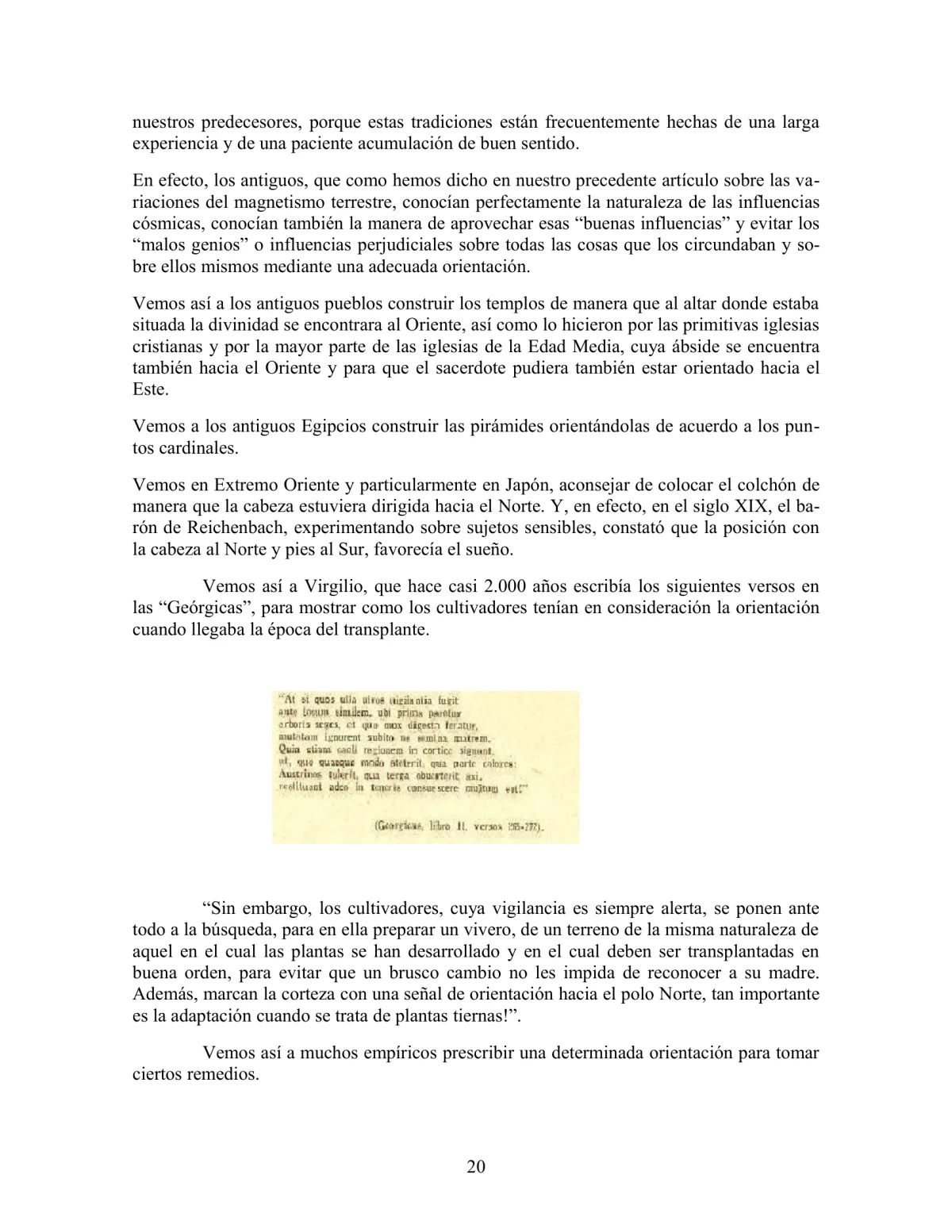
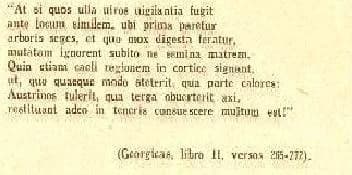
7We see Virgil, who almost 2,000 years ago wrote the following verses in the "Georgics", to show how the cultivators took orientation into consideration when the time for transplanting arrived:
8"Nevertheless the cultivators, whose vigilance is always alert, set themselves above all to the search — in order to prepare a nursery there — for a soil of the same nature as that in which the plants have developed and into which they must be transplanted in good order, to prevent a brusque change from hindering them from recognising their mother.
9Moreover, they mark the bark with a sign of orientation towards the North pole: so important is adaptation when tender plants are concerned!".
10We see many empirics prescribe a determined orientation for taking certain remedies.
1120
Our translation, period-faithful. Citable as our translation, never as the source.
May 1944; wrapper stereotype unchanged.
→ ini:3.24
Masthead unchanged.
The lead article is signed only "by a Br∴ Ill∴ of the O∴K∴R∴C∴" — internal evidence (the first-person interpreter of Lorelair's chart, the "little worm" phrase) points to Jehel himself.
The Order's own founding scene, dated and placed: 10 July 1941, Grand Council seat in Porto Alegre, twelve present of whom seven Rosicrucians — Cedaior "still in full vigour", Jehel presiding, Solón vice-president, Mauá secretary, and the Uruguayan delegation (Pitágoras with Asuri Kapila, Surya and Maya) visiting. The single densest page of institutional history the run has printed: the Order was Brazilian-seated before Montevideo.
The Prophecy: Lorelair's reading of the Order's foundation chart, published with per-period verdicts ("IT HAS BEEN FULFILLED INTEGRALLY") and a forecast ladder running to the Order's 29th–30th years — 1969-70-71 as the predicted maximum. A checkable long-range prophecy printed in 1944; the 1947-48 entry promises the "grandiose realisation" at 15 years (1955-56).
The support-evidence list names the Kabbalistic Rosicrucian Library as a realised creation, and healing assistance attributed to "the Venerable Masters AMO, PAPUS and others" — AMO the same name the Nº 5 lineage diagram carries.
The Androgony food-series reaches its third register: the soul fed on states of mind as literally as the stomach on bread, with digestion as the working metaphor throughout — and everything read, said or desired leaving "traces in our blood, in our aura and in the secret light".
The essay ends in an arithmetic of effort: physical care worth 10, passional discipline its square (100), disinterested acts its cube (1,000) — the run's fondness for quantified ethics at its plainest.
The planetary course opens its trans-Saturnian annex: Neptune and Uranus now, with Lorelair promised for a special article on Pluto (discovered only fourteen years earlier) tied to Scorpio — the course keeping pace with the astronomy of its decade.
The Aquarius dating stated numerically: the Era begins "around the year 2140", when "the Moral Capital of the Western World is magnetically fixed in the United States" — offered as the explanation for the migration of initiatic fraternities from Europe to the Americas (the editors' own migration among them).
The retyped source itself records a lacuna here: mid-article, the transcript carries the words "Faltan 2 páginas" (two pages missing). The gap is preserved and glossed on the face of the translation — what was lost fell between the poison-immunity examples and the dietary-transition counsel. Flag for the facsimile hunt: a complete copy of Nº 25 would fill it.
Kapila reports a self-experiment — a vegetarian deliberately gorging on meat and recording the symptoms and the aura shift (red up, orange-yellow down, blue sharply down) — the series' method at its most empirical and its most seer-dependent in one page.
Census: 83 → 88 (Argentina 42, Brazil 13, Uruguay 33), and a seventh exercise appears with its first practitioner. The March protocol numbers as printed (776–796) leave 756–775 unaccounted against February's close — glossed on the face.
→ ini:3.24:17:006
The May Full Moon — "the most important of the year" — scheduled to the minute: 8 May 1944, 7:28 a.m. Greenwich, with members instructed to convert to civil time and be "in full and serene action" at the instant. The Wesak observance, unnamed but exact.
Sir S. Subramania Iyer enters the run: Pandit Morli Dhar's memoir (from The Suddha Dharma, January 1935) of initiation at the hands of the retired Madras High Court judge and Theosophical grandee, External Head of the S.D.M. — with the 1915 postal initiation, the 1919 Bangalore diksha by rod-touch, and Srinivasachariar in Purasawalkam holding "all the ancient manuscripts". The run's Suddha column acquires its human lineage.
Subramania Iyer's answer on politics, printed in May 1944: the forces that once used him "are working through the Mahatma Gandhi" — and his emphatic 1919 prophecy, "India will succeed in federating without shedding of blood", set before Spanish-American readers three years before independence. The run's second dated political prophecy in two numbers.
Pitágoras grounds the orientation doctrine in Pasqually's letters to Willermoz (1767–1774) — citing their physical location (Lyon municipal library) and both editions: Papus's fragments and Van Rijnberk's integral second volume. The run documents the very correspondence tradition behind the Traité on our shelf; the operative instructions (circles, cardinal words, candles, celebrant's orientation) are summarised from it.
→ thread:pasqually_reintegration
Reichenbach's od-experiments, Virgil's Georgics on transplant orientation, Japanese north-heads and church apses — the column's method: one doctrine (orientation) traced through agriculture, liturgy, domestic custom and laboratory.
The modern evidence: Abrams's west-facing reflex maximum on earthed aluminium plates, Star-White's percussion zones, the whale of Prince Albert of Monaco — the same Abrams whose "electronic reactions" were the era's great medical heterodoxy, cited here without controversy.
Adhémar's diptych: the same teaching voiced twice — turbaned (Lanoo, Bodhi tree, HARI) and "très chic" Western (Virginal Spirits, Karma, the first breath's stamp) — with the same crowd dismissing both, and the naked claim "I am He" earning only "a madman who says he is God". A La Plata Martinist's essay on register itself; dated 14-2-1944.
The Western version's natal-breath doctrine — each atom stamped by the first inspiration, the stamp acting for life — is the astrological first-breath thesis in Rosicrucian dress; the essay's two voices are the review's own two languages.
Prospectus stereotype unchanged.
→ ini:3.24:25:007
Advertisements and imprint unchanged.
The forecast ladder's far end — fructification "fully at 22 years", maximum at 29–30 (1969-71) — now reads against what happened: the Order's Uruguayan phase, these very pages, and the movements that later grew from this milieu. The run hands its own future a measuring stick.
Srinivasachariar described in life: Sanskrit-and-Tamil only, interpreter required, "restorer of the S.D.M. in the world" with the manuscript corpus in his keeping — the same Pandit whose doctrinal notes the run has been serialising since Nº 19.
Gossip, criticism and rancour as "moral poisons" that sicken the soul the way bad food sickens the body — the alimentation analogy carried into ethics, with bicarbonate-and-lemon as the comic register of repentance.
The diksha itself: the Guru upright on the woollen couch, cylindrical rod in the right hand, mala on — initiation granted by rod-touch after "certain Suddha truths". The memoir's physical detail is the best description of S.D.M. ritual the run has printed.