March 1944; wrapper stereotype unchanged.
→ ini:3.22
Fetching
One moment.
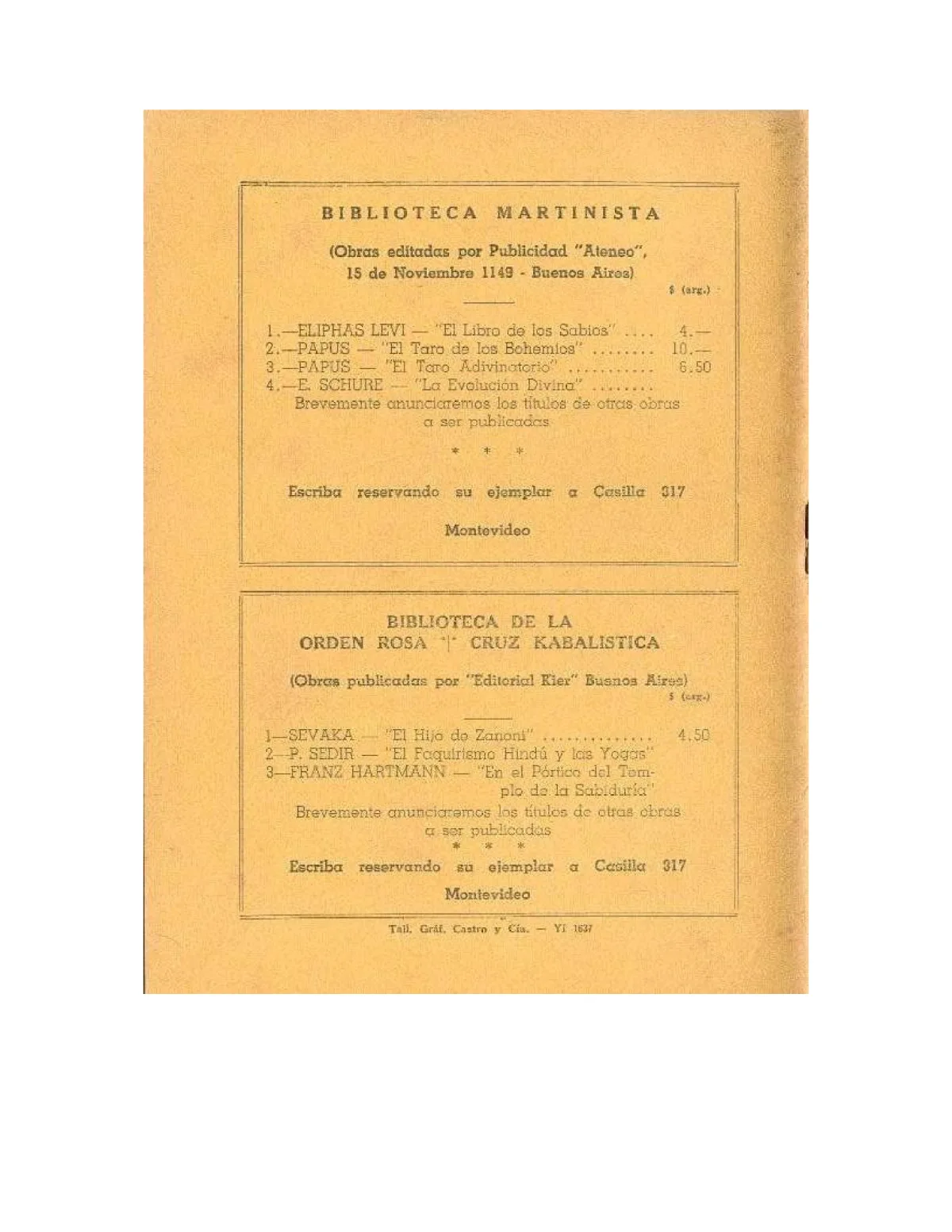
1MARTINIST LIBRARY (Works published by Publicidad «Ateneo», Buenos Aires). $ (arg.) 1.—PAPUS — «The Tarot of the Bohemians» . . . . 10.— 2.—ELIPHAS LEVI — «The Book of the Sages». 4.— 3.—PAPUS — «The Divinatory Tarot» . . . . . . 6.50
2Shortly we shall announce the titles of other works to be published
3Write reserving your copy to Casilla 317 Montevideo
4IT HAS APPEARED! AMERICAN ASTROLOGICAL ALMANAC FOR 1944 — YEAR XI. Awarded a prize at an International Exposition and two American Book Competitions. The Continent's only Yearbook on: Astrology, Spiritualism, Esotericism, Rosicrucianism and American Prehistory. PRICE: CHILE, $ 36. ARGENTINA, $ 5 m|n. Orders to: J. E. BUCHELI. Casilla 1880. Santiago, Chile.
5Printed by DORNALECHE Bros. — Cerro Largo 783. 25
Our translation, period-faithful. Citable as our translation, never as the source.
March 1944; wrapper stereotype unchanged.
→ ini:3.22
Masthead unchanged from Nos 21–22.
The SUMARIO's literary slot goes to an outside poet of stature — see the p. 22 note on Campos Cervera.
Jehel's dietetic instalment recalls "the admirable drawings I published in Nº 18… extracted from works of the Master PAPUS" — the physiognomic animal plates; the symbolic-animal doctrine (the man who "feels like a hyena") now grounds a typology of eaters.
→ ini:2.18
The run's most humane page on diet: between "the hyena that feeds on carrion and the saint who feeds on contemplation there is AN INFINITE DIVERSITY OF BEINGS" who must be helped, never pushed — closing against vegetarian self-righteousness: better a steak eaten with pity for the hungry neighbour than sanctimonious chicory beside indifference. A deliberate counterweight to Kapila's absolutism elsewhere in the same number.
Burgoyne's Mercury carries his Americanism intact: the "Yankee adage" and the United States under Gemini — the Chicago-published Light of Egypt speaking through a Montevideo monthly.
Jehel's own observations name two more Brothers — Géminis and Mauá — as chart examples; Mauá is a new name in the run. The section closes with initiatic gatekeeping by horoscope: Mercury afflicted in the twelfth marks "the perjurers… those who cannot stop lying".
The Adhirathasana — progressive cataleptic rigidity over stacked books (to seven), then stools — with its Fig. 18 referenced but not printed in this number: the plate either never ran or ran in a number that does not survive; flagged for the facsimile hunt.
Kapila's case against meat is argued in the vocabulary of 1940s biochemistry — ptomaines, indole, skatole, cadaverine, putrescine — the medicalised register at its most technical; "95% of illnesses" from diet is the series' strongest claim.
Census stabilises: 77 → 78 (Argentina 38, Brazil 13, Uruguay 27), and a sixth exercise appears with 3 practitioners — the practice ladder is growing at the top while the base has been pruned.
→ ini:3.22:17:005
Suddha Raja Yoga is set explicitly against hatha yoga, "whose methods invariably make the aspirant contract an almost incurable illness" — a striking condemnation to print in the same number as an asana course; the two columns hold opposed positions the editors never reconcile.
The Yoga-Brahma-Vidya exposition: Gayatri as the whole science of the universe, the 24 Dharmas, Vyashti/Samashti Pranava, Suddha vs Kevala Sankhya — the most technical Sanskrit doctrine the run has printed, closing the Pandit's notes on the Hierarchy (signed off 31-1-1944).
Pitágoras's new science column opens with the alchemical INRI (Igne Natura Renovatur Integra), Heraclitus, Agni and the swastika-as-fire — written in March 1944, when the symbol's other career was at its darkest; the text keeps strictly to its archaeological sense.
The Tai-Ki / Yang-Yin exposition with the Pa-Kua of Fu-Hsi, equated in one breath to the Hebrews' AOR and Ob/Od, Sushumna and Ida/Pingala, the Martinists' Astral Light, and Louis Lucas's "movement" — the run's correspondence method applied to Chinese cosmology for the first time.
The scientific apparatus is genuine and datable: Dr. Loir (Pasteur's collaborator) in La Côte d'Azur Médicale 1933, Jules Régnault's 1927 appeal for a Société de Biodynamique, and the Nice Institut d'étude des radiations under Maurice Faure — French cosmobiology's actual institutions, cited with the wry aside that these "new ideas (!!!)" are 3,600-year-old Chinese knowledge.
The magnetism primer (declination from the 1666 Paris baseline, isogonic/isoclinic/isodynamic lines, Bécédéef's 1666–1915 series) breaks off with (Continuará) — the science column now runs serials like the initiatic ones.
Hérib Campos Cervera — Paraguay's major modern poet (1905–1953), then in political exile — gives the run Elegía para la décima noche, dated Asunción, 11 August 1943. A find for the literary record: a Campos Cervera elegy printed in a Montevideo esoteric monthly two years before his landmark Ceniza redimida; the nine-nights dissolution of the body reads here as an initiatic death.
The elegy's end — another life "stripped of the long punishment of memory: a tree or a stone" — sits in the reader's hands two pages after the Suddha column's Turiya doctrine; the editors' juxtaposition does the commentary itself.
Prospectus stereotype unchanged.
→ ini:3.22:24:007
Back-cover advertisements and imprint unchanged.
Jehel's gendered occupational typology (Gemini typists and women of letters; Virgo seamstresses) is 1944 Montevideo's labour market read as astrology — kept as period evidence, with the era's assumptions on its face.
The asana's promised effects reach arterial decalcification — the rejuvenation series' arteriosclerosis theory and the yoga course meeting in one claim.
The dietetics turn domestic: mothers, bonbons, dates and figs — the counsel column voice that the praxis layer captures.
"We know by heart the constitution of a machine… but almost nothing of the constitution of our body" — the series' recurring modernity critique, here aimed at the era's engineers.
The triple Sakti (Gunamaya, Esha, Devi) with its function-names — the Suddha column's most compressed metaphysics; the translation keeps every transliterated term as printed.
The eight supreme virtues, paired: tolerance/compassion, tranquillity/non-ambition, purity/disinterestedness, unwearying service/yearning for the world's good — the Suddha ethic in its final catechetical form.